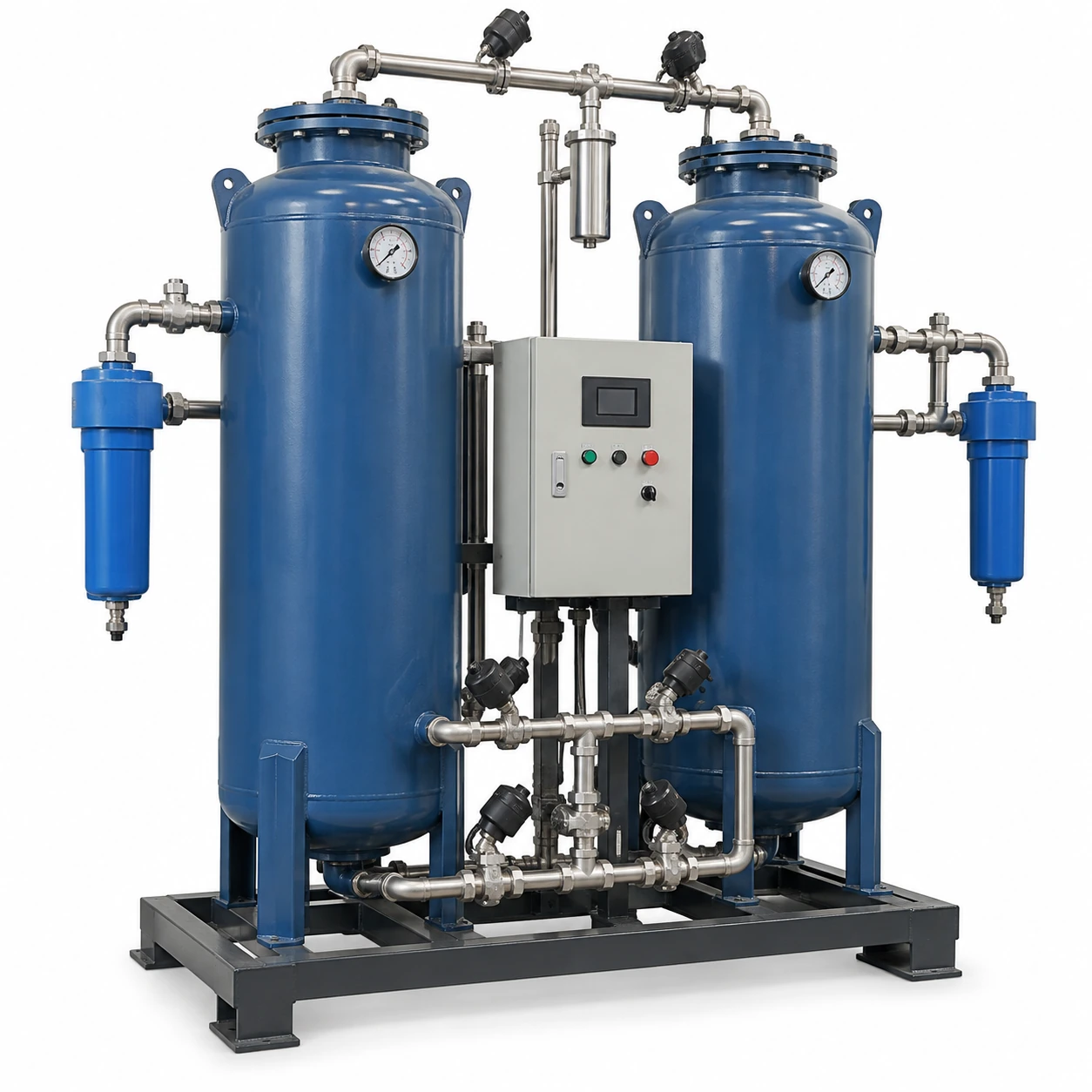
Nitrogen Generators
nitrogen generator
| Separation method | Pressure swing adsorption (PSA) or membrane separation |
|---|---|
| Gas-quality selections | Membrane configurations for 95–99.5%; PSA configurations for 99–99.999%, selected to the duty |
| Output selection | Capacity rated at the specified purity, feed-air pressure and temperature |
| Compact membrane W × D × H (mm) | 560 × 285 × 1150; larger enclosure 820 × 772 × 2090 |
| PSA enclosure W × D × H (mm) | 775 × 840 × 2015; 1400 × 840 × 2015 |
| Compressed-air supply | Dry, filtered air; compressor and treatment sized with the generator |
| Delivery arrangement | Regulated gas outlet; receiver and booster options where required |
| Monitoring and control | Oxygen analysis, pressure indication, quality alarm and off-spec gas diversion options |
Dimensions describe separate generator configurations and exclude receivers, compressor, pipework and service space. Gas quality and output are established for the selected assembly and operating conditions.
The nitrogen generator can be customized for the gas specification, consumption profile, available utilities and installation space.
A nitrogen generator separates nitrogen from compressed air so a facility can produce gas where it is needed. The right selection connects the required gas quality with the actual demand pattern and the available air supply. Purity, flow and delivery pressure must be considered together.
Choose the quality the process needs
The most demanding purity is not automatically the most economical choice. Producing a lower residual oxygen level usually reduces the output available from a given generator and increases the compressed-air requirement per unit of useful gas. Specify the process requirement before comparing capacity or price.
Also identify what the purity figure means. Some industrial ratings express nitrogen quality as the balance remaining after oxygen is measured. Moisture, oil, particles and other relevant contaminants need their own limits where the application requires them.
Two separation routes
Membrane separation
A membrane assembly separates gases through enclosed hollow fibres. It is useful where a compact continuous source meets the required gas quality. Its production rate changes with purity, inlet conditions and the selected membrane area.
The membrane nitrogen generator page explains the feed-air and flow trade-offs.
Pressure swing adsorption
A PSA assembly alternates adsorption and regeneration between beds. It can serve applications requiring lower residual oxygen levels, with the appropriate gas treatment, control and storage arrangement.
The pressure swing adsorption nitrogen generator page covers the cycle and the components that keep it consistent.
Measure demand where the gas is used
A monthly cylinder total helps estimate consumption but hides the highest simultaneous demand. A packaging machine may draw gas in repeated bursts; a process blanket may need a comparatively steady supply. The generator and storage arrangement must accommodate the pattern as well as the total.
Check the required pressure at the equipment connection while gas is flowing. Pressure losses through filters, regulators and distribution pipework can leave a correctly rated generator unable to serve the final machine. A receiver buffers demand; it does not create additional production capacity over a complete shift.
Include the supporting equipment in the decision
Compressed-air generation and treatment, drainage, gas storage and any backup supply belong in the comparison. A spare air connection is useful only if its pressure, quality and available capacity suit the new duty without disrupting other users.
Plan access to filters, valves and instruments, and assess ventilation and oxygen-deficiency monitoring for the installation. Nitrogen is not a breathing gas. shengtongJH can coordinate the equipment scope against these requirements, including the distinction between a generator-only supply and a complete nitrogen generator system.
The nitrogen generator can be customized for the gas specification, consumption profile, available utilities and installation space.