Nitrogen Generators
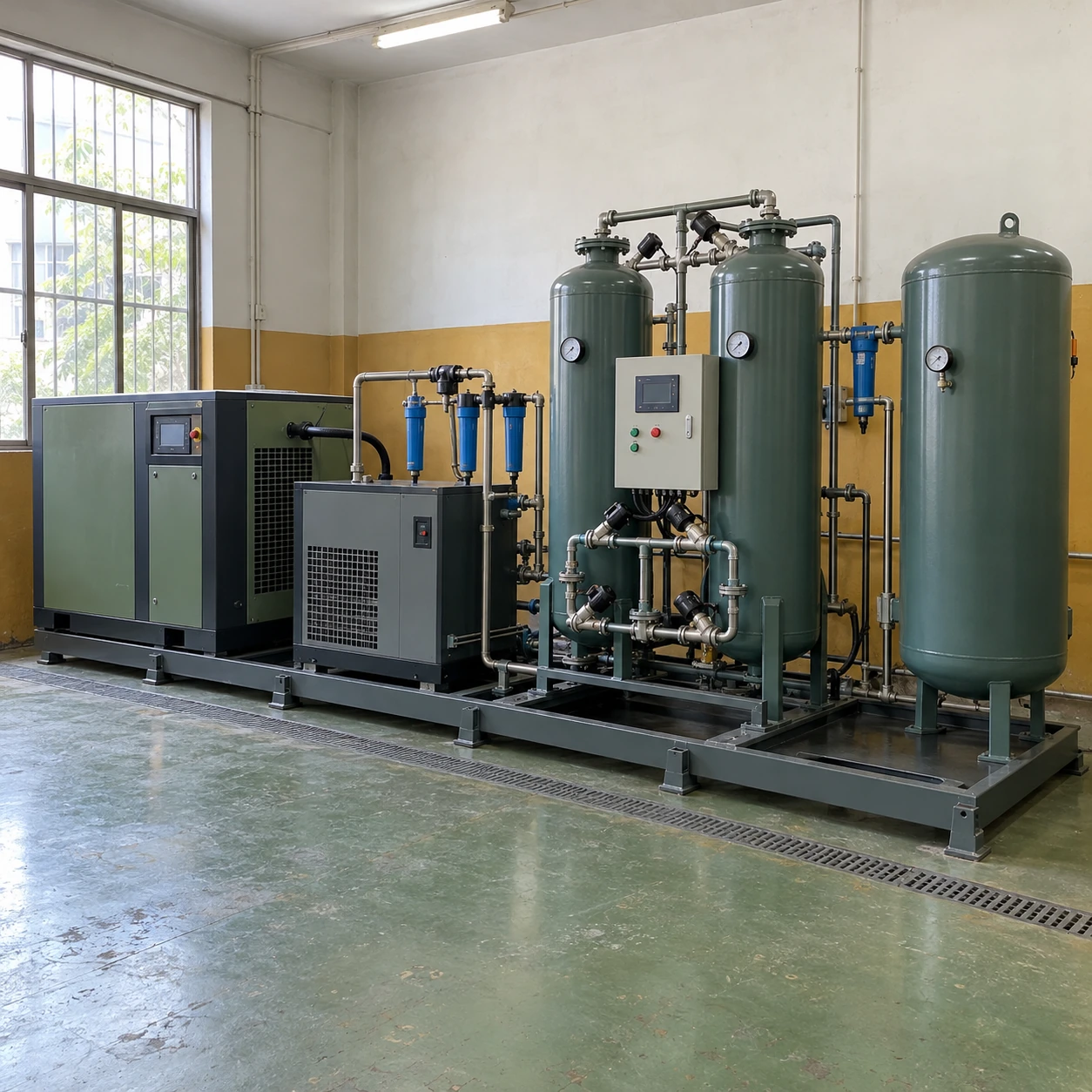
nitrogen generator system
| Package scope | Compressor, air treatment, nitrogen separation, receivers and delivery controls |
|---|---|
| Separation choices | PSA or membrane, matched to the required gas quality |
| PSA section W × D × H (mm) | 775 × 840 × 2015; 1400 × 840 × 2015 |
| Membrane section W × D × H (mm) | 560 × 285 × 1150; 820 × 772 × 2090 |
| Air treatment | Drying, particle/coalescing filtration and additional oil-vapour treatment where required |
| Gas delivery | Buffer storage, pressure regulation and process connection; booster where necessary |
| Control interfaces | Run demand, ready status, quality fault and pressure alarms |
| Installation scope | Separate or skid-connected equipment, with agreed service and utility interfaces |
Dimensions describe the separation section, not the complete system footprint. Receivers, compressor cooling, drainage and maintenance access are included in the final layout assessment.
The complete nitrogen generator system can be customized for the required gas duty, site utilities and equipment interface schedule.
A nitrogen generator system brings air compression, conditioning, gas separation and delivery together. A dependable installation needs agreement at every connection, including the controls that prevent unsuitable gas reaching the process. Buying the individual machines does not by itself establish a compatible system.
Follow the supply from inlet to outlet
- Compress the air. The air source needs enough capacity at the pressure available after treatment, while accounting for other users on a shared plant header.
- Condition the feed. Dryers, filters and drains prepare the air for the selected separation equipment. Their capacity and pressure losses belong in the calculation.
- Separate and verify the gas. The generator produces the specified nitrogen stream. Measurement and an appropriate quality response determine when it is acceptable to supply.
- Buffer and deliver. Receivers, regulators and distribution pipework carry the gas to the point of use. A booster is added only where the required delivery duty calls for it.
Make each interface an agreed item
An equipment list should identify more than the major cabinets. Connection type, available pressure, electrical supply, drain responsibility and control signals determine whether installation proceeds smoothly. Specify who provides the interconnecting pipework and who verifies the complete arrangement.
Where the customer already has an air compressor, clarify the boundary at the take-off point. Its rated output may already be committed to other machines, and the quality at that point may differ from the quality needed by the nitrogen section.
Design a useful ready signal
Power on is not the same as suitable gas available. The receiving process may need an indication that both gas quality and delivery pressure are acceptable. Define how startup, temporary loss of air and an analyser fault should affect supply.
Agree the handling of off-spec gas and where it is discharged. A quality-diversion function must be connected and commissioned as part of the installation; a controller menu alone does not establish that protection.
Allow the plant to be maintained
Dryer servicing, filter replacement, drain inspection and analyser calibration need practical access. Keep removal paths clear when arranging vessels and pipework. Compressor heat rejection and noise should also be considered when placing equipment near occupied workstations.
The installation assessment must address nitrogen release, ventilation and appropriate oxygen-deficiency detection. A compact closed room is not automatically a suitable utility space simply because the equipment fits inside.
Turn the enquiry into a connection schedule
Provide the gas specification, demand pattern and required pressure at the process, together with available electricity, compressed air and installation space. shengtongJH can coordinate a supply schedule that identifies included equipment and the work remaining at the site.
For more than one production line or a planned capacity increase, compare the architectures on nitrogen generator systems. That decision should precede detailed selection of the individual machines.
The complete nitrogen generator system can be customized for the required gas duty, site utilities and equipment interface schedule.