Cleanroom Trolleys & Storage Racks
ESD Trolley
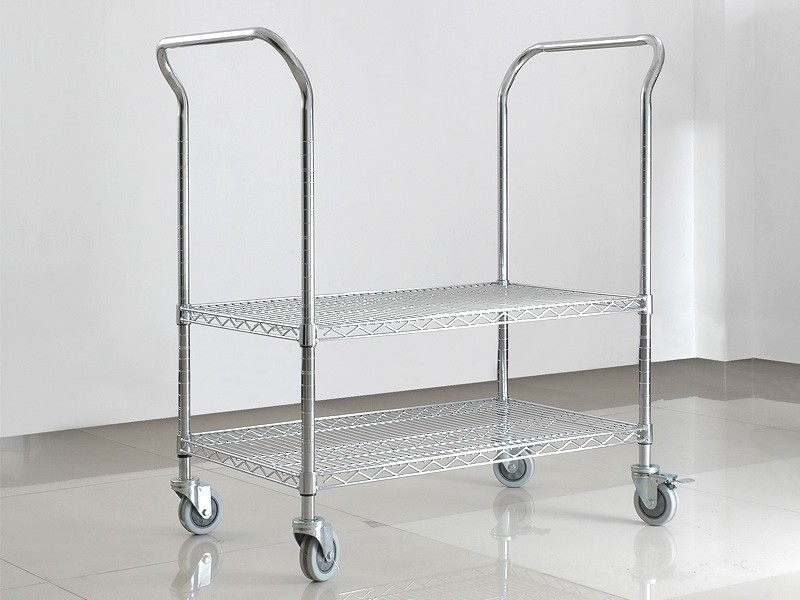
| Shelf arrangement | Two open wire shelves |
|---|---|
| Frame | Metal posts and wire shelf construction |
| Handles | Raised handles at both ends |
| Mobility | Four casters |
| Parking | Caster brake visible on pictured configuration |
Confirm shelf dimensions, load ratings, caster specification and the complete electrical path. A metal frame alone does not establish ESD performance.
Shelf layout, caster arrangement and ESD requirements can be configured for your transfer route.
This trolley uses open wire shelves to carry trays, containers and work in progress between stations. Raised handles at both ends give the operator a clear pushing point, and the open frame makes shelf contents easy to see.
Move trays without turning the trolley into a storage pile
Open wire shelves make loads visible from the side and provide a place to carry trays or containers between stations. Small loose components should sit in suitable containers rather than directly on the wire grid. Check the container footprint and support points so it cannot rock or catch between the wires.
Keep heavier items low and distribute them across the supported shelf area. A high load can obstruct the operator's view and change how the trolley responds when turning. Shelf and total load limits must come from the selected configuration; the appearance of the metal frame does not establish a rating.
The transfer route is part of the specification
- Measure the narrowest doorway and turning point with the intended load in place.
- Inspect thresholds, floor joints and ramps that can disturb trays.
- Choose caster behavior for pushing, steering and parking at the workstation.
- Provide a stable parking location that leaves the aisle and emergency routes clear.
Use the handles for movement and apply the appropriate parking brake before loading or unloading. Keep hands clear of adjacent benches and door frames. Do not use the shelves as steps.
Verify the electrical path during use
For ESD service, the shelves, frame, wheel contacts and floor must work together as the intended path to ground. Dirt on a caster tread, an insulating liner or a change of floor can affect that path. The ESD Association's guidance includes mobile equipment in the grounding plan.
Test the loaded arrangement used in production, including any shelf mats and containers. When the route crosses outside the protected area, choose suitable protective packaging for the components instead of relying on the trolley frame alone.
Related products
Shelf layout, caster arrangement and ESD requirements can be configured for your transfer route.