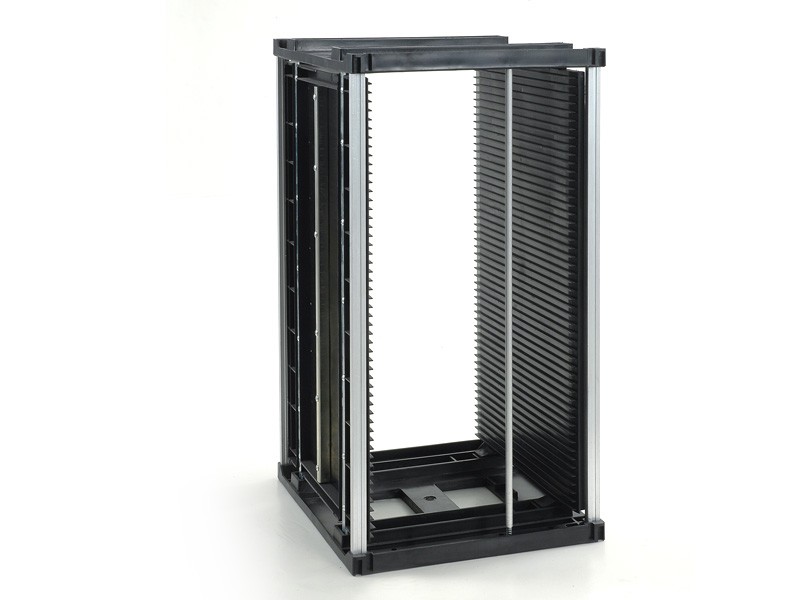
PCB Magazine Racks
PCB ESD Magazine Rack
| Product type | PCB magazine rack |
|---|---|
| Construction shown | Black slotted side panels with metal support rods |
| Board support | Opposing edge-guide slots |
| Frame | Open center with top and bottom supports |
| Application | PCB staging, handling and line transfer |
Board envelope, slot geometry, width adjustment, capacity and temperature rating are configuration-specific; match these to the actual assembly and equipment interface.
Rack geometry and material requirements can be configured for your PCB dimensions and process.
A PCB magazine rack keeps boards separated and supported at their edges during storage and transfer. The opposing guide slots organize boards in a repeatable orientation, reducing the need to stack assemblies directly on one another.
Support the board edge without loading the components
The two slotted side panels hold circuit boards apart and guide them into an organized stack of positions. This arrangement keeps the carrying function at the board edges, provided the assembly has a suitable clear edge and sufficient component clearance. It is useful for moving work in progress between inspection, assembly and storage stations without stacking boards face to face.
Start with the populated assembly envelope. A bare PCB that fits the rack does not prove that the finished assembly will fit: connectors, underside parts, heat sinks and temporary process fixtures may extend beyond it. Keep those features clear of the next board and the support rods throughout insertion.
Match the magazine to the transfer interface
- Board edges: identify the supported edges, thickness and any tabs or irregular cutouts.
- Usable spacing: allow for the tallest feature above and below each board, including handling clearance.
- Equipment interface: match the rack envelope, datum positions and loading direction to the line equipment.
- Handling: check how an operator lifts, parks and identifies a loaded rack.
Do not force a board through a tight guide or use the rack to straighten a warped assembly. Smooth entry should be possible without the board bowing or exposed components rubbing against the guides.
Storage, transport and heating are different duties
An ESD handling rack should be qualified for its intended electrical contact and storage environment. That qualification does not automatically make it suitable for an oven or a heated process. Temperature exposure, loading and repeated cleaning must be compatible with the chosen side-panel material and frame.
When moving a rack on a trolley, secure its base against sliding and keep the boards from moving out of their slots. Use identification that remains visible without covering the insertion guides, so operators can distinguish accepted work, work awaiting inspection and empty capacity.
Related products
Rack geometry and material requirements can be configured for your PCB dimensions and process.