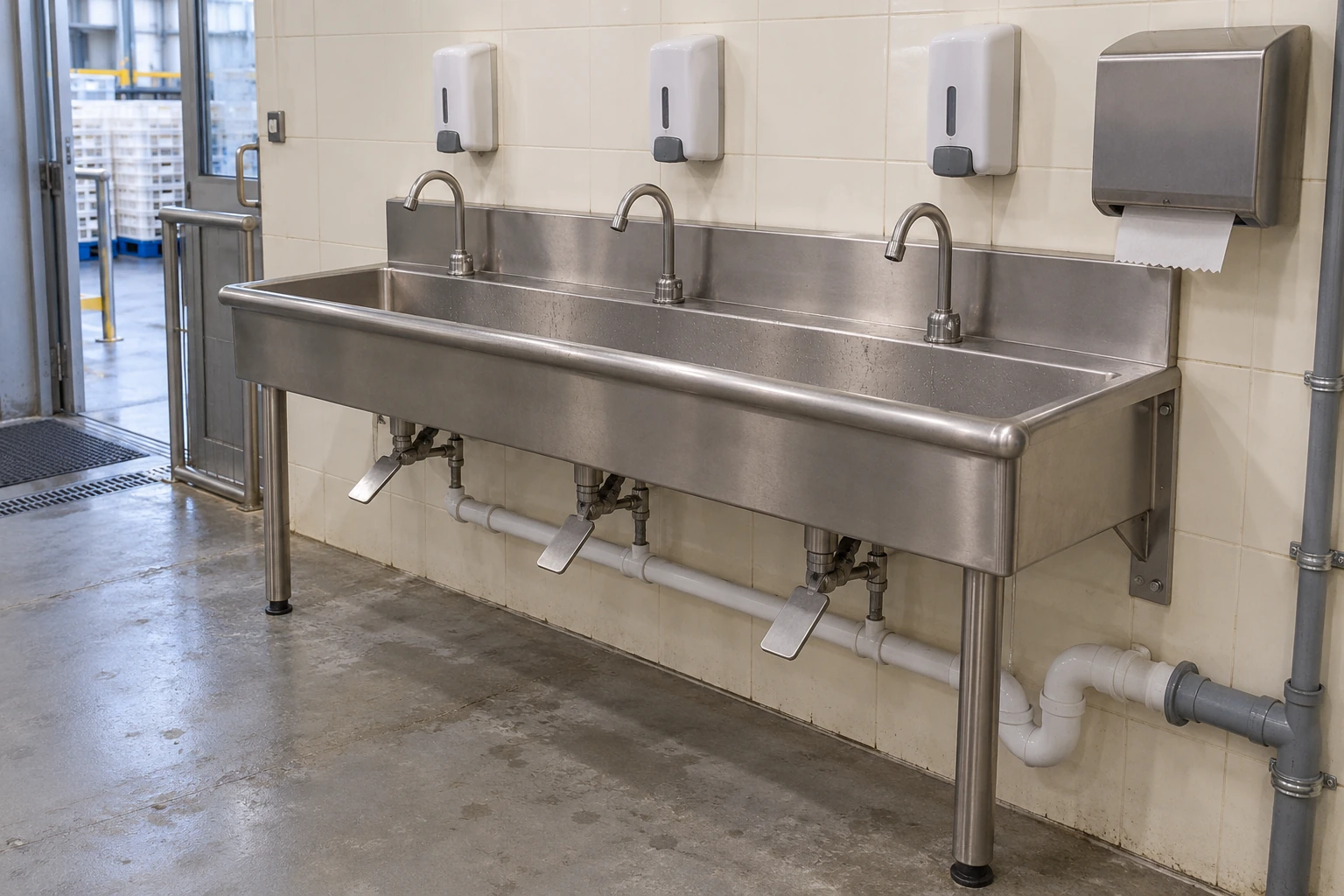
Cleanroom Sinks & Wash Stations
handwashing stations
| Trough dimensions, W × D × H | 1200 × 450 × 350 mm; 1800 × 450 × 350 mm; 2400 × 450 × 350 mm |
|---|---|
| Material and finish | 304 stainless steel; satin finish |
| Installation | Wall-mounted trough with rear upstand; supporting legs where required |
| Tap controls | Self-closing taps, knee-operated controls or sensor activation; spout positions matched to the basin |
| Water and drainage | Fixed water supply and trapped waste connection; inlet and outlet positions coordinated with site services |
| Accessories | Soap dispenser, paper-towel dispenser and waste bin positioned within the wash area |
W is the length along the wall, D is the projection from the wall and H is the trough assembly height. Finished-floor rim height and service connections are set for the installation.
Handwashing stations bring running water, soap and hand drying together at the point where people need them. A fixed stainless steel station suits a regularly used entrance, production support area or communal washroom when permanent water and drainage connections are available. The basin, controls and surrounding space should work as one usable facility.
Build the wash point around the whole routine
A basin alone does not make a convenient handwashing facility. People need room to approach, wet and wash their hands, rinse, dry and leave without crossing the next person's working space. Put soap where it can be reached without leaning across another user. Place the drying point close enough to avoid a trail of drips across a doorway.
For a shared trough, consider the distance between taps and the usable space beneath each spout. A long basin with closely packed outlets may still leave users shoulder to shoulder. Conversely, excessive space between outlets can consume wall length that would be more useful for a drying station or accessible position.
Permanent plumbing for regular use
A fixed station removes routine tank filling and emptying from a busy wash area. It needs a suitable supply, drainage route and installation surface. Check pipe positions before ordering: a waste outlet directly above a wall cove or structural bracket can make an otherwise suitable trough difficult to connect and clean.
Where the wash point must move between work areas, a mobile handwashing station provides a different arrangement. Its stored water and waste capacity bring a servicing duty that should be included in the decision.
Choose controls people can use easily
Self-closing taps can limit unattended flow, while knee controls keep the user's hands away from the operating surface. Sensor taps offer another approach, but require suitable detection, a power arrangement and access for maintenance. Select the control around the people using it, their reach and their ability to operate it.
A compact hands-free handwash sink may suit a single position. A multi-user trough is useful where several people arrive together and the room provides enough approach space.
Control splashing at the basin
The relationship between spout height, outlet direction and bowl shape affects where water lands. A high outlet aimed at a shallow or steeply curved surface can throw water onto clothing and floors. Select the tap and basin together, then adjust the flow during commissioning so hands can be rinsed comfortably without unnecessary spray.
A rear upstand helps protect the wall immediately behind the station. Seal the wall interface appropriately and leave access to valves and waste connections. Avoid hiding a slow leak behind a permanently closed panel where it cannot be noticed or repaired.
Make daily care straightforward
Smooth surfaces and reachable corners simplify cleaning, but taps, dispensers, waste fittings and the underside of the trough still need attention. Choose cleaning products compatible with the metal, seals and dispenser materials. Remove residues and address a blocked outlet before standing water interrupts use.
For selection, send the available wall length, busiest arrival period, intended users and a description of the existing services. These establish whether one shared trough, separate wash positions or several stations will serve the space more effectively.
Handwashing stations can be customized to your available space, user group, water services and cleaning routine.