Ultrapure Water Systems
ultrapure water systems providers for fabs
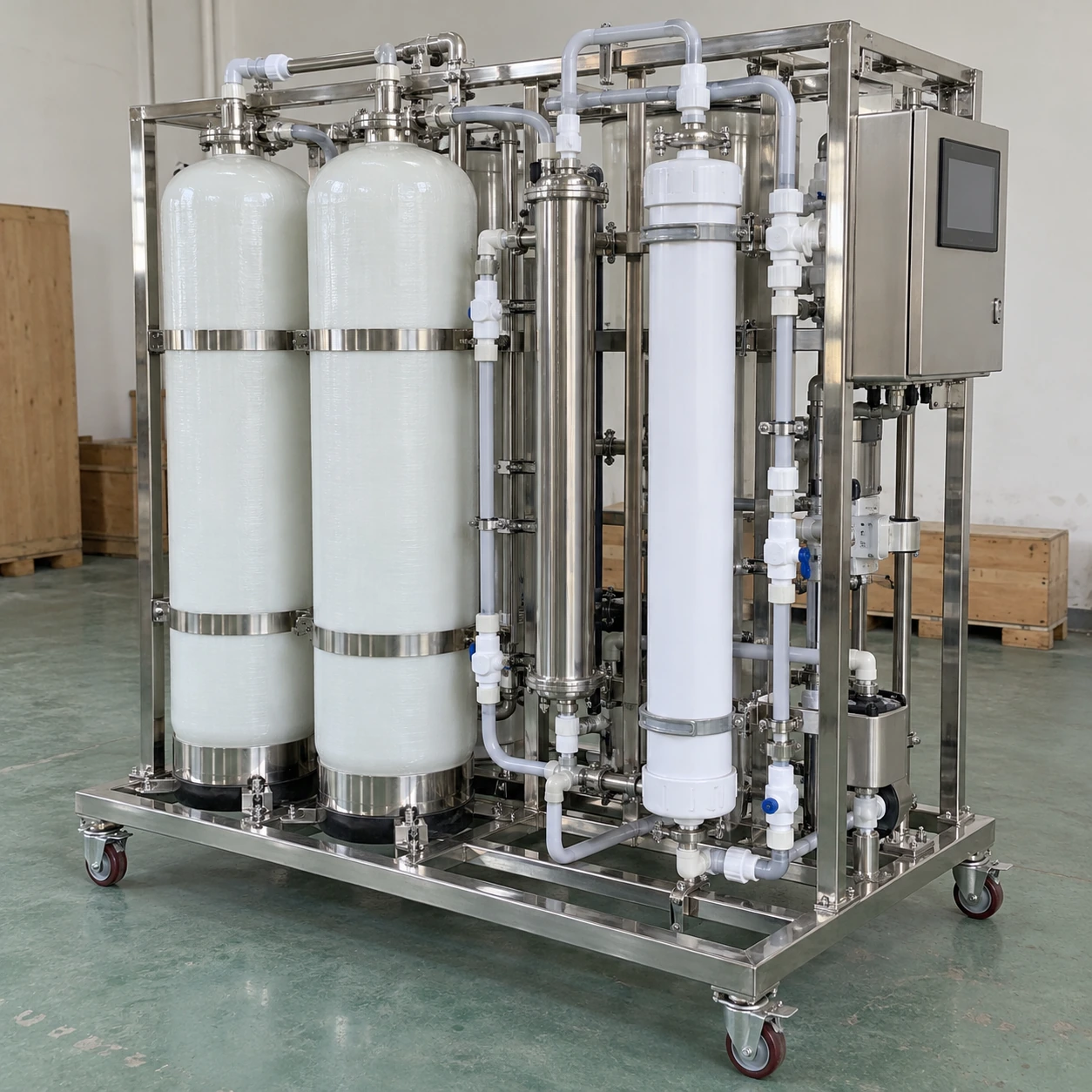
| Procurement scope | Make-up treatment, polishing package or coordinated equipment supply |
|---|---|
| Compact EDI skid, L × W × H | Approx. 991 × 1041 × 2032 mm |
| Larger EDI skid, L × W × H | Approx. 1905 × 1016 × 2032 mm |
| Skid feed | RO permeate meeting the selected EDI feed limits |
| System interfaces | Feed, accepted-water outlet, return, drains, power and control signals |
| Handover scope | Configuration drawings, component list and agreed factory/site records |
EDI skid dimensions exclude pretreatment, final polishing, tanks and the fab distribution loop. The full scope and installed footprint are established in the quotation.
Equipment scope and connection arrangements can be customized to the fab's approved water specification and installation conditions.
A fab water enquiry needs a coordinated equipment scope and an agreed acceptance boundary. Compare providers against the same source-water analysis, process requirements and site responsibilities.
A fab needs a defined supply boundary
When comparing ultrapure water systems providers for fabs, begin with the interface between the water package and the production facility. One proposal may cover only RO and EDI equipment; another may include storage, final polishing, distribution and commissioning support. Their headline prices cannot be compared until those boundaries are made visible. shengtongjh approaches this as equipment procurement and configuration coordination, with the proposed supply responsibilities stated in the quotation.
Identify where source water enters, where accepted water leaves and who owns the piping between that outlet and the process tools. Also assign responsibility for drains, power, instrument connections and the facility control interface. These details determine whether separately purchased components can become an operable system.
Make proposals comparable before selecting equipment
| Procurement item | What a useful proposal establishes | Why the distinction matters |
|---|---|---|
| Design basis | Feedwater variability, tool demand and the required quality at named delivery points | A skid outlet value may not represent water arriving at a distant tool. |
| Equipment scope | Included treatment stages, tanks, pumps, sensors, valves and excluded site work | An omitted distribution or pretreatment package can change both cost and performance. |
| Capacity basis | Net accepted production, operating conditions and capacity during maintenance | Peak component flow does not establish continuous system output. |
| Acceptance evidence | Measurements, sampling points, instruments, duration and treatment of deviations | A short factory run cannot reproduce every installed operating condition. |
| Lifecycle support | Consumable identities, service access, documentation and responsibility for replacement compatibility | Unidentified media or proprietary connections can complicate future servicing. |
Distinguish factory checks from site acceptance
Factory checks can establish that the delivered package matches its approved drawings, instruments respond and the control sequence operates under the available test conditions. Record those conditions with the result. A functional check using a temporary water supply is not evidence that the complete fab distribution loop has reached its process specification.
Site acceptance addresses the installed system: actual source water, connected utilities, circulation, tool demand and the agreed water-quality endpoints. It should account for conditioning after installation and for the instruments and sampling technique used to collect evidence. Acceptance criteria belong in the purchase agreement before dispatch.
Keep the records usable
Request a coordinated drawing set, component schedule, electrical diagrams, control narrative and maintenance instructions for the supplied configuration. For quality-critical wetted components, define the material and cleanliness records needed by the project. A generic brochure is not a substitute for documents identifying the equipment that will be delivered.
Plan how maintenance crosses the supply boundary
A replacement membrane, resin charge or pump can affect more than its own skid. Maintenance may require isolation, flushing and requalification before water returns to production. Establish who controls these steps and how the production team is informed. Where continuity is essential, evaluate standby capacity together with common items such as the power source, storage vessel and return header; duplicated skids alone do not remove every shared failure point.
Commercial comparison should also include training, commissioning attendance, spare-part identification and the scope of remote support. These are items to agree, not services to assume are included. Claims about previously completed fabs should be supported by attributable evidence rather than equipment photographs.
Use the wafer-process selection criteria to define the water requirement, and the plant integration considerations to establish the facility scope. This gives each provider the same basis for a technically meaningful quotation.
Equipment scope and connection arrangements can be customized to the fab's approved water specification and installation conditions.