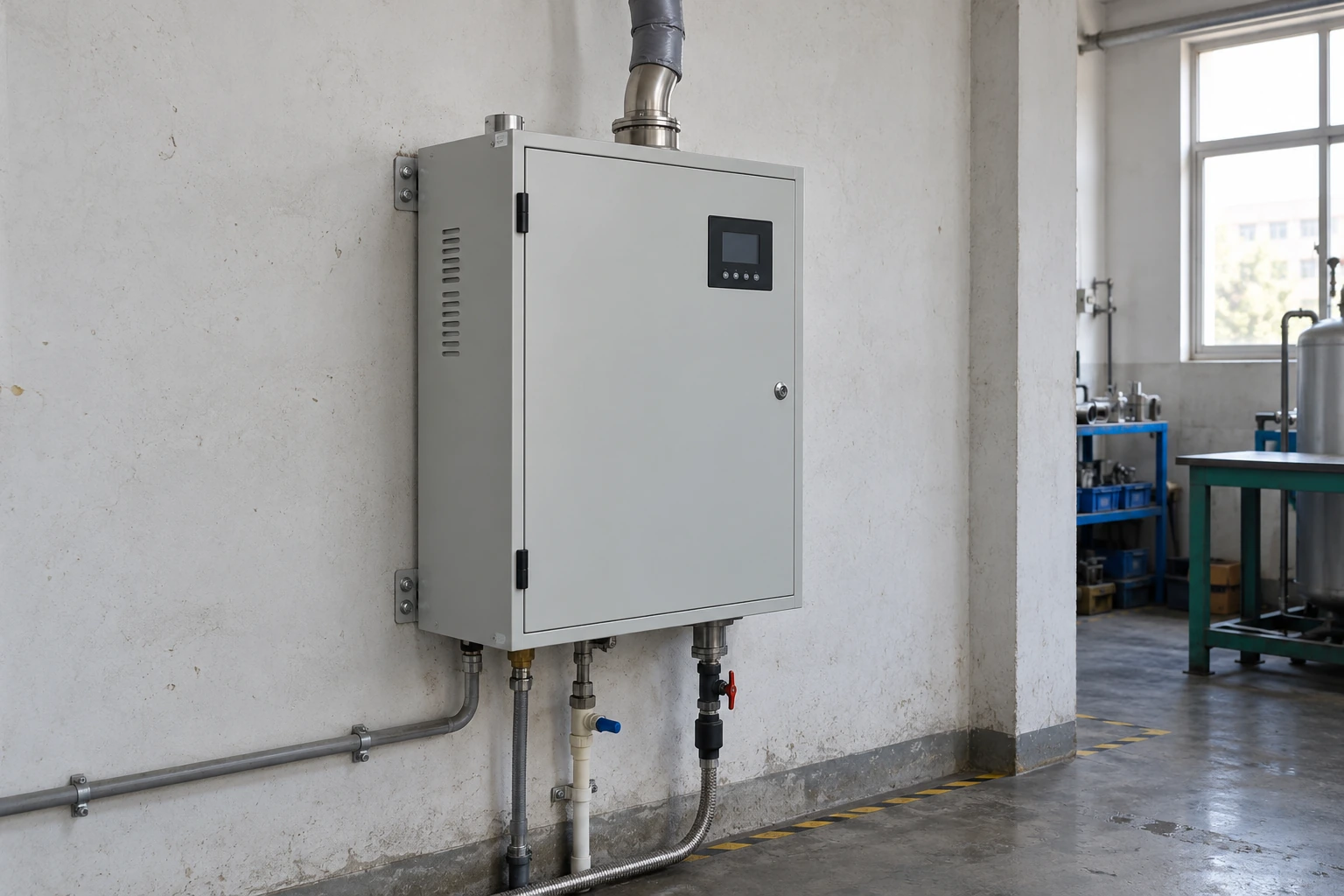
Steam Humidifiers
steam humidifiers
| Steam generation | Electrode cylinder or resistive heating tank |
|---|---|
| Compact electrode options | 5 or 9 kg/h; cabinet 371 × 221 × 523 mm (W × D × H) |
| Medium electrode options | 14 or 22 kg/h; cabinet 452 × 302 × 612 mm (W × D × H) |
| Larger electrode options | 34, 45 or 57 kg/h; cabinet 505 × 340 × 650 mm (W × D × H) |
| Moisture distribution | Single duct lance, multiple-tube assembly or room distribution unit |
| Water supply | Conductivity-matched water for electrode units; compatible treated-water options for resistive units |
| Control package | Modulating demand, airflow interlock and duct high-limit control |
| Installation | Supported indoor cabinet; electrical supply, drainage and steam route matched to the selected configuration |
Cabinet dimensions exclude external steam pipework, distribution assemblies and service clearances. Heating method and water treatment are selected together. Output and utility requirements are established in the selected equipment specification.
The steam humidifier, distribution assembly and controls can be configured to suit your application and installation conditions.
Steam humidifiers add moisture by boiling water and delivering the vapour to moving air or an occupied process space. A useful selection starts with the moisture shortage, then matches the generator, water supply and delivery arrangement so that steam reaches the intended area without wetting nearby surfaces.
Choose the moisture duty before the heater
A dry room and a dry process may need different control responses. A building that runs only during working hours has a different demand pattern from a production line that exposes moisture-sensitive material continuously.
Identify the required air temperature and humidity together. Relative humidity can fall when air warms even if its water content has not changed. Increasing steam output to compensate for every temperature swing can therefore create a second problem when the air cools again.
Outside-air intake, exhaust replacement, doors and material handling all influence the load. Floor area alone does not describe them. The selection should cover the expected operating range, including low-load periods when a large generator may need to reduce output substantially.
Two electric heating methods, different water requirements
Electrode generation
Electrical current passes through conductive water between electrodes. The cylinder, feed-water conductivity and drain control work together. This arrangement can suit routine building humidification where cylinder replacement is an acceptable maintenance task.
Very low-conductivity water is not an automatic upgrade: it may prevent an electrode unit from producing its intended output. Water treatment must be compatible with the particular cylinder and control system.
Resistive generation
Immersed heating elements transfer heat into the water. A suitable tank and level-control arrangement can work with treated water, making this route useful when process requirements call for that water quality.
Hardness deposits still need attention when untreated water is used. Compare access to the tank and heaters, the planned cleaning method and the time allowed for a safe shutdown.
The distribution assembly is part of the humidifier
A steam generator can operate normally while an unsuitable distribution arrangement leaves the room dry or the duct wet. The outlet assembly must spread vapour into the available airflow, and the air needs sufficient distance to absorb it before reaching a bend, filter or other obstruction.
A single lance is a straightforward choice where space and load permit. Multiple tubes spread the steam over more of the duct face when mixing space is restricted. Direct room delivery uses an appropriate distribution unit and requires its own clearance from ceilings, stored goods and people.
Keep four decisions connected
- Generator location
- Place the equipment where it can be serviced and where a practical steam route reaches the delivery point. A remote cupboard may save visible space but introduce a long, difficult pipe run.
- Steam and condensate
- Steam loses heat along its route and some becomes liquid. Supported piping, suitable insulation and a designed condensate path help keep that liquid out of the distribution outlets.
- Humidity measurement
- The controlling sensor should represent the area being served. A sensor in a local steam plume can stop output before the rest of the room reaches its required condition.
- Operating permission
- For duct delivery, humidity demand works alongside airflow proving and a high-limit control. A demand signal by itself does not establish that the duct can accept more moisture.
Build the package around the application
For sustained process duties, explore industrial steam humidifiers. Where gas is an available utility, gas fired steam humidifiers introduce a separate set of combustion and flue requirements.
For a quotation, the most useful starting information is the temperature and humidity target, ventilation or process airflow, operating hours, available utilities and proposed delivery position. Together these determine a workable configuration more reliably than a cabinet size alone.
The steam humidifier, distribution assembly and controls can be configured to suit your application and installation conditions.