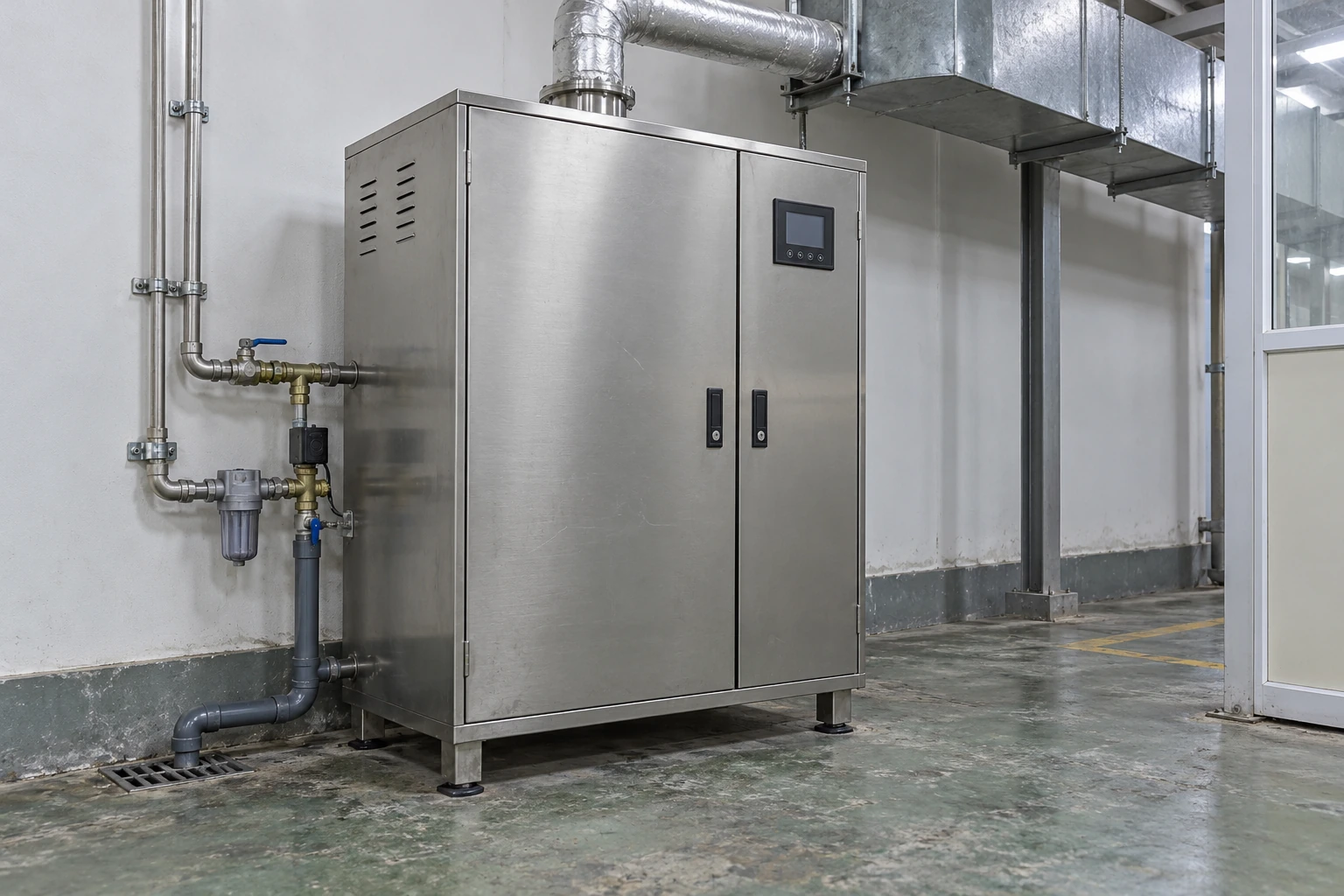
Steam Humidifiers
industrial steam humidifiers
| Generation technology | Electrode or resistive electric steam; gas-heated alternative by project requirement |
|---|---|
| Single-cylinder electrode options | 34, 45 or 57 kg/h; cabinet 505 × 340 × 650 mm (W × D × H) |
| Twin-cylinder electrode options | 68, 91 or 113 kg/h; cabinet 1008 × 340 × 650 mm (W × D × H) |
| Installation format | Supported cabinet or floor arrangement matched to the selected generator |
| Steam delivery | AHU dispersion, duct tube assembly or designated room distribution |
| Water package | Feed-water treatment and level control matched to generator technology |
| Control strategy | Modulating process demand, staged capacity and optional duty rotation |
| Service provision | Independent isolation, condensate drainage and accessible removable components |
Electrode cabinet sizes are listed separately from floor supports and distribution hardware. Capacity staging and standby provision depend on the process load and acceptable interruption. Output and utility requirements are established in the selected equipment specification.
Industrial steam humidification can be configured around your process, operating hours and required maintenance access.
Industrial steam humidifiers support processes where changes in air moisture affect handling, storage or production consistency. The useful specification describes the condition required at the process, how quickly the load changes and what happens when one part of the humidification system is unavailable.
Define the production condition that matters
Moisture-sensitive paper, textiles and other materials exchange moisture with surrounding air. A room reading taken away from the work may not describe conditions at an exposed web, worktable or storage opening. Start by identifying where the material is exposed and how long it remains there.
Humidification should support the process requirement without being treated as a cure for every production defect. Material conditioning, temperature stability and handling practices may also influence the result. A defined target and measurement location make the equipment selection more meaningful.
Separate continuous load from changing load
| Operating situation | What changes | Selection consequence |
|---|---|---|
| Steady production | Exposure and ventilation remain broadly consistent. | Give weight to sustained output, predictable water management and service availability. |
| Batch production | Doors, extraction and material movement change through the cycle. | Assess recovery and low-load control as well as the peak requirement. |
| Local extraction | Removed air is replaced by air with a different moisture content. | Include the replacement-air condition and simultaneous exhaust operation. |
| Future expansion | Another line or additional ventilation adds demand. | Reserve a practical capacity and utility path without oversizing every current component. |
Choose heating around water and service
An electrode system can provide a compact generation arrangement when the water conductivity and cylinder type are compatible. Its replaceable cylinder becomes part of the production maintenance plan.
Resistive heating separates the heat source from the electrical conductivity of the water. A suitable configuration can use treated water where that supports the process or maintenance strategy. The benefit still depends on maintaining the treatment equipment and matching wetted materials and level sensing.
Deliver moisture where production needs it
Central duct distribution can serve several work areas through the ventilation system. Local room distribution may be useful where a specific area needs treatment and the surrounding airflow allows effective mixing.
A local unit must not discharge onto product, overhead structures or a nearby sensor. Central distribution needs a suitable position in the air system. The choice is about reaching the exposure point consistently, not simply choosing the largest available generator.
Two units are not automatically a standby system
Splitting the duty across generators can make staged control and planned maintenance easier. However, if both units are required to meet the normal load, losing one still reduces available output. Define the required capacity during maintenance or a fault before describing the arrangement as redundant.
Shared services can also become a single point of interruption. Consider the feed-water supply, treatment plant, controls and distribution connection alongside the generators. Duty rotation and staggered service only help when the remaining arrangement can actually carry the intended load.
Plan access before the equipment arrives
The service route needs room to remove cylinders, tank covers or heating assemblies without dismantling unrelated pipework. Leave access to isolate water and power, manage hot drainage and inspect the steam path. In a production area, also consider how maintenance tools and removed components reach the equipment.
A gas-fired configuration may be considered where the utility arrangement suits the load. It adds combustion-air and flue interfaces that need to be resolved alongside the process steam connection.
For an existing installation with declining output or frequent interruptions, the industrial delivery and maintenance review follows the path from generator demand to moisture received at the process. For a new enquiry, include operating hours, ventilation and extraction conditions, target temperature and humidity, and the interruption the process can tolerate.
Industrial steam humidification can be configured around your process, operating hours and required maintenance access.