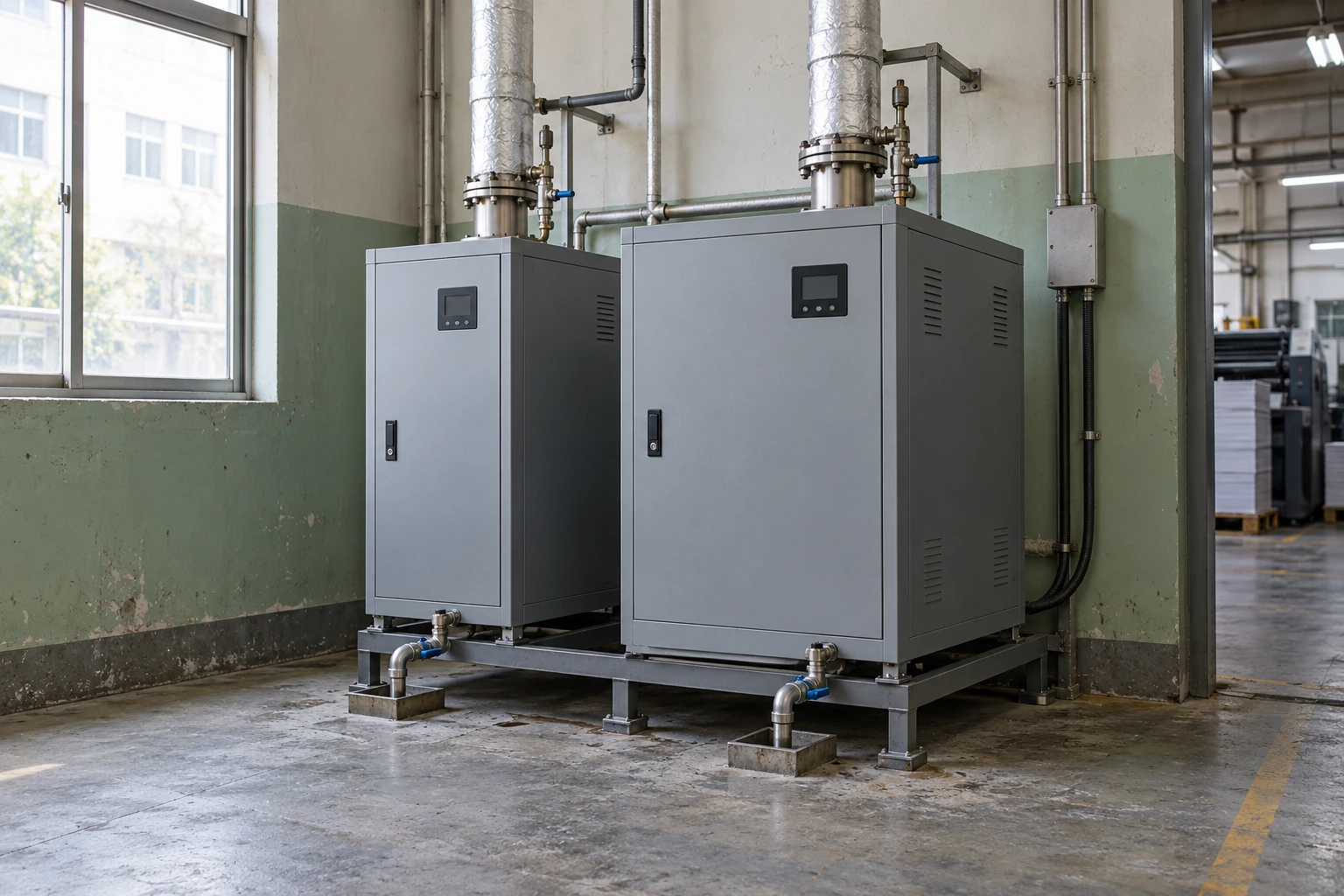
Steam Humidifiers
steam humidifiers industrial
| System arrangement | Single generator or staged multiple-generator installation |
|---|---|
| Single-cylinder electrode options | 34, 45 or 57 kg/h; cabinet 505 × 340 × 650 mm (W × D × H) |
| Twin-cylinder electrode options | 68, 91 or 113 kg/h; cabinet 1008 × 340 × 650 mm (W × D × H) |
| Heating alternatives | Electrode cylinders or serviceable resistive heating tanks |
| Delivery interface | Insulated steam pipework, compatible dispersion assembly and condensate drainage |
| Monitoring | Humidity demand, enable status, operating output and service alarms |
| Water management | Matched conductivity or treated-water arrangement with accessible fill and drain components |
| Maintenance layout | Independent service isolation and clear removal paths |
Dimensions describe individual electrode cabinets, not a complete multi-unit installation. Interconnecting pipework, support frames and maintenance space are sized for the chosen arrangement. Output and utility requirements are established in the selected equipment specification.
The industrial humidification arrangement can be configured for your existing services, production schedule and maintenance requirements.
For an industrial steam humidifier installation, useful output is the moisture delivered to the process. A running generator, a hot steam pipe and a humidity demand signal do not prove that the production area is receiving the required moisture. Review the complete delivery path before increasing equipment capacity.
Follow the demand from the process back to the generator
- Confirm what the process is experiencing. Compare temperature and humidity at the relevant exposure point with the normal production pattern. Check whether the change began with a new extraction duty, an open doorway, a different shift or altered air distribution.
- Separate demand from permission to run. A controller can request humidity while a high-limit condition, missing airflow proof or equipment alarm prevents delivery. Identify which signal is limiting operation without bypassing the protective control.
- Compare requested and available output. Review the operating record for filling, draining, service indications and capacity staging. Repeated interruptions can make the average output much lower than the maximum rating suggests.
- Inspect delivery as a separate part of the system. Steam-line condition, condensate drainage and distribution location influence how much generated vapour reaches the moving air.
Low room humidity with a busy generator
If the humidifier spends long periods at high demand, first look for a changed moisture load. More exhaust air or additional fresh air can increase the replacement duty. A production change can also expose more material to the room.
If the load has not changed, investigate the route to the distribution point. Heat loss turns some steam into condensate. Poorly supported pipework or an unsuitable drainage arrangement can hold liquid in the steam path and disturb delivery.
Wet ductwork with a dry production area
This combination points to a distribution problem as well as a possible capacity problem. Vapour may encounter a cold surface or obstruction before it has mixed sufficiently with the airstream.
Increasing the generator setting can worsen local wetting. Review airflow, entering-air condition, the dispersion assembly and downstream clear space together. A change in tube arrangement or location may be more useful than a larger heater.
Service demand is an operating variable
Water quality and operating hours influence mineral accumulation and cylinder life. If maintenance becomes more frequent, compare current feed-water conditions with those used for selection. Changes to a treatment system can affect an electrode generator differently from a resistive unit.
Establish a service interval from the equipment instructions and operating observations. A fixed calendar interval alone may miss a significant change in production duty. Record what was found during service, not only the date on which the alarm was cleared.
Make the next service visit easier
Before shutdown
Identify the affected process and whether another generator can maintain the required condition. Have the correct consumables, service parts and access arrangement ready.
At the equipment
Provide a clear route for authorized personnel to isolate and cool the unit and remove its service components according to the instructions. Pipework should not block routine removal paths.
After return to operation
Check that the unit resumes the intended sequence and that the delivered condition recovers under a representative production load. A cleared fault display alone is an incomplete handover.
Use operating evidence to choose the next configuration
Replacement becomes more useful when the cause of the old installation's difficulty is understood.
A generator that is adequate for steady operation may lack recovery capacity after an extended stop. A shared water supply may restrict several units during simultaneous filling. A difficult location may turn a routine task into a production interruption. Each points to a different improvement.
The HVAC integration page covers the relationship with the air system. For a new process duty or a larger expansion, review industrial steam humidifiers around the required exposure condition and continuity of operation.
Useful enquiry material includes operating trends, the existing steam route, observed service issues and any recent ventilation changes. This allows the replacement or additional capacity to address the actual limitation.
The industrial humidification arrangement can be configured for your existing services, production schedule and maintenance requirements.