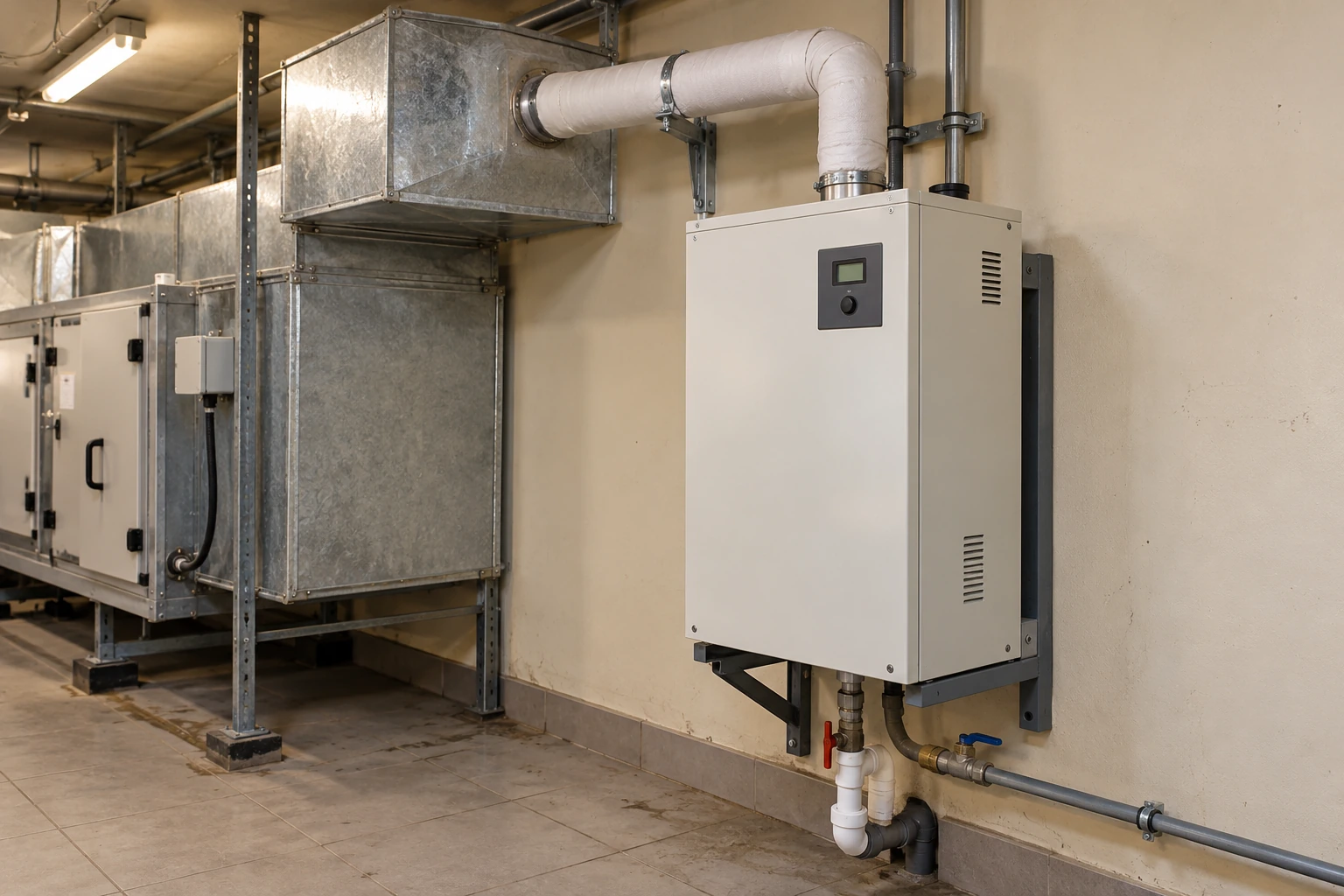
Steam Humidifiers
commercial steam humidifiers
| Heating arrangement | Electrode cylinder or resistive electric generation |
|---|---|
| Small electrode options | 5 or 9 kg/h; cabinet 371 × 221 × 523 mm (W × D × H) |
| Medium electrode options | 14 or 22 kg/h; cabinet 452 × 302 × 612 mm (W × D × H) |
| Larger electrode options | 34 or 45 kg/h; cabinet 505 × 340 × 650 mm (W × D × H) |
| Distribution | Duct lance or multiple-tube assembly; room distribution where appropriate |
| Operating control | Occupied schedule, modulating humidity demand and remote enable |
| Duct protection | Airflow proving and independent high-limit control |
| Water and service | Feed-water compatibility, accessible drain and front service space |
The dimensions describe indoor generator cabinets. Allow separately for mounting, cylinder or tank removal and the complete steam distribution route. Output and utility requirements are established in the selected equipment specification.
Commercial humidification configurations can be adapted to the building schedule, available services and air distribution arrangement.
Commercial steam humidifiers should follow how a building is used. Offices, retail premises, archives and other occupied facilities can have long periods of low demand followed by busy hours with increased ventilation. The equipment and control sequence need to handle both conditions without creating wet ducts or an excessive maintenance burden.
Follow a building through its operating day
Before occupancy
A system returning from setback may need to recover its required condition. Coordinate humidification with fan operation and temperature recovery, rather than enabling steam against an inactive air system.
During busy hours
More outside air can change the moisture load. A meeting area, shop entrance or frequently used loading door can behave differently from an enclosed office served by the same plant.
After closing
Decide whether the protected contents still need humidity control. An archive may require a different overnight strategy from a general office. The decision belongs in the operating sequence, alongside ventilation and temperature settings.
A peak rating does not describe everyday behaviour
Maximum output matters during the driest design condition. Most operating hours may occur below that point.
Ask how the proposed humidifier responds when demand falls. Output modulation, restart behaviour and the effect of fill-and-drain events influence whether the space condition remains steady. Oversizing without considering this lower end can leave the unit repeatedly starting and stopping.
Variable-air-volume systems deserve particular attention. When airflow reduces, the same steam quantity creates a larger moisture increase in the supply air. The duct limit must be able to restrict delivery even while a room sensor continues to request humidity.
Temperature zoning also matters. Rooms at different temperatures do not necessarily share the same relative humidity when they receive air with the same moisture content. Define which spaces govern the central system and whether any zone needs separate treatment.
Locate equipment for the person who must maintain it
A cabinet hidden above a difficult ceiling may be convenient on a drawing and inconvenient at every service visit. The installation needs access for removing the cover, changing a cylinder or cleaning a tank, and reaching water isolation and drainage connections.
Keep the steam route practical. Long detours can increase condensate formation and complicate drainage. Coordinate the humidifier position with the distribution point early, especially when plant rooms are separated from the served duct.
Choose water treatment deliberately
Electrode units rely on water conductivity. Resistive systems use heating elements and may support a different range of treated waters. Select the equipment around the actual feed-water condition, rather than specifying reverse osmosis for every installation.
Maintenance frequency depends on water quality and use. A seasonal building and a heavily ventilated building may accumulate different service demands even when their cabinets have the same rated output.
Keep the occupied area in view
The humidity sensor should reflect the area that matters to the operator. Avoid letting an unrepresentative corner, supply plume or nearby heat source dominate the control response.
The building envelope also sets a practical boundary. Cold surfaces can condense moisture before the average room condition appears excessive. Setpoints should suit both the use of the space and its temperature conditions.
Coordinate the air system and the handover
For a central installation, review the humidifier together with the commercial air handling units and the proposed duct-mounted steam distribution. Identify the responsible party for the fan interlock, humidity limit, drain connection and building-control signals.
A useful handover records the operating schedule, target conditions, alarm response and consumable or cleaning requirements. This gives the facilities team a practical basis for maintaining the selected configuration through the seasons.
Commercial humidification configurations can be adapted to the building schedule, available services and air distribution arrangement.