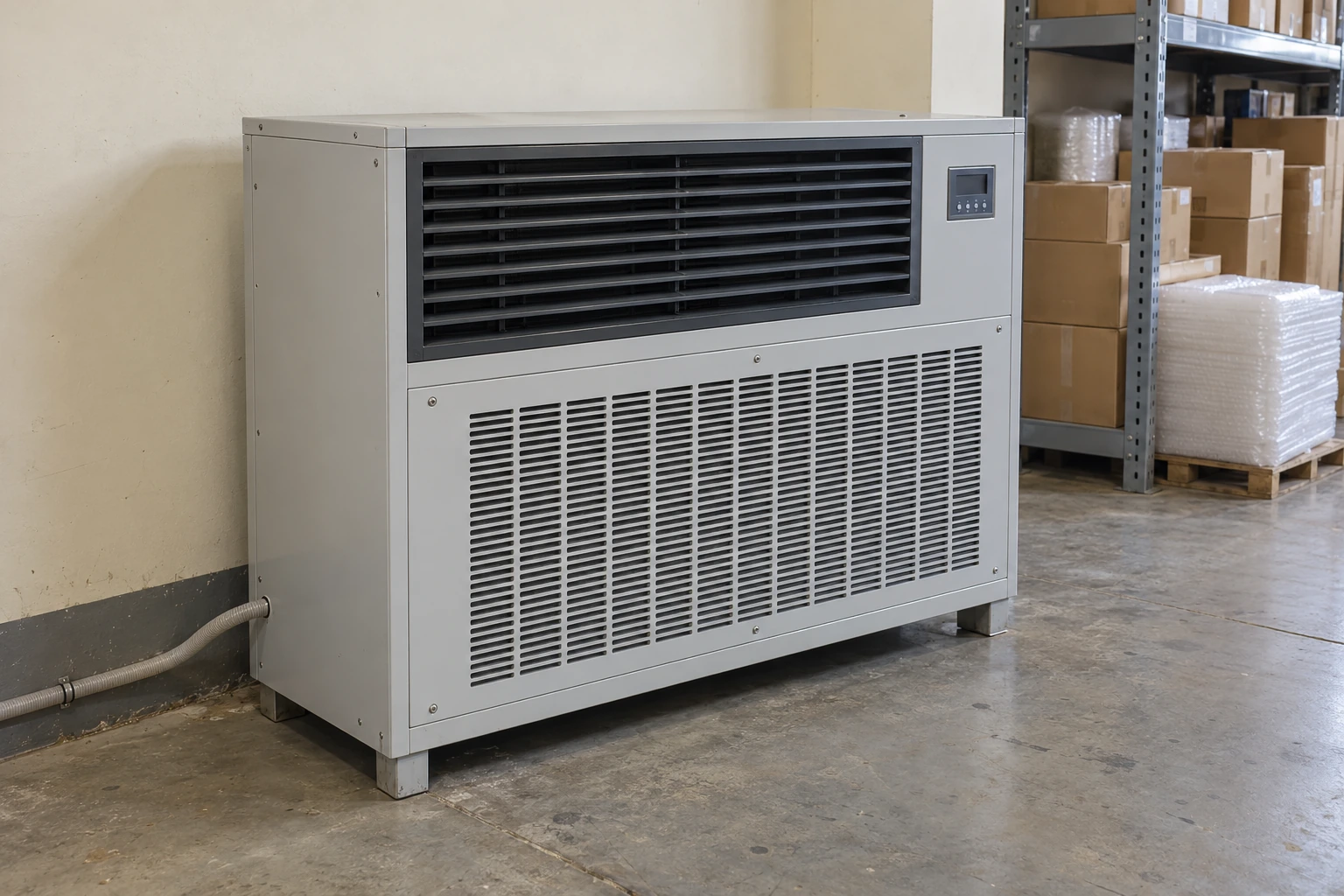
Refrigerant Dehumidifiers
Refrigerant Dehumidifiers
| Cabinet W × D × H | 1010 × 326 × 770 mm; 1160 × 326 × 770 mm; 1495 × 326 × 770 mm |
|---|---|
| Water removal at 20°C / 60% RH | 25.3 / 37.6 / 50.4 L per 24 hours, respectively |
| Air circulation | 410 / 680 / 840 m³/h, respectively |
| Electrical configuration | 230 V, single-phase, 50 Hz; input at 20°C / 60% RH: 0.6 / 0.9 / 1.1 kW |
| Operating envelope | 3–32°C and 40–95% RH for these configurations; output varies across the range |
| Installation and control | Floor-standing or wall-mounted cabinet; electronic humidity control and continuous condensate drainage |
Capacity, airflow and input follow the three cabinet sizes in the order listed. Dimensions exclude installation clearances. Electrical input at the stated duty point is not the maximum supply requirement; the selected unit's nameplate and manual govern installation.
Refrigerant dehumidifiers collect water from air using a compressor-driven cooling circuit. They suit many enclosed storage and production support spaces where excess moisture affects goods, packaging or equipment. Selecting a range of units for a facility means matching each drying duty, installation position and service arrangement, rather than choosing every cabinet by its headline daily capacity.
Separate steady humidity control from drying a wet load
A materials store may need to hold a stable condition throughout the week. A workwear drying room receives a wet load at the end of a shift and needs to recover before the next one. Both can use refrigeration-based drying, but their priorities differ: one is governed mainly by continuing moisture entry, the other by the amount of water to remove within an available period.
Define those duties for each location before selecting equipment. Record the usual room temperature, desired humidity and periods of heavy use. Include wet materials and cleaning activities, as well as doors and ventilation. A single floor-area rating cannot describe these different demands.
Account for the heat returned to the room
Air passes over a cold evaporator, where water condenses, and then over the condenser before returning to the space. The normal self-contained arrangement delivers warmer, drier air. That heat may be helpful in a drying room, while an equipment room with an existing cooling load needs a different assessment.
Where temperature must remain closely controlled, coordinate dehumidification with the cooling system or assess a purpose-designed arrangement that rejects heat outside the space. A humidity setting by itself does not control the heat balance.
Check the coldest operating period
The lower limit on a temperature range indicates where a unit may operate, not where it retains its warm-condition drying capacity. Defrost also affects the time available for collecting water. An unheated store can therefore need a different selection from an adjacent occupied workshop.
For persistently cold air or a very low required dew point, compare a suitable desiccant system during selection. Increasing the size of a conventional condensation cabinet does not remove the need to check its performance at the required condition.
Choose how the equipment will occupy the building
- Floor-standing cabinets
- These provide accessible service positions where floor space is available. Keep the intake and discharge clear when racks are fully loaded, and allow room to remove filters and reach the drain. The space needed for operation is larger than the metal enclosure.
- Wall-mounted units
- Wall mounting can free the floor for handling and cleaning. The wall, brackets, condensate route and maintenance access must suit the complete installation. Avoid placing the unit where routine filter work requires moving sensitive stock or shutting a main passage.
- Ducted arrangements
- A remote cabinet can serve a defined air path, but its fan must overcome the resistance of the connected ducts and fittings. Free-air circulation figures cannot establish ducted performance. For larger installations, compare the industrial dehumidifier configuration alongside the proposed air distribution.
Compare output and energy at the same conditions
Ask for water removal and electrical input at the intended entering-air temperature and humidity. Comparing a warm, humid capacity rating with another unit's cooler-condition result can reverse the apparent ranking. For running-cost comparisons, use energy per quantity of water removed at matching conditions, then consider expected operating hours and controls.
A useful equipment schedule keeps cabinet size, airflow, power, refrigerant and drainage together as one configuration. The refrigerant designation belongs to the factory-designed circuit; it is not a field-selectable substitute. Specify the destination supply and documentation needed for each installation.
Keep water removal dependable between service visits
A continuous drain avoids repeated tank emptying. Gravity discharge needs a suitable route and the connection arrangement specified for the unit. If the drain must rise, select a condensate pump for the required lift and flow, with an appropriate response to a pump fault. Keep the line reachable for cleaning.
Before routine operation, confirm drainage and compare humidity readings at the goods or work positions, not only beside the outlet. Include filter cleaning and drain inspection in the maintenance plan. An unexpected fall in collection needs diagnosis in context; the low-refrigerant troubleshooting page explains why that symptom alone does not identify a circuit fault.
Refrigerant dehumidifiers can be customized to suit your moisture load, operating conditions, installation space, drainage and control requirements.