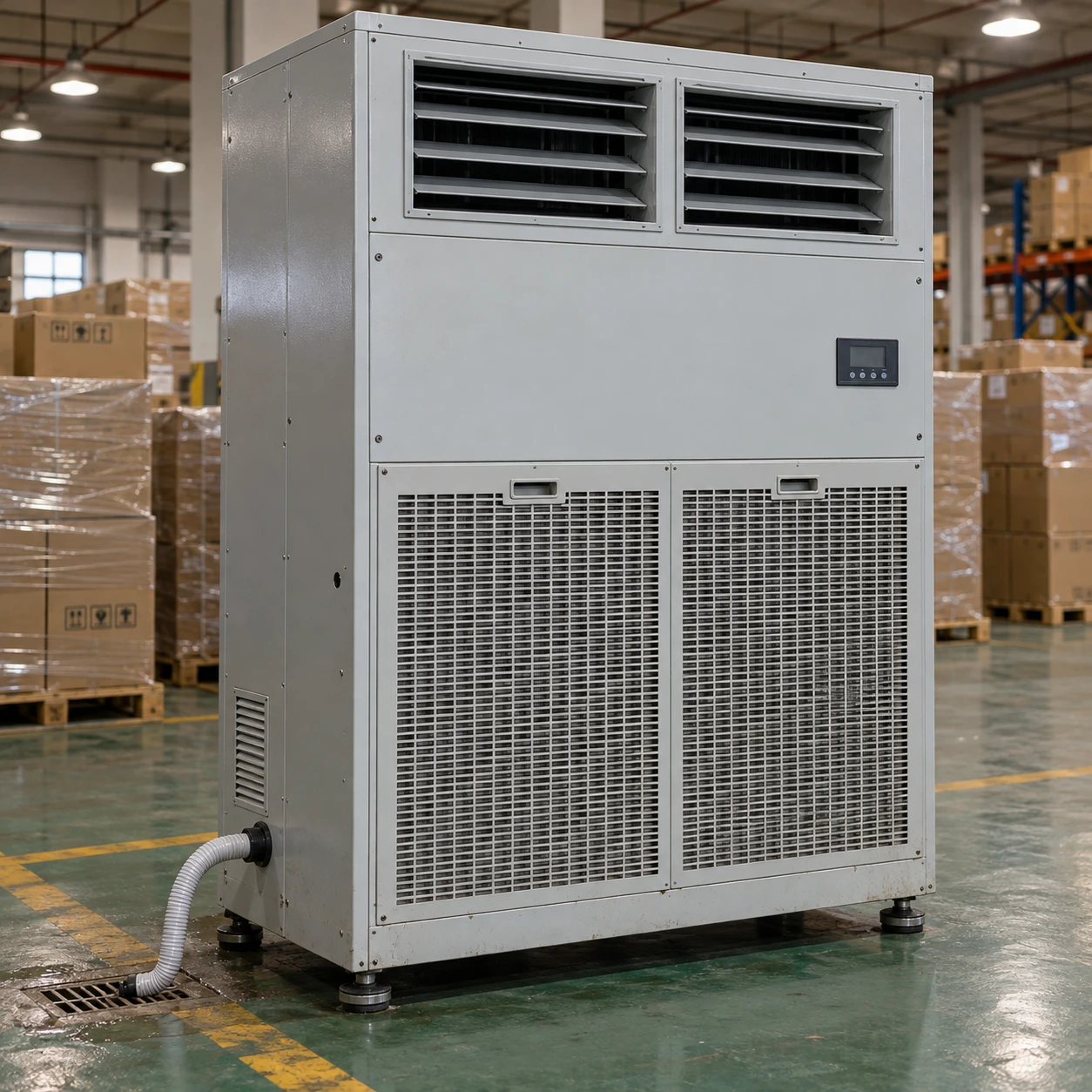
Refrigerant Dehumidifiers
industrial refrigerant dehumidifier
| Brand | shengtongJH |
|---|---|
| Capacity choices | 240 / 480 L/day at 30°C / 80% RH |
| External cabinet sizes, W × D × H (mm) | 240 L class: approximately 600 × 500 × 1320 or 774 × 470 × 1685; 480 L class: approximately 970 × 500 × 1612 |
| Input power selection | 240 L class: around 3.1–3.9 kW rated; 480 L class: around 6.5 kW rated |
| Maximum input allowance | Up to approximately 4.7 / 9.8 kW for selected 240 / 480 L configurations; final circuit sizing follows nameplate data |
| Power supply | 380–415 V, three-phase, 50 Hz; voltage, neutral and earthing arrangement matched to the unit |
| Air circulation selection | Around 1,500–5,600 m³/h across industrial configurations; fan duty matched to air distribution |
| Operating temperature | Common indoor selection range 5–35°C; low-temperature duty assessed separately |
| Drainage | Continuous condensate pipe; pump and fault indication options |
| Cabinet & access | Coated steel enclosure, removable filter panels and service access |
| Controls | Automatic humidity control, defrost and compressor protection; remote signals by specification |
| Refrigerant & installation | Factory-matched circuit selected for destination requirements; free-blowing or purpose-designed ductable configuration |
These are configuration choices, not a single fixed model. Cabinet, fan duty, refrigerant and electrical values must be selected as a compatible package. Removal rates are stated at 30°C / 80% RH, not guaranteed daily collection on site.
Dehumidification capacity, cabinet dimensions, air connections, drainage, power supply and control interfaces can be configured to suit the process and installation environment.
An industrial refrigerant dehumidifier controls moisture generated by production, incoming air and stored materials. Selecting it for a factory or warehouse means matching water-removal capacity with the air path, working temperature, electrical supply and drainage—not simply choosing the largest cabinet that fits.
Start with the moisture load
A large building is not one uniform drying space
A packaging hall with regular loading-door traffic behaves differently from a closed spare-parts store. Washing operations, exposed wet material and ventilation can add moisture throughout a shift. New construction or damp stored goods can create a temporary drying load on top of that continuing demand.
Separate those loads before selecting capacity. A unit sized only for maintaining a dry room may recover slowly after wet stock arrives. Conversely, buying enough capacity for the first drying period without considering control and air distribution can leave an oversized, poorly coordinated installation for normal operation.
Match the arrangement to the production area
Packaging and finished-goods storage
Reduce moisture around cartons and stored products while keeping loading routes clear. Door seals, opening duration and the position of stock affect the result. Check humidity among the storage aisles, not only beside the equipment.
Metalworking and equipment storage
Humidity control can reduce conditions that favour surface corrosion. Airborne oil, dust or corrosive vapours require a separate suitability review; an ordinary inlet filter is not a process-exhaust or chemical-protection system.
Production after wet cleaning
Account for moisture released from floors and equipment after cleaning, and for the time allowed before production resumes. Cabinet protection, cleaning practices and placement must suit the area. A general industrial unit should not be assumed to tolerate washdown.
Daily capacity is a condition-dependent rating
Compare offers at the same air temperature and relative humidity, then review the expected operating point. A machine's output drops as the air becomes cooler or drier. Dividing a warm-condition daily rating by the hours available for drying does not establish the capacity at a different room condition.
For demanding humidity targets, use a moisture-load assessment and performance data at the required conditions. A low dew-point process or cold environment may call for desiccant equipment or a combined system. The target should determine the technology, rather than forcing every project into refrigerant drying.
One central unit or several zones?
A central unit can simplify drainage and service access, but needs an effective route for air to reach and return from the affected area. Long aisles, partitions and dense racking can leave pockets of high humidity even while air beside the cabinet is dry.
Several units can serve separate loads and operating schedules. That approach uses more electrical and drain points, and needs coordinated humidity settings. Position equipment according to the air path and operational access rather than spacing units evenly for appearance.
Ducting changes the fan requirement
A free-blowing fan is selected for a different duty from one moving air through ducts, bends and grilles. Adding a duct to an ordinary cabinet can reduce flow and drying performance. Specify the required external static pressure when a ducted arrangement is needed.
Keep discharge air from immediately returning to the intake. Allow removal of filters and service panels without dismantling fixed pipework or moving stocked pallets. Check the delivery route as well as the final footprint.
Plan for continuous operation, not just commissioning day
Provide a permanent condensate route with access for inspection. Where a pump is necessary, decide how a drainage failure should stop the equipment or raise an alarm. The electrical design must account for the selected unit's maximum current, starting requirements and protection, not only its normal running power.
Record humidity at representative locations during ordinary production and during the highest-load period. Filter condition, drain reliability and room openings should be part of routine operation. If performance changes, compare those conditions before assuming the equipment needs more refrigerant.
For a quotation, send the layout, room height, operating temperature, humidity target, major moisture sources and available services. shengtongJH can discuss a supply scope covering the unit and relevant interfaces. Smaller or intermittently used spaces can also be assessed with portable refrigerant equipment.
Dehumidification capacity, cabinet dimensions, air connections, drainage, power supply and control interfaces can be configured to suit the process and installation environment.