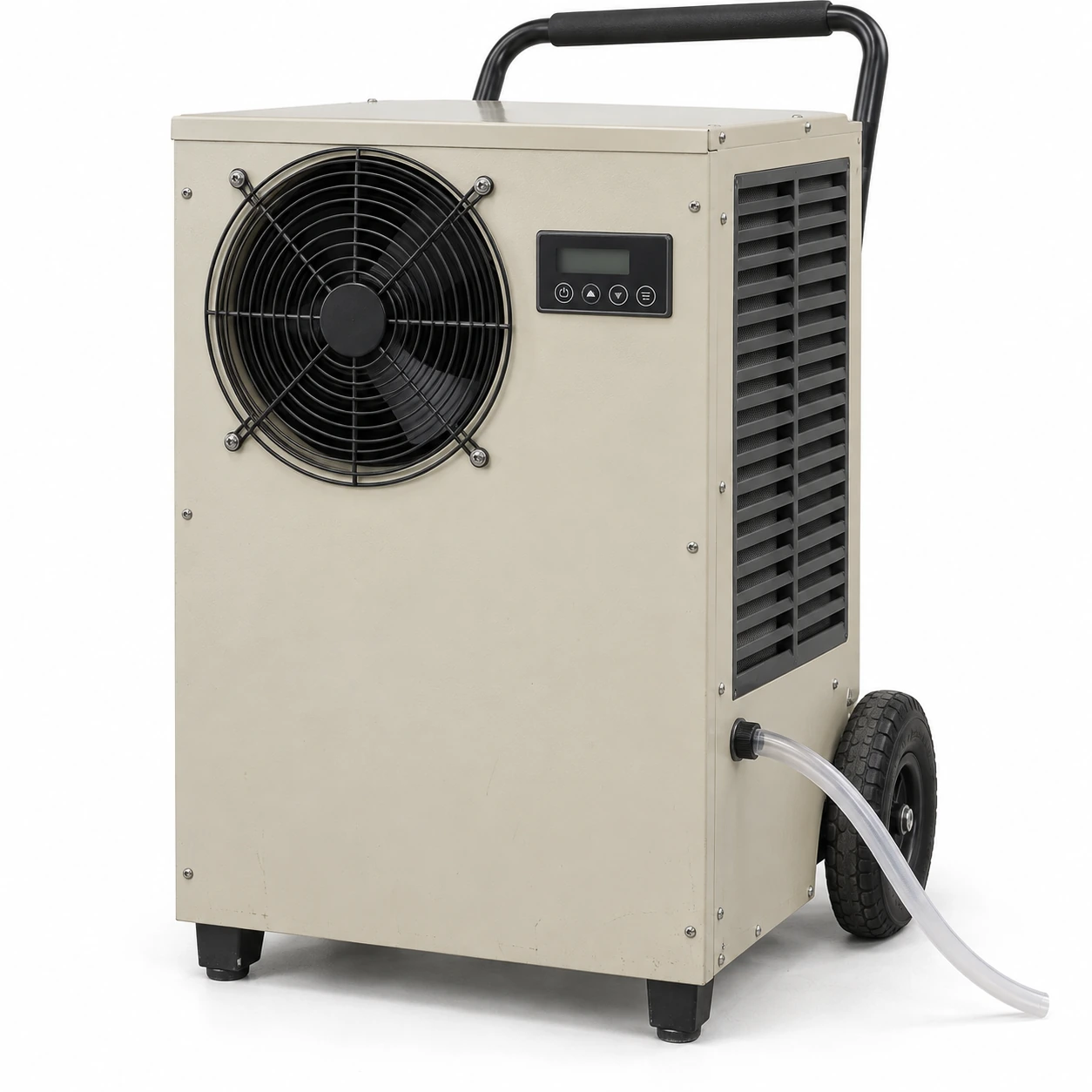
Refrigerant Dehumidifiers
dehumidifier with refrigerant
| Brand | shengtongJH |
|---|---|
| Capacity classes | 50 / 90 L/day at 30°C / 80% RH |
| Cabinet dimensions, W × D × H (mm) | Approximately 410 × 365 × 550 / 480 × 485 × 955 |
| Rated input selection | Approximately 750 / 1,150 W, respectively |
| Supply voltage | 220–240 V, single-phase, 50 Hz; other supplies require a matching unit |
| Circulation airflow | Around 850 m³/h for the listed portable options |
| Humidity adjustment | Typically 35–80% RH; achievable room humidity depends on conditions |
| Temperature range | 5–38°C or 8–35°C, according to the chosen capacity and refrigerant design |
| Condensate removal | Tank or gravity hose; pump-assisted discharge as a separate configuration |
| Refrigerant options | R290 on compatible compact designs; other factory-matched circuits by destination requirements |
| Cabinet & transport | Coated metal housing, handle and wheels; removable inlet filter |
| Operating controls | Electronic humidistat, timer, automatic defrost and compressor restart delay |
Listed values describe common procurement configurations. Refrigerant, electrical data, dimensions and drainage equipment are confirmed for the selected unit; different refrigerants cannot be substituted into the same circuit.
The capacity, cabinet format, electrical supply, drain arrangement and control functions can be tailored to the application and site requirements.
A dehumidifier with refrigerant uses a compressor and sealed cooling circuit to take moisture out of room air. For buyers, the useful choice is not simply which gas is inside: drainage, temperature range, controls and the ability to move and maintain the equipment determine how well it fits everyday work.
A closed cooling circuit, not a water refill system
The refrigerant transfers heat inside the equipment. The collected water comes from moisture in the room air, and leaves through a tank or drain. You do not add water for normal dehumidification, and refrigerant is not a routine consumable. That distinction matters when planning ongoing operation: staff may need to empty a tank or clean a filter, but should not be expected to recharge the cooling circuit.
The usual self-contained arrangement returns warmer air to the room. In a small equipment room, include that heat in the ventilation or cooling assessment. A machine that dries the air can still increase room temperature.
Occasional drying
Move the unit to the work
A portable cabinet is useful for intermittent damp storage, maintenance activities or moving between enclosed work areas. Compare the access route and floor transitions with the wheels and handle, not just the cabinet footprint. Empty collected water and follow the transport instructions before moving it.
A water tank avoids an immediate drain connection, but adds an emptying task. A full-tank shutoff protects against overflow by stopping collection; it does not keep the room dry while nobody is available to empty it.
Regular operation
Give condensate a dependable route out
For recurring humidity loads, a continuous drain can reduce interruptions. Gravity drainage needs a suitable downhill route without kinks or a submerged outlet. Where discharge must rise, select a condensate pump with enough lift and capacity rather than lifting a hose and expecting gravity flow.
Consider how a blocked pipe or pump fault will be detected. The drainage route should remain accessible for cleaning and should not create a trip hazard across a walkway.
The refrigerant must suit the complete equipment
Refrigerant selection affects the compressor, heat exchangers, controls, service method and installation requirements. Choosing a refrigerant by name alone does not establish efficiency or suitability. R290, for instance, requires the precautions specified for a flammable-refrigerant appliance; it is not a drop-in replacement for another circuit.
Ask for the supplied unit's refrigerant designation, nameplate charge and manual, together with the electrical and destination requirements. For new procurement, review the complete current equipment specification rather than requesting an old refrigerant simply because an earlier machine used it.
Choose controls that match the way the space is used
A humidistat cycles the equipment around a setting, but a displayed setting is not a guarantee of uniform humidity throughout the room. Place a separate sensor where the sensitive goods or process are located, away from the discharge stream, and compare readings during normal operation.
A timer can limit operation to a shift, although moisture does not stop entering because the shift has ended. Auto-restart may be useful after a power interruption, but its suitability depends on drainage and the site's operating procedure. Discuss these functions as choices rather than assuming every cabinet includes them.
Auto-defrost helps manage ice under suitable conditions. It cannot turn an ordinary condensation unit into a solution for every cold-room or low-dew-point application. If drying in cold air is the main task, have the selection checked against performance at that temperature.
Keep the purchase easy to compare
Provide the room's typical conditions, desired humidity, available electrical supply and whether water can drain continuously. For an enquiry covering several locations, identify which units need mobility and which can be permanently positioned. shengtongJH can organise those requirements into a sourcing specification without assuming that one portable design fits every site.
For the basic moisture-removal process and selection limits, see refrigerant dehumidifier. For production areas with larger ongoing loads, compare the industrial options.
The capacity, cabinet format, electrical supply, drain arrangement and control functions can be tailored to the application and site requirements.