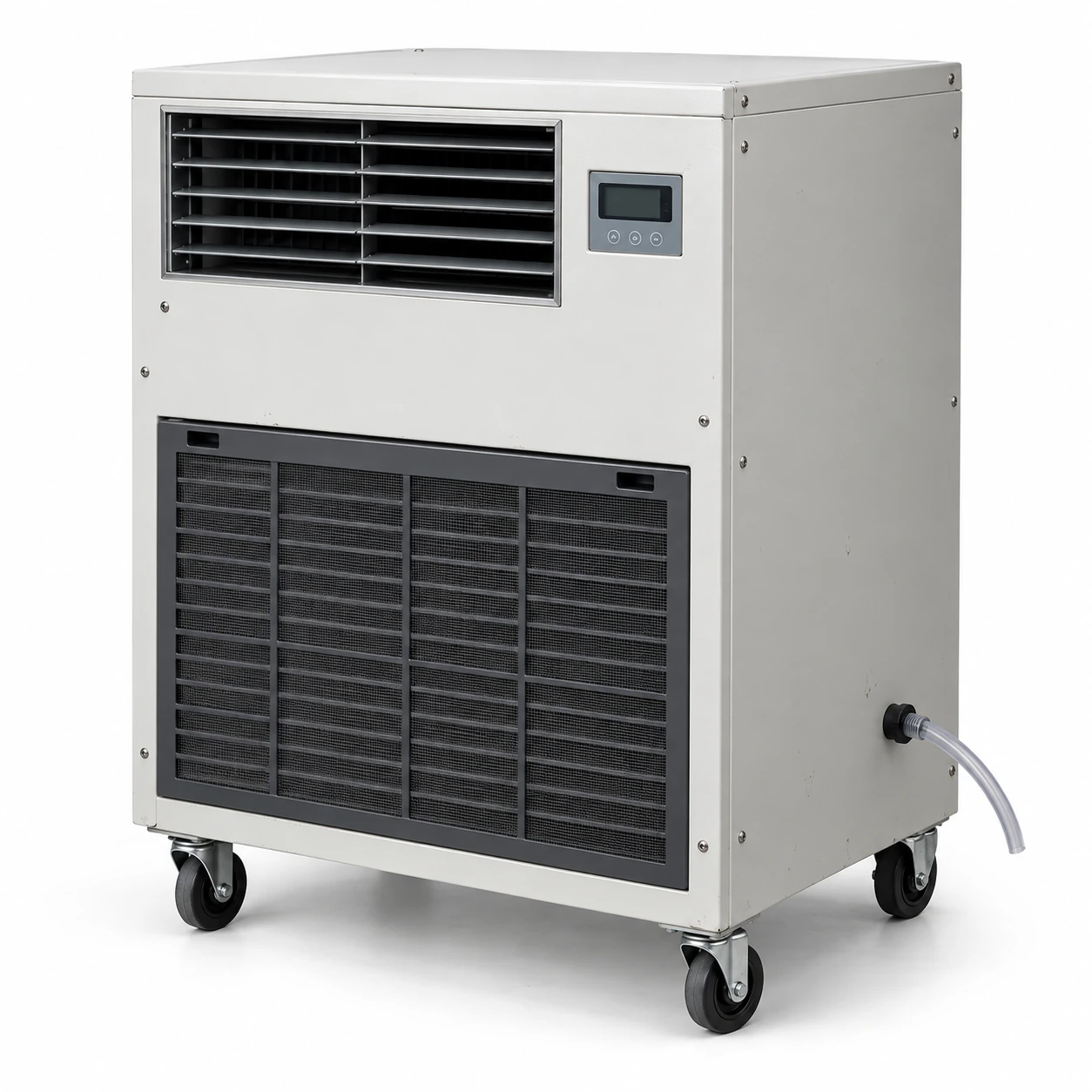
Refrigerant Dehumidifiers
refrigerant dehumidifier
| Brand | shengtongJH |
|---|---|
| Configuration | Mobile commercial cabinet; automatic humidity control |
| Nominal removal capacity | 90 or 138 L/day; compare at 30°C / 80% RH |
| External size, W × D × H (mm) | 90 L class: approximately 480 × 420 × 960; 138 L class: approximately 480 × 420 × 1060 |
| Input power | Approximately 1.3 / 1.5 kW, respectively |
| Air circulation | Approximately 1,100 / 1,300 m³/h, respectively |
| Power supply | 220–240 V, single-phase, 50 Hz; destination-specific supply options |
| Operating temperature | Common selection range 5–35°C; capacity reduces in cooler air |
| Construction & filter | Powder-coated steel cabinet; removable inlet filter |
| Controls & drainage | Humidistat, automatic defrost, compressor delay; continuous hose drain |
| Refrigerant | Factory-selected sealed circuit; type and charge specified for the supplied unit |
Capacity depends on inlet temperature and humidity. Cabinet dimensions and electrical data are confirmed together for the selected configuration in the quotation.
Capacity, cabinet arrangement, power supply, drainage and control options can be configured to suit your application and installation conditions.
A refrigerant dehumidifier removes water vapour by cooling circulating air until moisture condenses, then returning the air through a warm condenser. It is a practical option for enclosed spaces where damp air affects packaging, metal parts or stored materials, provided the room conditions suit condensation drying.
Moisture out, room air recirculated
Control the humidity around the goods you need to protect
In a storeroom, moisture can arrive with outside air, wet goods, recently washed floors or the building itself. A closed door alone does not remove the water already present. A refrigerant dehumidifier collects that moisture as liquid, allowing the room to dry without continually exchanging its air with humid outdoor air.
The result depends on the whole space. Repair a rainwater leak and limit unnecessary door opening before increasing machine size. Otherwise the equipment keeps treating a fresh moisture load while the underlying source remains. For moisture-sensitive stock, use a separate humidity sensor near the stored goods rather than judging conditions only from the display beside the machine.
What happens inside the cabinet?
Air reaches the cold coil
The fan moves room air through the inlet filter and across the evaporator. Moisture condenses when the coil is cold enough relative to the entering air's dew point.
Water leaves the air path
A collection tray directs liquid to a tank or drain. The outlet must remain clear; a machine with a blocked drain cannot provide dependable unattended drying.
Air returns to the room
The condenser reheats the treated air. A conventional self-contained unit adds heat to the room, so it should not be selected as a substitute for cooling equipment.
Compare performance at the conditions you actually have
A headline daily capacity measured in warm, very humid air will not be achieved continuously in a cooler room near its target humidity. Ask for performance at your expected inlet temperature and relative humidity. The moisture entering each hour, available operating time and desired recovery after doors open are more useful selection inputs than floor area alone.
A larger room with sealed doors and dry stock may be easier to control than a smaller washing area. For low-temperature storage or very dry process air, compare another dehumidification method instead of assuming that a larger compressor cabinet will solve the problem.
Make the airflow reach the damp area
Leave the intake and discharge clear of cartons and shelving. A discharge pointed straight back into the intake can produce a reassuring local reading while the far end of the room stays damp. Arrange circulation along accessible aisles and check conditions at more than one position.
Portable cabinets suit changing work areas. A fixed installation is more useful where permanent drainage and a defined air path are available. Ordinary free-blowing cabinets should not be connected to long ducts unless their fan has been selected for that resistance.
Keep routine care straightforward
Plan access to the filter, drain and service panel before choosing a tight corner. Inspect the filter as dust loading requires and clean it according to the supplied manual. Separate routine user cleaning from work on the sealed refrigerant circuit.
If water collection falls unexpectedly, compare room conditions and airflow first. The low-refrigerant troubleshooting page explains why reduced output alone does not establish a refrigerant fault.
Specify the purchase around the application
For a packaging store, describe the goods and door-opening pattern. For a production room, include moisture from washing or processing and any temperature restriction. shengtongJH can use that information to discuss equipment capacity, drainage and electrical arrangements as one purchasing scope. Where the load is larger or distributed across production zones, compare the industrial configuration.
Capacity, cabinet arrangement, power supply, drainage and control options can be configured to suit your application and installation conditions.