Refrigerant Dehumidifiers
dehumidifier low refrigerant
| Brand | shengtongJH |
|---|---|
| Equipment type | Compressor-based dehumidifier; low refrigerant describes a fault, not a model |
| Replacement capacity classes | 50 / 90 L/day at 30°C / 80% RH |
| External size, W × D × H (mm) | 50 L class: approximately 410 × 365 × 550; 90 L class: approximately 480 × 485 × 955 |
| Input power | Approximately 0.75 / 1.15 kW, respectively |
| Air circulation | Around 850 m³/h for these portable configurations |
| Power supply | 220–240 V, single-phase, 50 Hz |
| Operating envelope | 50 L class: 5–38°C; 90 L class: 8–35°C, depending on selected design |
| Drain & control | Hose drainage, humidistat, automatic defrost and delayed compressor restart |
| Service identification | Unit nameplate, refrigerant type, charge mass and fault history |
| Circuit work | Refrigerant-specific qualified service; no universal refill quantity |
The table describes replacement equipment choices, not the output of a machine with a refrigerant fault. The quotation confirms the selected unit's complete specification.
If replacement is appropriate, capacity, dimensions, drainage and power supply can be selected for your site and application requirements.
Low refrigerant can reduce a dehumidifier's ability to collect water, but an empty tank or frosted coil does not prove that the charge is low. Start with operating conditions and accessible checks, then use qualified refrigeration diagnosis if the problem remains. A sealed circuit does not normally need routine topping up.
Less water does not automatically mean a leak
Water collection falls naturally as the room becomes drier. It also falls when the inlet air is colder, the humidistat has reached its setting, or the machine is defrosting. Compare the present conditions with the conditions when the unit previously performed well. A bucket emptied yesterday and a bucket checked after a short cycle today are not a useful performance comparison.
If the room remains damp while collection has dropped, investigate further. Low charge is one possible cause alongside restricted airflow, compressor or control faults and a refrigeration restriction. A photograph of ice cannot separate these causes reliably.
Checks that help narrow the problem
The tank stays empty
First check whether water is leaving through a continuous drain. Confirm that the tank is seated correctly and that a full-tank switch or pump alarm has not stopped drying. Compare the humidity setting with an independent reading.
The coil repeatedly freezes
Look for a dirty user-serviceable filter or a blocked inlet. Check the room temperature against the operating range. Persistent icing after the stated defrost cycle needs service attention; it is not a reason to bypass the protection.
The fan runs but drying is weak
The compressor may be waiting through a restart delay, stopped by a control, or unable to run correctly. Note the indicator state and any error code. Running the fan does not establish that the refrigeration circuit is operating.
A confirmed circuit fault
Find the cause before adding refrigerant
Refrigerant circulates within a sealed system rather than being consumed during normal drying. If charge has been lost, replenishing it without resolving the leak can give only a temporary improvement. Previous incorrect servicing is another possibility. The technician needs the exact refrigerant and charge information for that unit, not a generic internet pressure value.
Qualified service should establish the fault, address the cause and verify operation using the manufacturer's procedure. Refrigerant types are not interchangeable. Some use flammable refrigerants, and all require appropriate handling. Do not pierce tubing, connect a charging kit or heat an iced coil to try to restore performance.
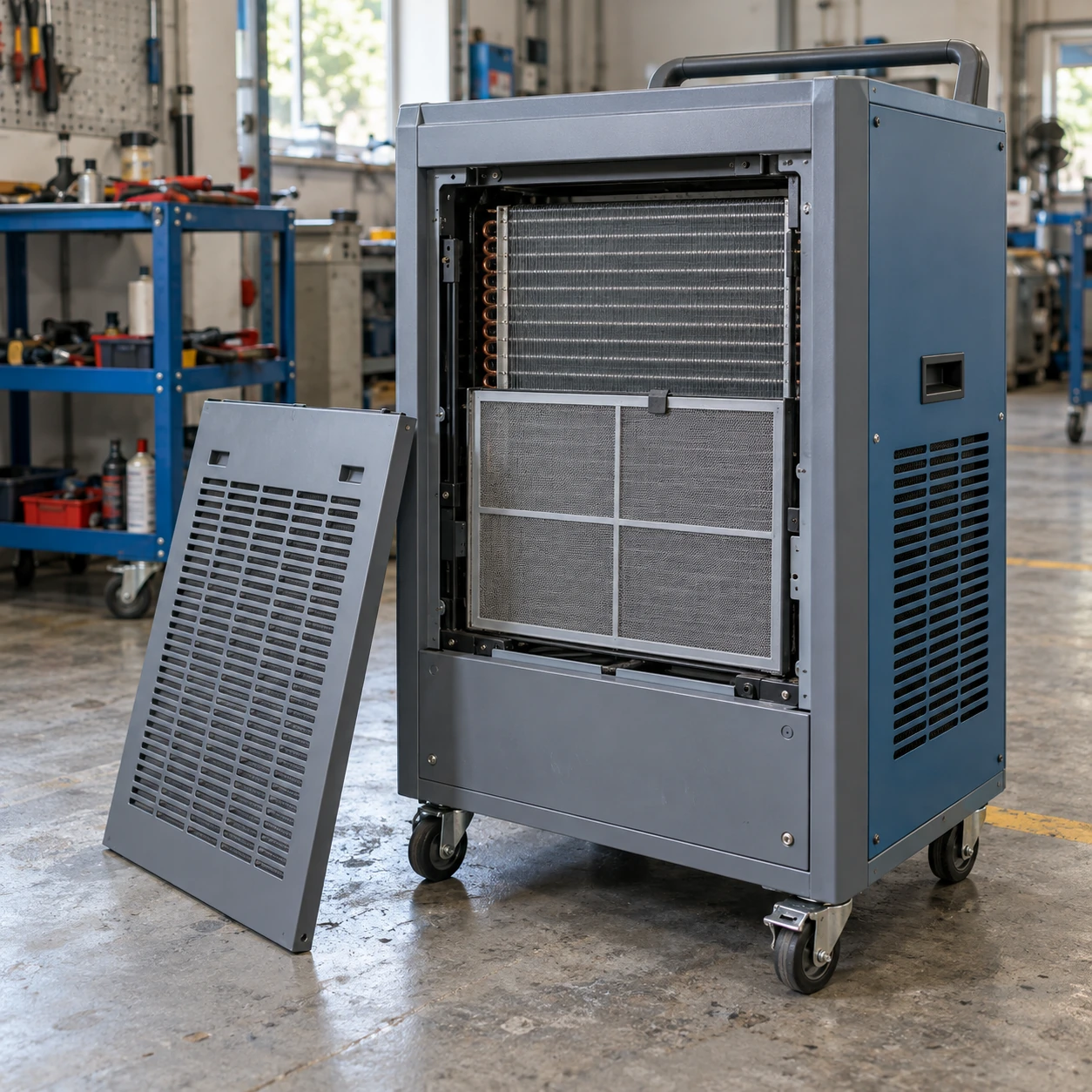
Switch off and isolate the unit before user-accessible filter work, following its manual. Keep covers fitted during operation. The open-panel image shows access for inspection, not a running arrangement.
When repair can make sense
A serviceable cabinet with an identifiable fault, available parts and a sound heat exchanger may justify repair. Compare the diagnosed repair scope, likely interruption and the condition of the compressor and coils. Check the existing warranty before arranging third-party circuit work.
Record whether the fault appeared suddenly or gradually, recent transport or servicing, room readings and drain behaviour. Those details help a technician investigate without treating every symptom as low charge.
When replacement deserves a comparison
Repeated leaks, extensive corrosion, unavailable parts or an unsuitable operating range can make replacement more practical. Choose the new unit around the current moisture load rather than automatically buying the same advertised capacity.
Allow for disposal or refrigerant recovery through an appropriate service provider. If operations cannot stop, assess a temporary drying arrangement separately; a damaged or electrically unsafe unit should not be kept running simply to avoid downtime.
Prepare a useful equipment enquiry
Send the nameplate details, room temperature and humidity, observed symptoms and any technician's findings. If you want to compare a replacement, add the available space, electrical supply and drain route. shengtongJH can discuss replacement sourcing options; remote symptoms alone cannot establish a refrigerant diagnosis. See refrigerant equipment configurations for drainage and installation choices.
If replacement is appropriate, capacity, dimensions, drainage and power supply can be selected for your site and application requirements.