Precision Tweezers
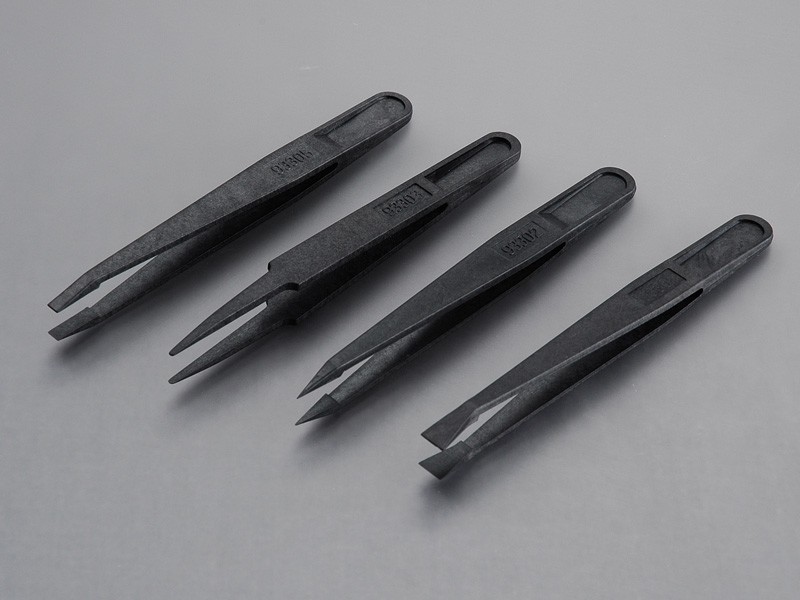
ESD Plastic Tweezers
| Product type | Molded plastic ESD tweezers |
|---|---|
| Body and tips | Black molded construction |
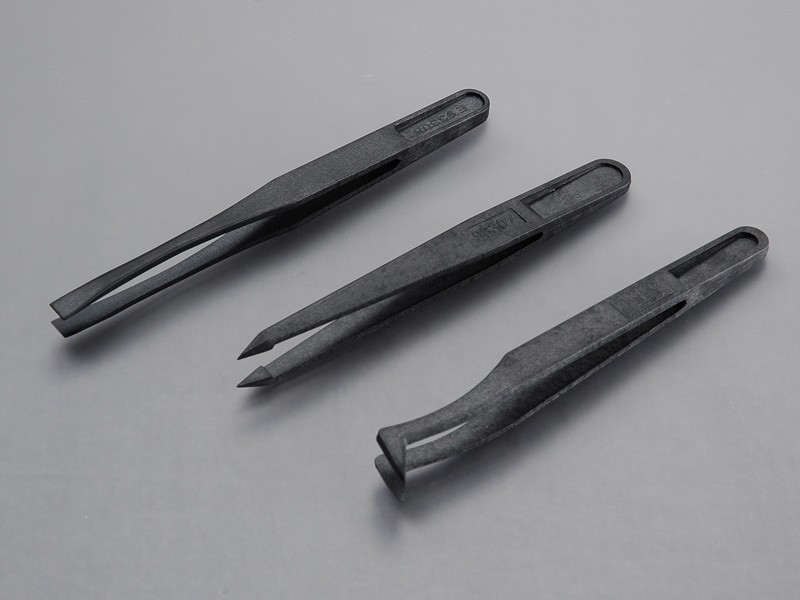
| Tip options shown | Pointed, flat and shaped contact ends |
| Grip | Manual flexible arms |
| Selection basis | Contact shape, material grade and ESD properties |
Black color alone does not establish electrical performance. Resin, resistance range, temperature limit and chemical compatibility must match the selected grade.
Plastic grade and tip geometry can be selected to suit your part and handling conditions.
These molded plastic tweezers offer an alternative contact material for handling small, easily marked components. Pointed, flat and shaped ends let the operator choose between access into a narrow gap and support across a wider contact face.
A different contact material for delicate surfaces
Molded plastic tips can be useful when a bare metal point would be too hard for the contact surface. The broader profiles shown also support small flat pieces without requiring the operator to pinch one tiny corner. This does not make the tool scratch-proof: trapped particles, a damaged tip or excessive pressure can still mark a part.
Choose a shape that holds the component in its natural lifting direction. A long narrow point improves access, while a wider contact face can stabilize an edge. Flexible arms also change how grip force builds as the tweezers close, so a trial with the actual part is more useful than choosing by appearance alone.
Electrical grade and process compatibility
For an ESD workstation
The selected plastic formulation must provide the electrical properties required by the handling process. Black pigment is not evidence of a resistance range. Establish the tool's acceptance test, contact method and cleaning condition alongside the bench's other ESD controls.
For heat and chemicals
Plastic formulations differ in stiffness, solvent response and temperature limits. Do not use an unspecified grade against a hot soldering surface or leave it soaking in solvent. Manufacturer guidance on plastic tips illustrates why the material grade needs to be selected for the process.
Keep the tip profile consistent
Inspect the molded contact ends for wear, bending and adhered material. A softened or rounded point may need greater squeezing force and can make placement less repeatable. Store tweezers with the tips protected from heavy tools, and replace a damaged pair instead of trimming its tips into a different shape.
Product views and details
Related products
Plastic grade and tip geometry can be selected to suit your part and handling conditions.