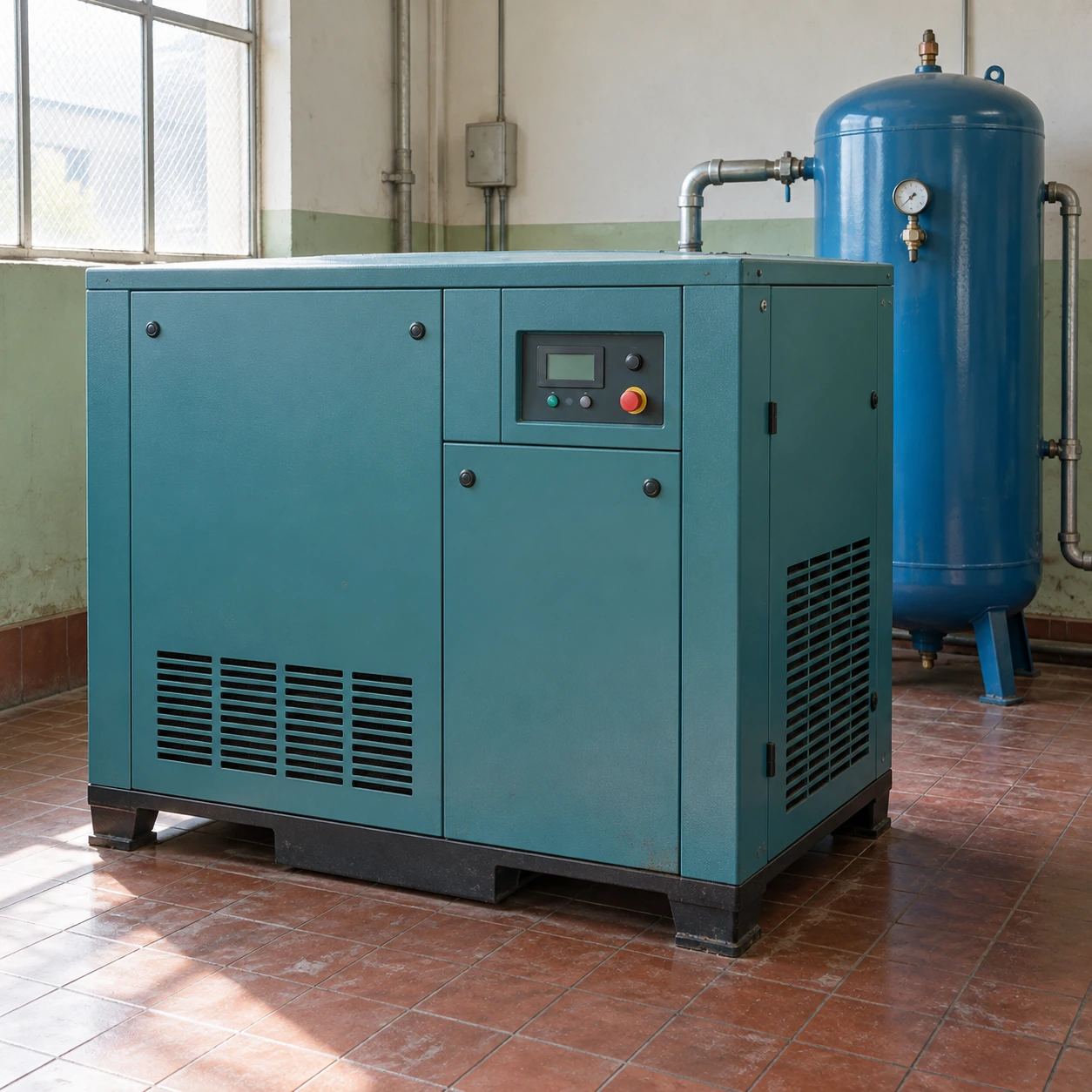
Oil-Free Air Compressors
oil free air compressor
| Compression options | Oil-free piston, scroll or dry rotary screw |
|---|---|
| Compact scroll power | 2.2, 3.7 or 5.5 kW; larger multi-element packages available |
| Pressure choices | 8 or 10 bar(g), matched to the selected compressor |
| Cabinet sizes W × D × H (mm) | 600 × 850 × 930; 600 × 640 × 895; 750 × 1020 × 1645 |
| Supply and controls | Single-phase compact piston or three-phase industrial package; start/stop, sequencing or suitable variable-speed control |
| Air treatment | Receiver, condensate separation, dryer and downstream filtration selected for the process |
| Capacity basis | Free air delivery at the specified pressure, supply frequency and inlet conditions |
Overall cabinet dimensions exclude separate receivers, dryers and service clearances. Package configuration and air-quality requirements are agreed with the quotation.
The compressor package, air treatment and connections can be customized for your operating conditions and application.
An oil free air compressor avoids injecting lubricant into the compression chamber. The right package combines that design with enough delivered air, suitable cooling and treatment matched to the equipment using the air.
Choose the compression method around the job
Intermittent local demand
A dry piston package can serve a test fixture, assembly tool or occasional maintenance task. Its receiver supports short bursts, while the pump refills between operations. Check the permitted run/rest cycle: a small receiver-mounted unit intended for intermittent work cannot be made continuous-duty by adding a larger tank.
Steady demand near a work area
A scroll package moves air through narrowing pockets between fixed and orbiting scrolls. Enclosed versions suit instrument areas and smaller production utilities where pulsation and operating sound matter. Multi-element packages bring additional elements on as demand rises, provided their controls and maintenance access suit the installation.
A central industrial supply
Dry screw equipment is appropriate when sustained demand justifies a larger package. The air circuit, cooling equipment, drive and controls must be selected together. Its gearbox or bearings may still require lubrication outside the compression chamber; “oil-free” does not mean that every component is lubricant-free or maintenance-free.
The outlet connects to a complete air system
Air leaving the compressor still carries moisture introduced at the intake. Cooling separates some of that moisture as liquid, and drains must remove it. A matched compressed air dryer then controls water vapour to a pressure dew point suited to the lowest pipe temperature and the process. A water separator alone cannot perform the job of a dryer.
Particles can enter through the intake or develop downstream through pipe corrosion and wear. Hydrocarbon vapour can also be present in the surroundings. Specify the required particle, water and total-oil limits at the point of use, then select treatment and verification for those limits. An oil-free compression mechanism alone is not evidence that a complete installed system meets ISO 8573-1 Class 0, produces sterile air or supplies breathing air.
For a laboratory instrument, start with its inlet specification. For industrial product contact, identify the material and quality risk. For pneumatic actuators, review valve, seal and lubrication requirements. These are different duties even when they share a pressure setting.
A receiver covers a short peak; it does not create flow
When several users open together, stored air can reduce the immediate pressure dip. If demand stays above compressor delivery, pressure will continue falling after the stored reserve is used. Select against free air delivery at working pressure, include dryer consumption and losses, and use the receiver to manage the remaining short-duration changes.
Place it where it can keep working
Give the cooling inlet a clean air supply and prevent hot exhaust from returning to it. Leave room to change filters and belts, inspect drains and remove service panels. A small cabinet footprint is useful only if routine maintenance remains possible without disconnecting adjacent equipment.
A receiver-mounted package simplifies a local installation. Separate equipment can be easier to replace or expand, but needs more connecting pipe, isolation points and floor space. Neither layout is automatically better: the service route and future demand decide the practical choice.
Set the supply scope before ordering
shengtongJH coordinates industrial equipment sourcing and package selection. A useful enquiry identifies operating pressure, simultaneous air demand, hours of use, available electricity and the required air quality. Include the location and expected ambient conditions so cooling and treatment are included from the start.
Compare small packages for individual workstations, or review two-stage compression for a larger continuous supply. The quoted assembly should clearly identify what is included and what the site provides.
The compressor package, air treatment and connections can be customized for your operating conditions and application.