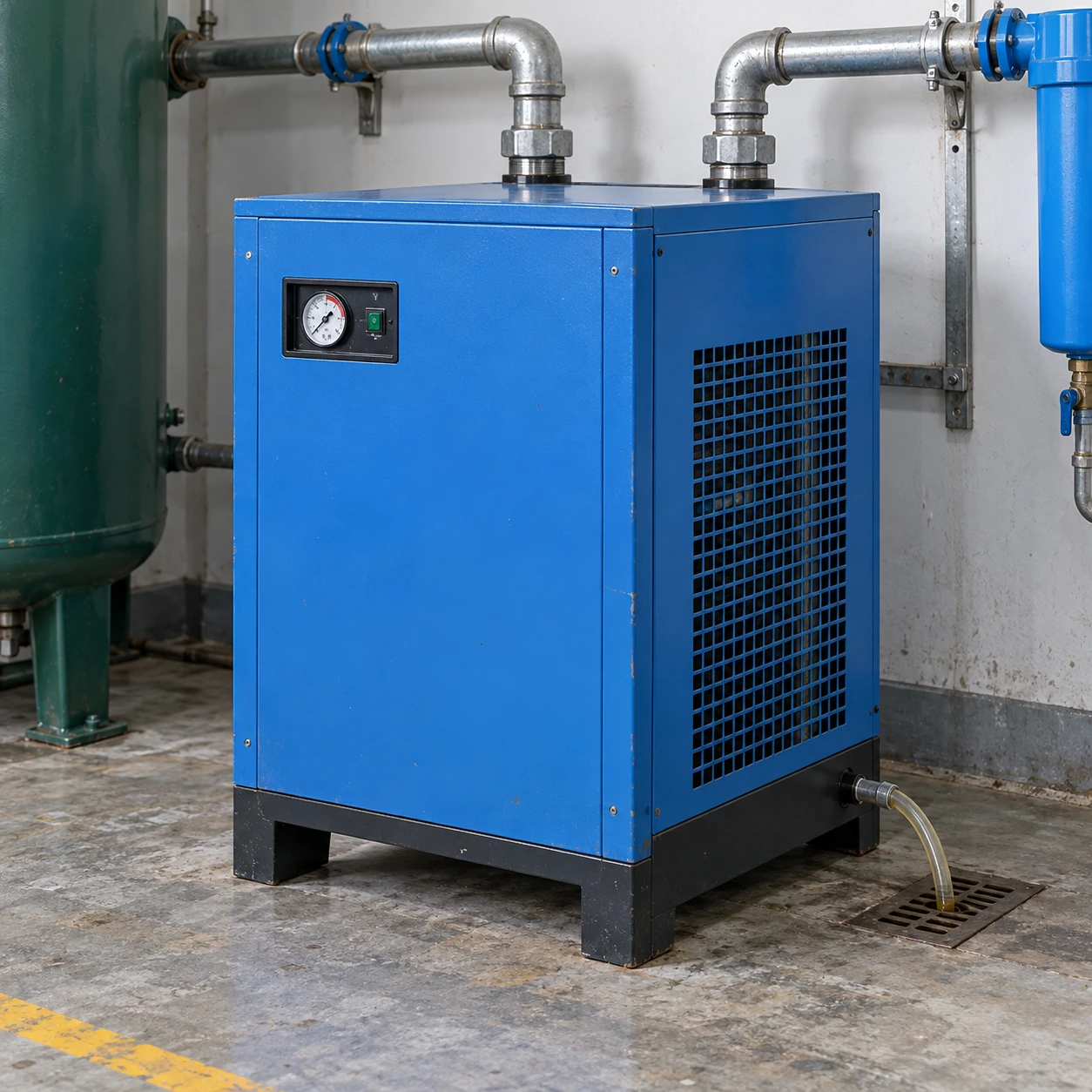
Compressed Air Dryers
compressed air dryer
| Drying method | Refrigerated, regenerative desiccant or point-of-use membrane |
|---|---|
| Refrigerated cabinet W × D × H (mm) | 630 × 484 × 779; 620 × 540 × 963; 764 × 660 × 1009 |
| Twin-tower assembly W × D × H (mm) | 675 × 450 × 1600; 905 × 650 × 1890 |
| Pressure dew point selection | +3°C refrigerated; −40°C desiccant, at the selected rating conditions |
| Flow selection | Correct inlet capacity and net delivered air for pressure, temperature and regeneration |
| Construction | Painted steel cabinet or pressure-vessel assembly; corrosion protection to suit location |
| Moisture removal | Automatic condensate drain for refrigeration; regeneration exhaust for adsorption |
| Package options | Inlet treatment, outlet filtration, dew-point monitoring and service isolation |
Dimensions describe equipment envelopes, excluding pipework and maintenance access. The selected configuration determines flow, operating limits and guaranteed pressure dew point.
Dryer configuration, filtration and installation interfaces can be tailored to your operating conditions.
Water in a compressed-air line can interrupt tools, damage pneumatic components and spoil a process even when the compressor itself runs normally. A dryer reduces water vapour before the air reaches colder pipework or moisture-sensitive equipment. The useful starting point is the air condition required at the outlet, followed by the operating conditions the dryer will actually see.
Follow the moisture to the point of use
Compression and subsequent cooling bring water out of humid intake air. An aftercooler and separator remove much of the resulting liquid, but water vapour continues through the line. A bowl filter that looks dry therefore does not prove that the air is dry enough.
The deciding limit is often the coldest pressurised pipe or the most sensitive process. Air that stays clear in a warm machine room can condense when it crosses a cold loading area. Define the required pressure dew point below the relevant temperature limit, with allowance for operating variation, rather than choosing a dryer solely because its connection fits the pipe.
Pressure dew point describes the temperature at which moisture would condense at the stated pressure. It is different from the temperature of the air leaving the dryer and from dew point measured after expansion to atmospheric pressure.
Match the method to the job
General indoor air services
A refrigerated dryer cools air, separates the condensed water and drains it. It is a practical choice where a positive pressure dew point meets the process and pipework requirements.
Colder or more demanding duties
A desiccant dryer adsorbs moisture onto a porous medium. Regeneration restores the medium, with a cost in compressed air, heat or both depending on the design.
A small dedicated branch
A membrane dryer can condition a limited flow near a machine. Its purge consumption and required inlet filtration belong in the selection, even when the module needs no electrical connection.
A capacity label needs its conditions
Hotter inlet air carries a greater moisture load. Lower operating pressure and a hotter room can also reduce the usable capacity of a selected dryer. Compare the highest expected flow at the lowest normal pressure and the worst credible inlet and ambient temperatures. Compressor motor power and pipe diameter cannot provide that information by themselves.
For a regenerating unit, distinguish air entering the dryer from dry air available to the process. A supply calculation that ignores regeneration can leave the machine short of air during its busiest cycle.
Complete the treatment path
Specify separators, filters, drains and monitoring as a connected package. Drying does not by itself remove every particle, oil aerosol or vapour, and a dry-air reading does not establish suitability for breathing, medical service or direct product contact. Those duties need their own complete air-quality requirements.
Compare the dryer technologies or review the system arrangement before sending operating conditions through the quotation form.
Dryer configuration, filtration and installation interfaces can be tailored to your operating conditions.