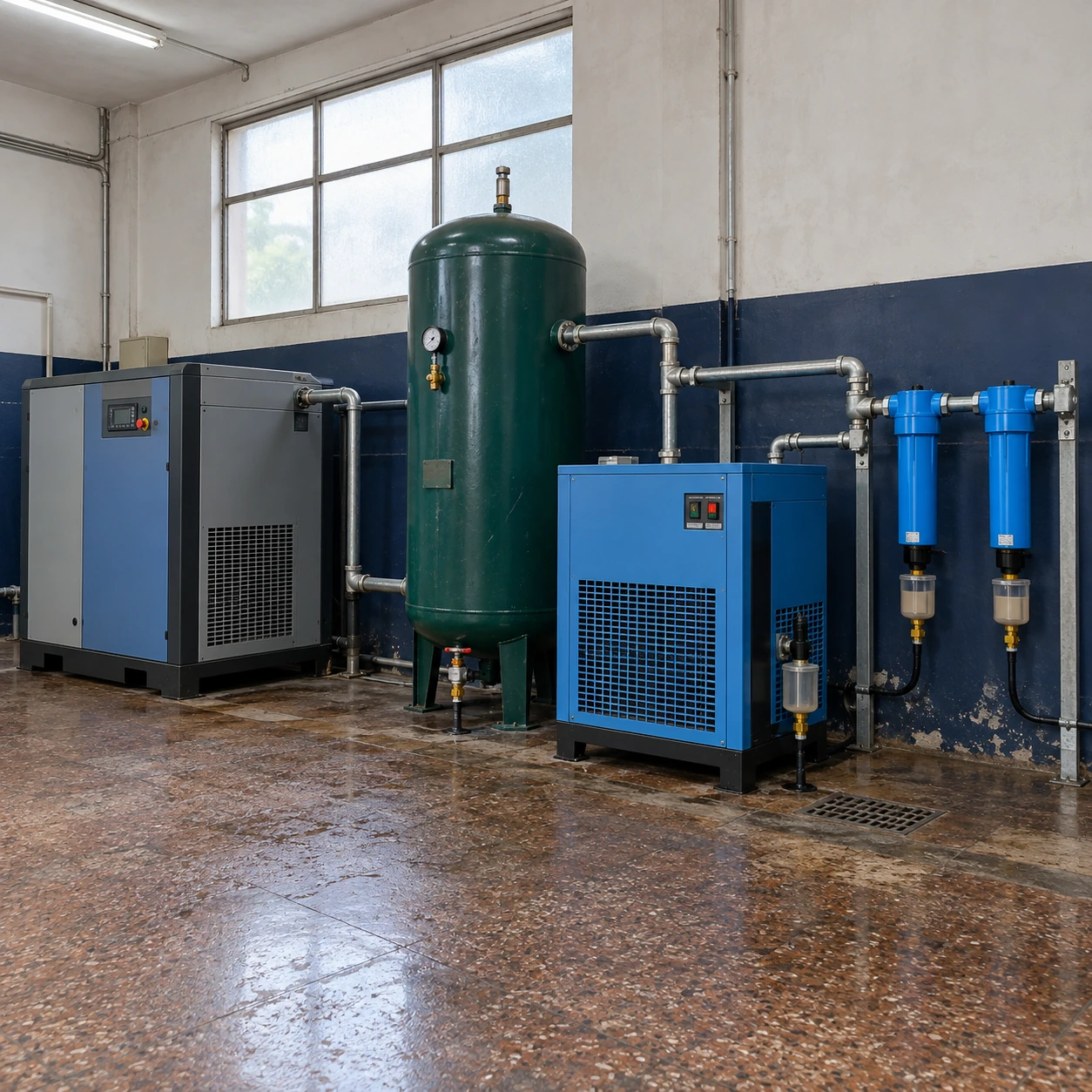
Compressed Air Dryers
compressed air dryer system
| Dryer arrangements | Refrigerated main supply; desiccant or membrane treatment for selected duties |
|---|---|
| Refrigerated cabinet W × D × H (mm) | 620 × 540 × 963; 764 × 660 × 1009 |
| Desiccant assembly W × D × H (mm) | 905 × 650 × 1890; 1190 × 750 × 2180 |
| Air storage | Receiver before or after drying, sized for its buffering and process role |
| Inlet treatment | Aftercooling, bulk-liquid separation and dryer-specific filtration |
| Outlet treatment | Particle filtration after adsorption; additional treatment to match the end use |
| Drainage and isolation | Accessible drains, rated isolation valves and managed maintenance connections |
| Monitoring scope | Pressure, temperature, differential pressure and outlet moisture measurement |
Sizes apply to the dryer equipment only. Receiver, filter, valve, pipework and service-space dimensions are established in the complete arrangement.
Dryer, receiver, filtration and control interfaces can be coordinated for your process layout and operating pattern.
A compressed air dryer system has to manage more than the dryer’s nominal throughput. It must deliver usable air during changing demand, remove water without sending it back into the line, and remain maintainable without an unnoticed loss of air quality. The position of each component affects the others.
Give the dryer the inlet it was selected for
Air leaving a compressor can be hot and moisture laden. Aftercooling reduces its temperature; a separator then removes bulk liquid. If either stage is ineffective, the dryer can receive a larger thermal or water load than its selection assumed.
The required filter sequence depends on the drying method and the compressor. A desiccant bed or membrane needs the specified protection from liquid and oil contamination. A refrigerated dryer also has inlet cleanliness requirements. Use the selected manufacturer’s arrangement, and include filter pressure loss when assessing available pressure at the machine.
Every water-removal stage needs a workable discharge path. Collecting condensate in a separator without draining it only relocates the problem temporarily.
The receiver has a job, not a universal position
Storage ahead of drying
An upstream receiver can cool and buffer air before treatment, with drainage for liquid that collects. During a sudden downstream demand, however, stored wet air still has to pass through the dryer. The peak flow through that dryer may exceed the compressor’s immediate output.
Storage after drying
A downstream receiver stores treated air for short peaks and can limit the immediate demand on the dryer. It needs to remain clean and suitable for the specified air quality. Receiver sizing, pressure-control strategy and the duration of the peak must be considered together.
Plan what happens during service
A maintenance bypass preserves a route for air but bypasses moisture treatment too. If the process cannot accept untreated air, continuity needs a correctly sized standby or parallel treatment path and a clear switching procedure. Isolating only the dryer while leaving shared filters or drains inaccessible may not provide the intended maintenance capability.
Use rated piping and valves, accessible isolation and provisions for safe depressurisation. Keep heavy pipe loads off the dryer connections and preserve the manufacturer’s ventilation and maintenance envelope.
Check air quality where it matters
- At the inlet: establish temperature, pressure and the expected flow pattern during busy operation, not just while the machines are idle.
- Across treatment: distinguish pressure loss through filters, the dryer and connecting pipework. A single distant gauge does not identify the restriction.
- At the process: measure moisture at the relevant pressure and location. A good dryer outlet result does not identify contamination introduced by downstream pipes or accessories.
Water, particles and oil are separate aspects of air quality. Special product-contact or breathing applications require an appropriate complete specification rather than acceptance based on a dryer label.
Define the package boundary before ordering
Identify which receiver, filters, drains, controls and installation connections are included, and who provides the remaining site work. For multiple branches, compare industrial continuity arrangements with local treatment at the most demanding users. A clear system enquiry avoids gaps between separately purchased components.
Dryer, receiver, filtration and control interfaces can be coordinated for your process layout and operating pattern.