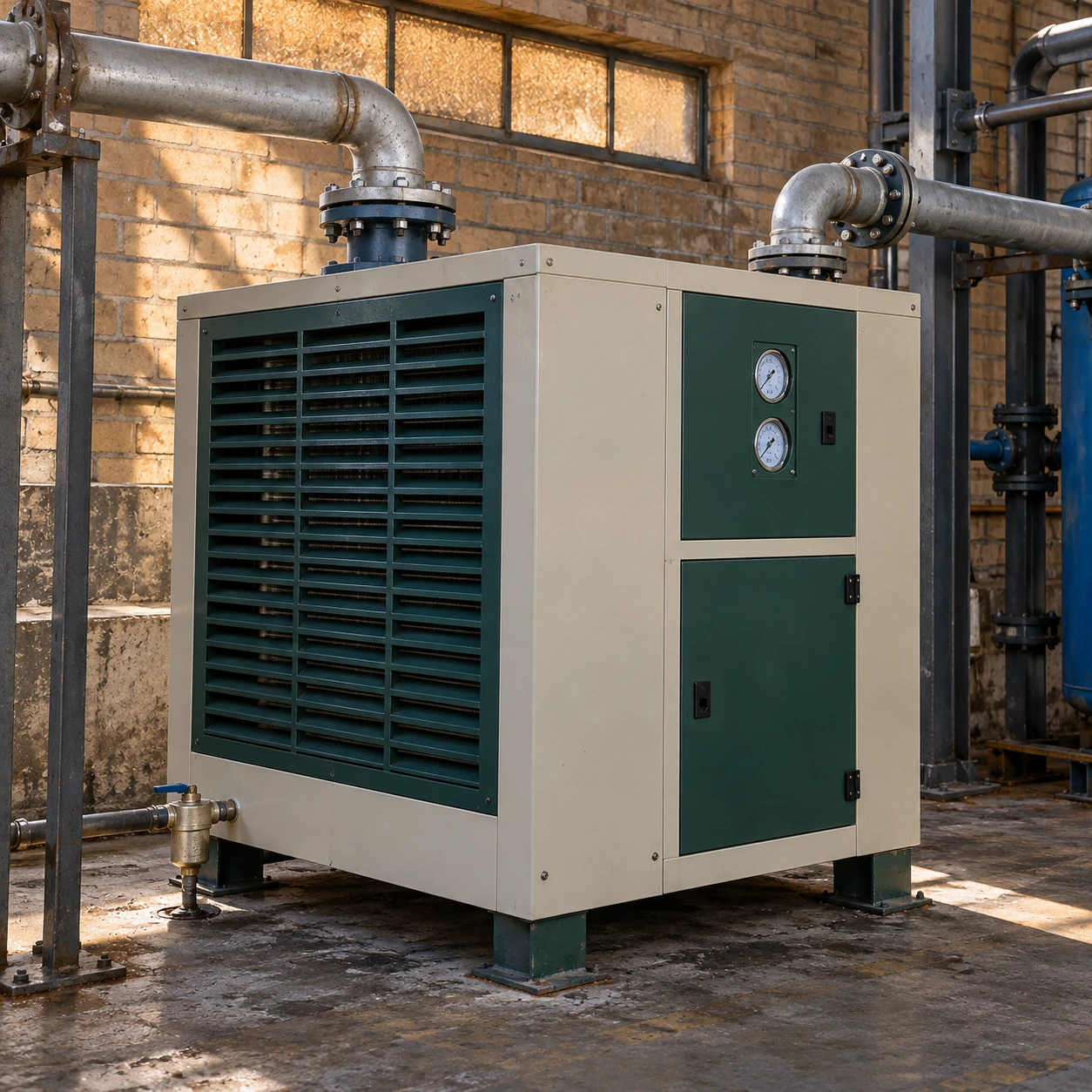
Compressed Air Dryers
industrial compressed air dryer
| Drying arrangement | Central refrigerated treatment; regenerative drying for specified subzero duties |
|---|---|
| Cabinet W × D × H (mm) | 555 × 625 × 975; 665 × 725 × 1105; 790 × 1000 × 1465 |
| Capacity selection | Maximum simultaneous demand corrected for minimum pressure and worst temperatures |
| Pressure dew point | Set by the most demanding connected duty or by separately treated branches |
| Connections | Threaded or flanged interfaces matched to pressure, flow and piping standard |
| Cooling | Air-cooled or selected water-cooled arrangement with defined utility requirements |
| Continuity options | Parallel duty, standby treatment and accessible isolation |
| Controls | Outlet moisture monitoring, differential-pressure indication and alarm contacts |
Dimensions identify cabinet envelope options, not equal-capacity units. Selected duty, supply voltage, cooling arrangement and full package footprint are documented together.
Industrial dryer capacity, redundancy and treatment interfaces can be configured for your production requirements.
An industrial compressed air dryer serves a changing network of production users. Its selection must account for simultaneous demand, environmental conditions and the consequences of a treatment interruption. A unit that covers the average flow can still become the limiting component when several machines cycle together.
Find the operating peak that reaches the dryer
List continuous users separately from short, high-flow events. Then consider where storage sits and how compressor controls respond. A dryer downstream of wet-air storage may see a rapid discharge from the receiver, while a dry-air receiver can support some peaks after treatment. The two arrangements create different duties for the same production equipment.
Use the lowest normal pressure and highest credible inlet temperature during these events. Selecting from a compressor’s installed motor power can miss both the flow pattern and the moisture load. Include agreed future users explicitly; an unexplained oversizing allowance can add cost without addressing a specific constraint.
Divide the air quality requirement intelligently
Shared plant services
General indoor pneumatic distribution may be adequately served by refrigerated drying. Size and monitor it for the actual common load, and preserve the drain and ventilation arrangements that keep it operating at that duty.
Critical or cold branches
An outdoor pipe run or a moisture-sensitive process may need a lower pressure dew point. A separate desiccant package can treat that branch without imposing its regeneration demand on every air user.
Document which outlets depend on which treatment stage. A central moisture alarm cannot confirm the condition after a separate branch dryer, and downstream hoses or equipment can introduce contamination after either stage.
Standby capacity must remain usable
A standby dryer is helpful only if the switching arrangement, filters, power and drains also support the required duty. Common isolation valves or inaccessible shared components can prevent maintenance even when a second cabinet is installed. Establish how the treatment path is restored and how acceptable moisture performance is confirmed before reconnecting the process.
Watch pressure loss
Separate the losses of filters, the dryer and the pipe network. Raising compressor pressure to overcome an unidentified restriction can increase energy use while leaving the underlying maintenance problem unresolved.
Watch the hot conditions
Condenser intake air can be hotter than the room’s general reading. Water-cooled equipment adds a cooling-water requirement that must remain available when production peaks.
Watch the moisture trend
Record pressure dew point under representative load. Trends and relevant alarms provide more useful evidence than a single reading immediately after an idle period.
Order the operating arrangement
The system package should identify treatment capacity, isolation boundaries, monitoring, maintenance space and responsibility for site utilities. Special air uses require separate particle, oil and any relevant biological requirements; a dry compressed-air line is not automatically suitable for direct product contact.
Industrial dryer capacity, redundancy and treatment interfaces can be configured for your production requirements.