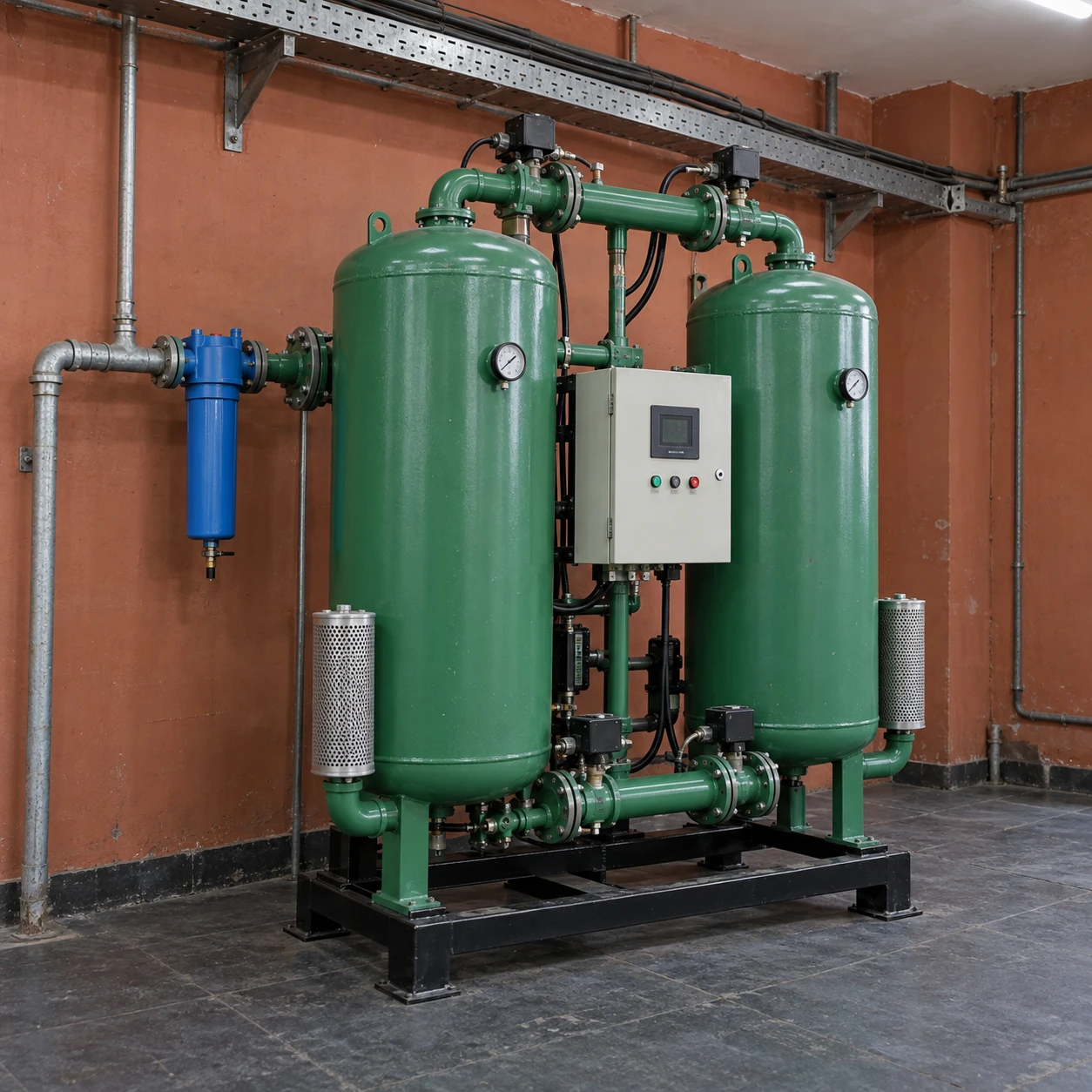
Compressed Air Dryers
regenerative desiccant compressed air dryer
| Regeneration choices | Heatless purge or a separately selected heated/blower-assisted arrangement |
|---|---|
| Twin-tower W × D × H (mm) | 675 × 450 × 1600; 905 × 650 × 1890; 1190 × 750 × 2180 |
| Nominal inlet-flow formats | 100, 300 or 550 m³/h for the corresponding listed heatless envelopes |
| Rating point | 7 bar(g), saturated 35°C inlet and −40°C pressure dew point |
| Flow reference | 20°C and 1 bar absolute; delivered air is lower after regeneration consumption |
| Controls supply | 230 V, 50/60 Hz; selected 115 V or 24 V DC versions |
| Filtration | Specified inlet coalescing treatment and outlet desiccant-dust filtration |
| Control options | Timed switching, selected dew-point demand control and relevant fault alarms |
These heatless configuration ratings do not transfer to a different regeneration design. Dimensions exclude connecting services and maintenance access; electrical control input does not represent total drying energy.
Regeneration method, filtration, controls and installation interfaces can be configured for your moisture requirement and air demand.
A regenerative desiccant compressed air dryer restores its drying medium while continuing to supply dry air. In a typical twin-tower arrangement, one bed adsorbs water vapour while the other is regenerated. Reliable performance depends on the complete cycle, including moisture removal, pressure recovery and switching.
Regeneration is part of the capacity calculation
The drying bed has a finite moisture capacity. Regeneration removes the accumulated water so the bed can return to service. If the incoming air becomes hotter, wetter or greater in volume than expected, the bed may reach its moisture limit before the intended changeover.
A heatless design diverts part of the dry compressed air through the regenerating bed at reduced pressure. That air is then exhausted with the removed moisture. The useful process supply is therefore less than the inlet flow. Compare quotations on net delivered air and the complete operating cycle rather than on the pressure-vessel size alone.
Adsorb
The active bed captures vapour from correctly prepared inlet air. Bulk liquid and oil should be controlled upstream according to the selected dryer’s requirements.
Regenerate
Purge, heat or an appropriate combined method releases water from the other bed. A restricted exhaust or defective switching component can prevent effective recovery.
Return to duty
The bed must be prepared for the next adsorption period, including the design’s cooling and repressurisation requirements. Correct sequencing limits disturbance to the air supply.
Compare heatless and heated systems honestly
Heatless regeneration has a comparatively direct arrangement but consumes compressed air. Heated and blower-assisted designs change the balance between electrical input, purge, cooling demand and cycle time. Their maintenance components and utility interfaces also differ.
A small control-panel wattage is not the total energy cost of a heatless dryer. The compressor supplies the energy used to make the purge air. Compare the total system demand over the expected load pattern.
Use moisture-based control where it fits
A fixed cycle switches at a set interval. Selected demand-controlled systems can respond to moisture loading, but sensor location, control logic and operating limits matter. Such control cannot compensate for an undersized bed, contaminated medium or unsuitable inlet conditions.
Confirm the required pressure dew point under the lowest operating pressure and highest inlet temperature. A lower target may require a different medium or configuration rather than a changed display setting.
Protect both the bed and the downstream process
Specify inlet coalescing filtration and dependable drainage. Provide the selected outlet filter to capture particles released from the drying medium. Differential-pressure information helps identify filter loading; it does not measure the remaining adsorption capacity of the bed.
Leave access to valves, silencers, filters and the media-service route. Maintenance requires appropriate isolation and depressurisation, and the process needs a defined treatment arrangement while the dryer is unavailable.
Provide the cycle conditions with the enquiry
State the required net outlet flow, pressure range, inlet temperature, moisture target, operating hours and available electrical supply. The quotation comparison should identify regeneration consumption and the included filters, controls and service provisions alongside the dryer.
Regeneration method, filtration, controls and installation interfaces can be configured for your moisture requirement and air demand.