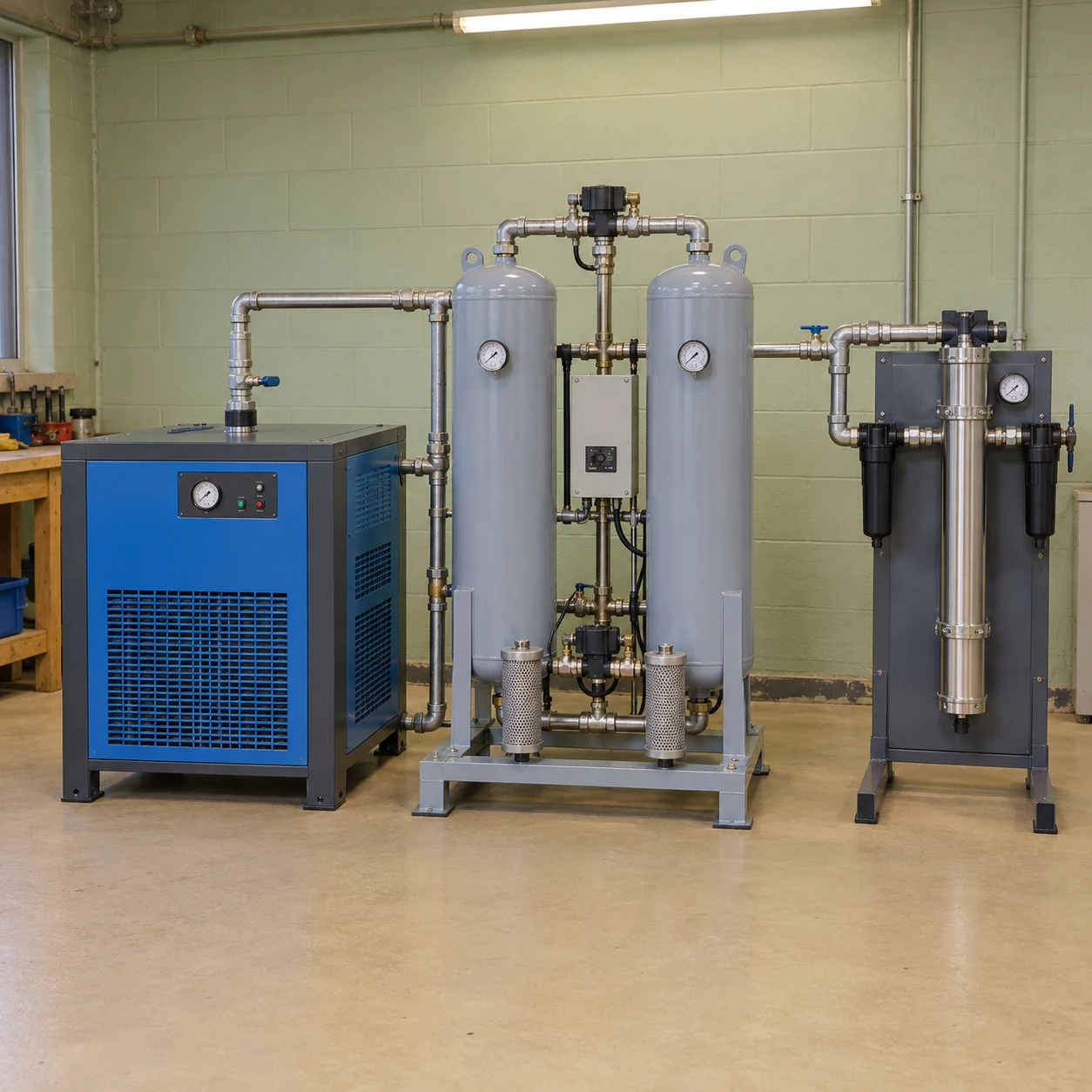
Compressed Air Dryers
compressed air dryer types
| Refrigerated cabinet W × D × H (mm) | 630 × 484 × 779; 620 × 540 × 963 |
|---|---|
| Twin-tower package W × D × H (mm) | 675 × 450 × 1600; 905 × 650 × 1890 |
| Membrane module height (mm) | 290.7; 349.8; 368, excluding the complete filter assembly |
| Moisture target | Positive pressure dew point or selected subzero pressure dew point |
| Regeneration arrangements | Heatless purge, heated regeneration or compressor-specific heat recovery |
| Point-of-use arrangement | Membrane module with required upstream filtration and purge allowance |
| Monitoring | Outlet pressure dew point, pressure loss and relevant operating alarms |
| Selection inputs | Net outlet flow, pressure range, inlet temperature, ambient conditions and duty cycle |
Dimensions describe equipment formats within their respective technologies; they do not establish equal capacity. The final selection couples size, ratings and treatment requirements.
The drying technology and supporting treatment package can be configured around your process and air supply.
The main compressed air dryer types solve the same moisture problem by different mechanisms. Refrigeration removes condensed water; desiccant holds vapour on a regenerable medium; a membrane transfers water vapour through selective fibres. The best fit depends on how dry the air must be, how much is used and what the surrounding system can support.
First decide how dry is dry enough
A positive pressure dew point can be sufficient for warm indoor pneumatic distribution. Exposed cold pipework, moisture-sensitive instruments or a stricter process specification may need a subzero pressure dew point. Specify the value at the pressure where it applies. Comparing an atmospheric dew point with a pressure dew point can lead to the wrong technology even when both brochures display the same temperature.
Refrigerated
Cooling turns part of the vapour into liquid, which a separator and drain remove. The dryer then commonly reheats the outgoing air through heat recovery.
Choose this route where its moisture level meets the duty. Allow for heat rejection, condenser cleaning and an effective condensate discharge. A bigger cabinet does not make a conventional refrigerated design a subzero dryer.
Desiccant
Porous drying material captures vapour. In a regenerative unit, another part of the cycle releases that moisture so the material can be reused.
This route can provide lower pressure dew points. It adds regeneration demand, switching components and a need to protect the medium from liquid water and oil contamination.
Membrane
Water vapour passes through selective hollow fibres and is carried away by a purge stream. A compact module can be useful close to a limited-flow air user.
Include the specified inlet filters and count purge air in compressor demand. A module with no electrical lead still has an operating energy cost through its compressed-air consumption.
Adsorption has more than one regeneration method
A heatless dryer uses part of the dried air at reduced pressure. A heated arrangement adds thermal energy and may reduce process-air consumption in part of its cycle. A blower-assisted arrangement brings another air-moving and heating system to maintain. Compare the complete regeneration and cooling cycle rather than one component’s power rating.
Heat-of-compression drying uses energy available from a compatible compressor arrangement. It is a system-specific choice, not an accessory that can be attached to every existing compressor. The compressor type, operating pattern and required dew point determine whether the approach is appropriate.
Two arrangements can coexist
A facility may refrigerate its main air supply while using a desiccant or membrane dryer for a smaller moisture-sensitive branch. This can avoid treating the entire site to the most demanding outlet specification. It also creates two maintenance and monitoring boundaries, so the branch dryer needs correct inlet conditions even when central treatment is operating.
Compare the complete duty
Put net delivered flow, moisture performance at worst conditions, pressure loss, regeneration consumption, electrical input and service access on the same comparison sheet. A system review makes these interfaces visible; a matched quotation should identify the selected technology and the equipment included around it.
The drying technology and supporting treatment package can be configured around your process and air supply.