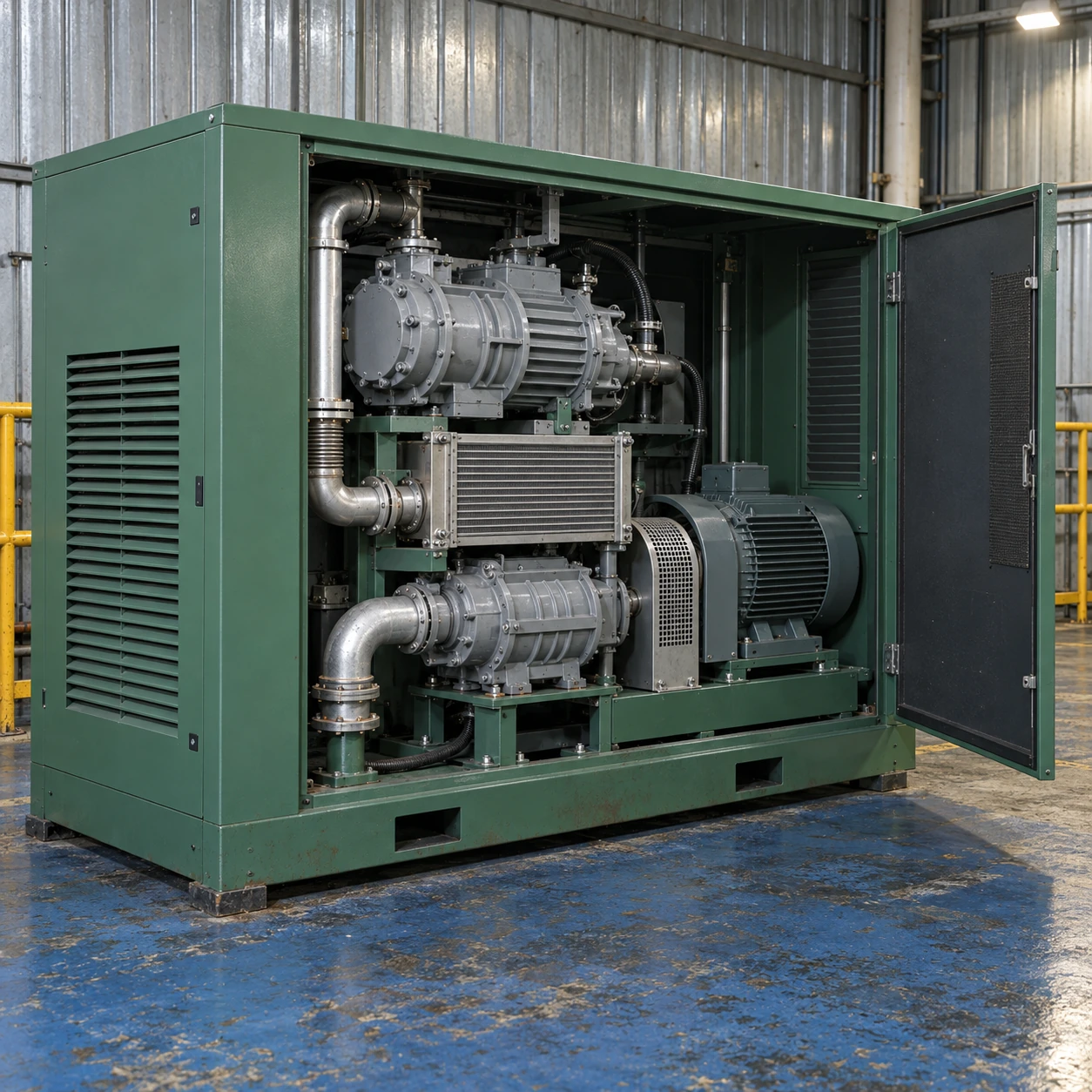
Oil-Free Air Compressors
2 stage oil free air compressor
| Compression arrangement | Two serial dry compression stages with intercooling; dry tooth or dry screw design |
|---|---|
| Compact rotary power options | 15, 22, 30, 37 and 45 kW classes; larger industrial screw packages by duty |
| Cabinet W × D × H (mm) | 1026 × 1760 × 1621; 1026 × 2005 × 1880; 1026 × 2440 × 1880 |
| Pressure variants | 7.5, 8.6 or 10 bar(g) packages, selected against required FAD |
| Cooling options | Air-cooled or water-cooled configuration, with interstage and final cooling |
| Drive and controls | Fixed speed or appropriate variable-speed drive; stage temperatures and protective functions |
| Treatment interfaces | Condensate separation/drainage plus process-matched downstream drying and filtration |
Overall cabinet dimensions vary by drive and cooling configuration. Separate treatment and maintenance space are additional; two independent parallel pumps are not two-stage compression.
The two-stage compressor, cooling, treatment and control arrangement can be customized to the required industrial duty.
A 2 stage oil free air compressor raises pressure through two compression stages in series, with cooling between them. The arrangement must be selected as a complete compressor package, including its controls, cooling and moisture management.
What the two stages actually do
The first stage takes in atmospheric air and raises it to an intermediate pressure. That air is cooled before entering the second stage, which raises it to the final discharge pressure. The intercooler limits the temperature entering the next stage and reduces the work compared with compressing the same air through an equivalent uncooled path.
The stage sizes, pressure ratio, cooling and control functions are designed together. This is why a two-stage package is more than two compressors joined by a pipe. Its performance must be assessed at the complete package outlet, including the losses and auxiliary power associated with the chosen design.
First compression stage
Accepts the inlet air and performs the initial pressure rise. Intake condition and restrictions affect what the package can deliver.
Interstage cooling
Removes heat before the next pressure rise. Where moisture condenses, the package's separation and drainage arrangement must remove it as designed.
Second compression stage
Raises the cooled air to final pressure, followed by the package's final cooling and downstream treatment appropriate to the use.
Two pumps do not necessarily mean two stages
Two scroll elements or two piston pumps can feed the same receiver in parallel to increase capacity or improve demand matching. Each may still compress from inlet to final pressure in one stage. Ask for the compression arrangement and air-path description instead of counting visible motors or cylinder heads.
Intercooling depends on the installation
For an air-cooled package, cooler performance relies on an adequate air supply and a clear path for heat to leave. For a water-cooled package, water conditions and flow must meet the selected equipment's requirements. Poor cooling can affect stage temperatures and operating reliability even when the compressor motor and pressure setting appear normal.
Keep access to cooling surfaces and drains. Dust accumulation or a drainage fault can interfere with the intended air path. Inspect and maintain these items according to the manufacturer's instructions; interstage settings and protective functions should not be altered simply to keep an abnormal machine running.
Oil-free refers to the compression air path. Some dry rotary packages use oil-lubricated gears and bearings outside that path, isolated by the machine's sealing arrangement. The service schedule therefore still needs to identify lubrication, seal, filter and cooling work for the actual design.
Judge efficiency over the working range
Two-stage compression can provide useful thermodynamic benefits, but the stage count alone is not an efficiency result. Compare total package input and delivered air at the same pressure and inlet conditions. Include part-load behaviour if production demand changes during the day.
Control strategy matters when several compressors share a main. Uncoordinated settings can leave machines unloading against each other or make one carry an unsuitable load. Define the station's sequencing and standby role before selecting the drive option.
Specify what happens after compression
Intercooling and aftercooling do not replace a dryer. The process still determines the required pressure dew point, particle control and total-oil limit. Treatment must be sized for the actual temperature, pressure and flow, with its pressure drop considered in the complete system.
Some packages support integrated treatment or heat-of-compression drying. Compatibility and delivered quality depend on the selected assembly and operating profile; an integrated option should be evaluated with its own performance conditions.
Order the complete duty
Give shengtongJH the required flow and pressure, expected running pattern, air-quality target, power supply and cooling conditions. The quotation can then identify the compression arrangement, package dimensions, service requirements and equipment interfaces as one coherent scope.
Review air-cooled installation when evaluating ventilation, or the 450 hp industrial package page when the duty requires a larger central supply.
The two-stage compressor, cooling, treatment and control arrangement can be customized to the required industrial duty.