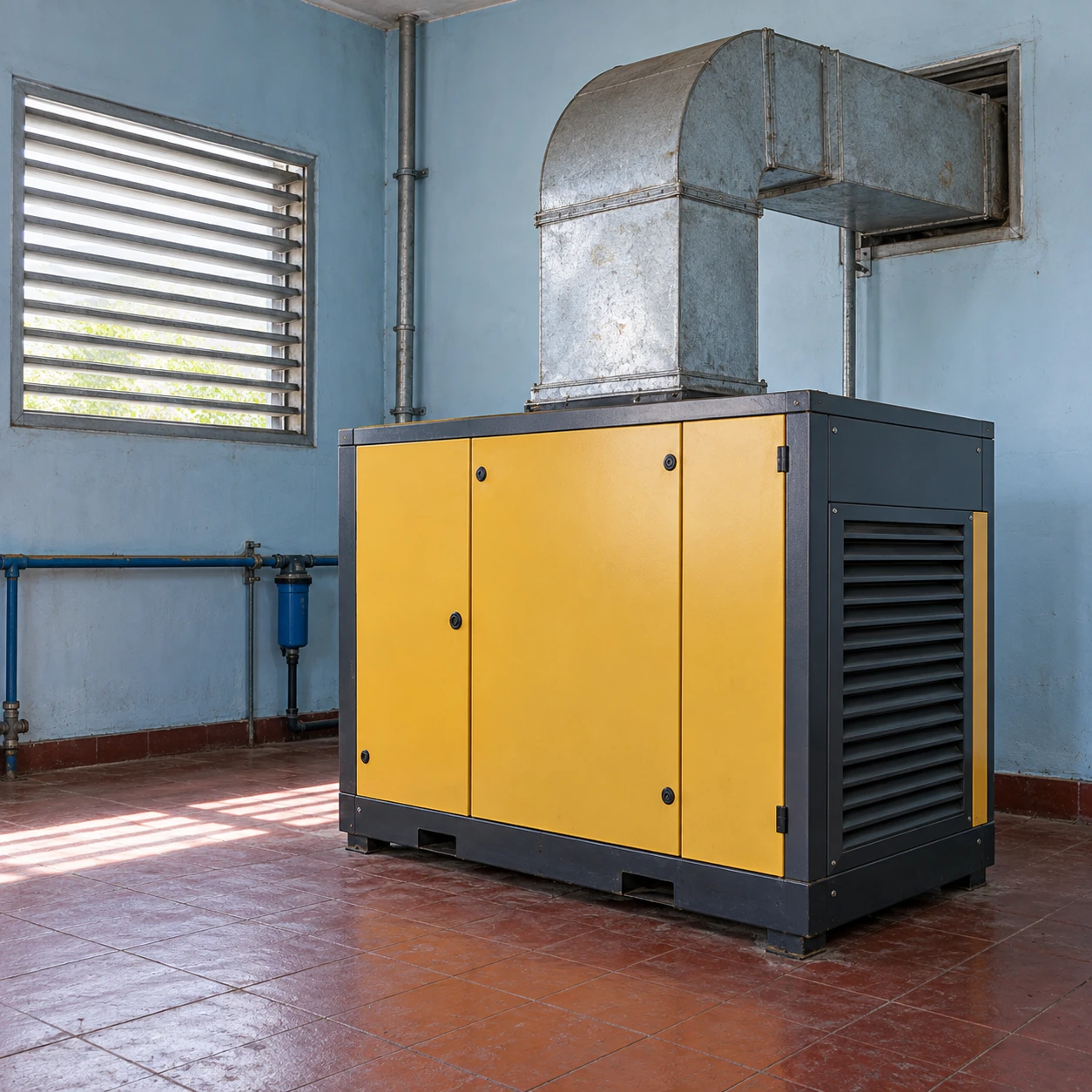
Oil-Free Air Compressors
air cooled oil free air compressor
| Compression choices | Air-cooled scroll, two-stage dry tooth or dry screw |
|---|---|
| Rotary package selections | 15, 22, 30, 37 or 45 kW classes; larger duties selected separately |
| Rotary cabinet W × D × H (mm) | 1026 × 1760 × 1621; 1026 × 2005 × 1880 |
| Pressure options | 7.5, 8.6 or 10 bar(g) rated package variants |
| Cooling interface | Package cooling fan, clean make-up air and permitted exhaust-duct resistance |
| Compressed-air treatment | Aftercooling, condensate drainage, selected dryer and filters |
| Controls | Temperature protection and operating alarms; control method matched to load |
| Site selection inputs | Maximum intake temperature, altitude, dust exposure, room layout and heat discharge route |
Cabinet sizes are overall package dimensions; ductwork and access are additional. Rated capacity and ambient limits must be selected for the actual site conditions.
The air-cooled package, duct interface, treatment and controls can be customized to your installation and operating environment.
An air cooled oil free air compressor rejects heat through its cooling airflow instead of relying on a site cooling-water circuit. The machine and the room must be planned together so hot exhaust does not return to the intake.
Follow the heat from intake to discharge
- Bring suitable air to the machine. The cooling inlet needs enough clean make-up air. Keep it away from exhaust discharge, process fumes and locations where dust will quickly load the cooler.
- Move that air through the package. Fans and cooling surfaces are designed as a system. Cabinet panels, louvres and internal seals help direct the flow; operating with a panel missing can disturb that route.
- Carry heated air away. Exhaust should leave the room or reach an approved heat-recovery route without being drawn straight back into the compressor.
- Keep the route serviceable. Leave access to clean cooler fins and inspect fan operation. Ducting should not trap a removable panel or prevent future component replacement.
The compressed-air intake and the cooling-air supply are different functions, even when both draw from the same room. Good room design supports both without assuming that a single small wall opening is sufficient.
Size for the warm operating period
The temperature entering the compressor matters more than the outdoor weather report. Other equipment, solar gain and recirculated exhaust can make an enclosed utility room much warmer. Select the package using the expected intake temperature and obtain its heat rejection, required airflow and permissible duct resistance.
A long duct, tight bend, louvre or added silencer increases resistance. It may require a different duct design or an engineered auxiliary fan arrangement. Simply attaching a duct of convenient size can reduce cooling flow and cause temperature trips.
Control the cold operating period
In colder climates, continuous outdoor-air ventilation can cool idle equipment and drains below their permitted conditions. Heat recirculation or recovery needs controlled dampers and an appropriate operating sequence. It should not cause hot-air recirculation when full cooling is needed.
Drain lines and treatment equipment have their own temperature limits. Review the compressor, receiver and dryer together rather than protecting only the main cabinet.
Air-cooled does not mean moisture-free
An aftercooler lowers compressed-air temperature so some water can be separated and drained. It does not remove all water vapour. The dryer must handle the resulting inlet temperature and flow at the worst intended conditions, with a pressure dew point appropriate to the downstream pipework and process.
Common symptoms point to different causes
| Observed issue | What to investigate |
|---|---|
| Temperature trips during a warm shift | Intake temperature, exhaust recirculation, blocked cooling surfaces and restricted ductwork. |
| Higher outlet temperature after room changes | New equipment heat, obstructed make-up air, changed exhaust routes or altered fan operation. |
| Water reaching downstream users | Condensate drains, aftercooler condition, dryer operating limits and distribution temperature. |
| Noise increases after duct installation | Fan operating condition, vibration transmission and duct resonance, with the approved cooling design retained. |
Use the equipment manual and qualified service support to investigate an abnormal condition. Changing protection settings to keep an overheating machine running does not solve the cooling problem.
When air cooling is the practical choice
Air cooling avoids a dedicated cooling-water connection and can suit sites with a workable ventilation route. It still requires space and a suitable way to reject heat. Where the air route is severely constrained, water cooling may deserve comparison, including water availability, quality and the cost of that circuit.
shengtongJH can coordinate the compressor and interface requirements with your installation information. For larger central duties, the 450 hp oil free air compressor page covers the broader plant utilities and standby questions.
The air-cooled package, duct interface, treatment and controls can be customized to your installation and operating environment.