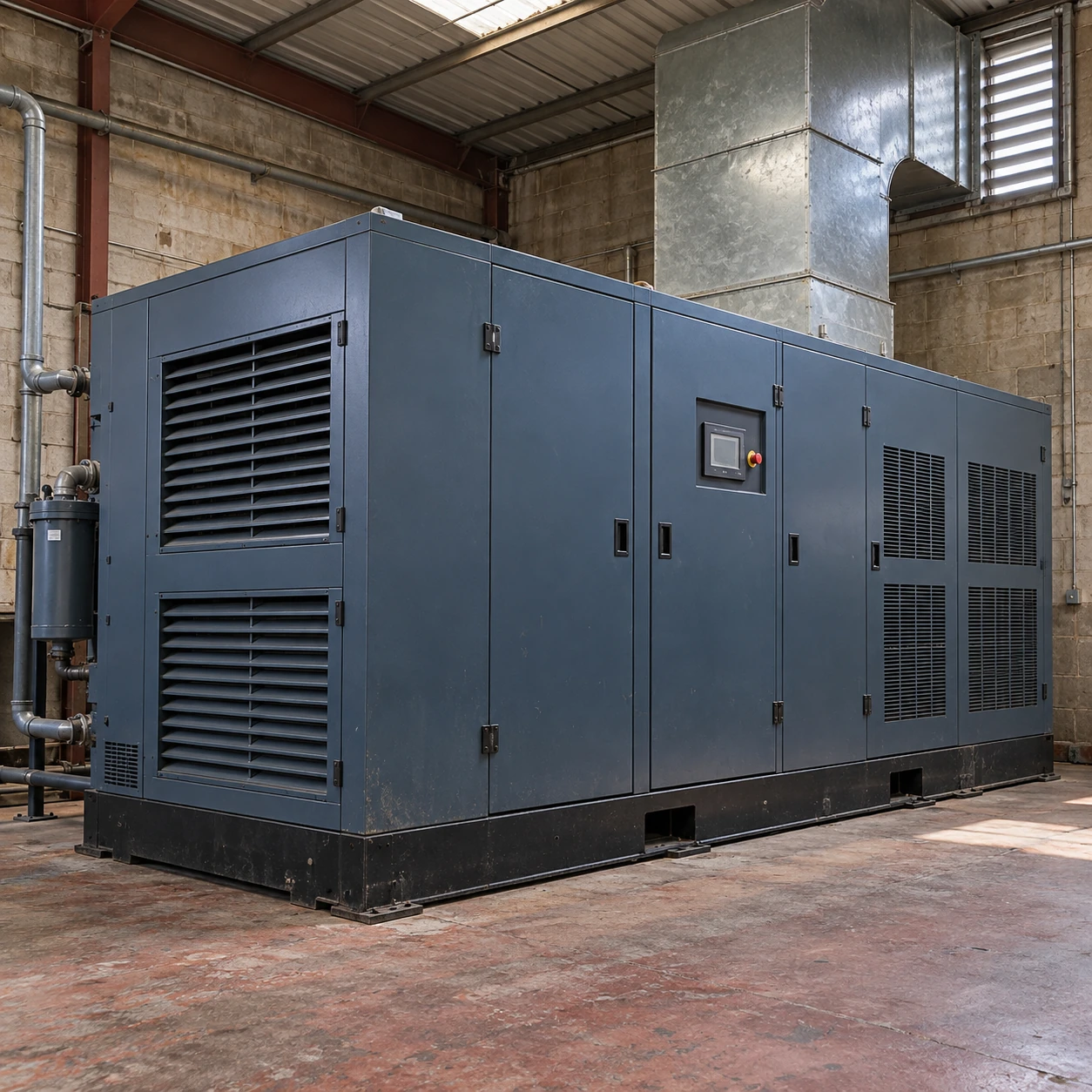
Oil-Free Air Compressors
450 hp oil free air compressor
| Duty class | 450 hp industrial oil-free rotary screw requirement; exact motor rating and frequency specified in the offer |
|---|---|
| Compression and control | Two-stage dry compression; fixed-speed or suitable variable-speed package |
| Cooling choices | Air-cooled or water-cooled assembly |
| Package W × D × H (mm) | Air-cooled format approximately 3860 × 2080 × 2740; water-cooled format approximately 3660 × 2080 × 2240 |
| Integrated-dryer format (mm) | Air-cooled package approximately 4620 × 2080 × 2740, W × D × H |
| Pressure / output | Select rated FAD at the required discharge pressure; compare part-load performance separately |
| Site interfaces | Three-phase power, cooling-air duct or cooling-water circuit, drains, controls and air-main connection |
| Treatment and storage | Separate or integrated dryer, filtration and receiver sized for the process and load profile |
Rounded overall package envelopes vary with the selected manufacturer and cooling/dryer arrangement. They exclude maintenance space, external pipework and lifting clearance.
The industrial compressor package, cooling arrangement, treatment and control interfaces can be customized to the site's air demand and operating conditions.
A 450 hp oil free air compressor is a central plant utility package. Selection depends on the required air delivery and operating profile, with cooling, electrical infrastructure and service access planned as part of the installation.
Horsepower identifies a size class, not air delivery
A mechanical horsepower converts to about 0.746 kW, so the requested rating is roughly 336 kW of mechanical power. That conversion does not establish a standard catalogue motor, total electrical input or delivered airflow. Catalogue families may group different nominal ratings by market and frequency. The offer must state the actual motor nameplate rating, package input and capacity at the required pressure.
Establish the plant demand before selecting the machine
Log demand over representative production periods, including low-load shifts, start-up peaks and shutdowns. A large compressor can be efficient when serving a suitable sustained load, yet poorly matched when it spends long periods unloaded or below its controllable range. The current installed horsepower is not a reliable substitute for this load record.
Compare free air delivery and total package power on the same basis. State pressure, inlet conditions, frequency and whether cooling fans or other auxiliaries are included. A variable-speed option needs a performance curve across the useful range; its maximum output alone does not describe operation on a quiet night shift.
If a small part of the process needs a higher pressure, consider whether it should have a separate solution rather than raising pressure throughout the plant. Pressure losses through treatment and distribution should be addressed with the layout and component sizing, not hidden by continually increasing the compressor setting.
Cooling is a site utility
An air-cooled machine rejects substantial heat into its cooling airstream. The installation needs a clean intake route, an exhaust path that avoids recirculation, and duct resistance within the selected package's allowance. Ordinary room ventilation selected without the compressor's heat and airflow data may be inadequate.
A water-cooled arrangement exchanges that large air-side duty for a defined cooling-water requirement. Review water temperature, flow, quality, pressure loss and available capacity during the site's worst operating conditions. Water cooling does not remove all room ventilation needs.
Electrical and mechanical interfaces need early review
Confirm supply voltage, frequency, starting method, protection and the electrical capacity available to the complete package. Cable and switchgear design belongs with a qualified site electrical engineer using the selected manufacturer's data.
Check access from delivery vehicle to foundation, lifting arrangements, floor loading and space for major service. A machine that fits inside the room may still be impossible to maintain if a cooler or motor cannot be withdrawn. Use the approved general arrangement for construction and installation.
Plan failure and low-load operation as well as full output
One large machine can simplify the station, but stopping it may remove a large part of the site's supply. Compare the practical consequences with multiple coordinated machines and an appropriate standby arrangement. Standby capacity should reflect the air demand that must continue, rather than a vague promise of uninterrupted production.
A receiver buffers changes and provides useful control storage. It does not replace sustained compressor capacity. A dryer and filters also need to support the required flow and quality across operating conditions, including summer inlet temperatures and any temporary standby source.
For product-contact air, define the acceptance location and contamination limits. Oil-free compression reduces one source of oil; it does not establish the quality of old pipework or remove the need for appropriate water and particle control.
Prepare a complete industrial enquiry
Provide the load profile, required pressure, process air-quality specification, electrical service, ambient conditions and cooling-water information if available. Include site access restrictions and the intended operating/standby philosophy. These details allow equipment and installation responsibilities to be priced coherently.
shengtongJH coordinates sourcing for the defined package. The supply offer identifies the selected assembly, motor rating and agreed performance conditions. Review air-cooled installation requirements and two-stage compression when developing the scope.
The industrial compressor package, cooling arrangement, treatment and control interfaces can be customized to the site's air demand and operating conditions.