Oil-Free Air Compressors
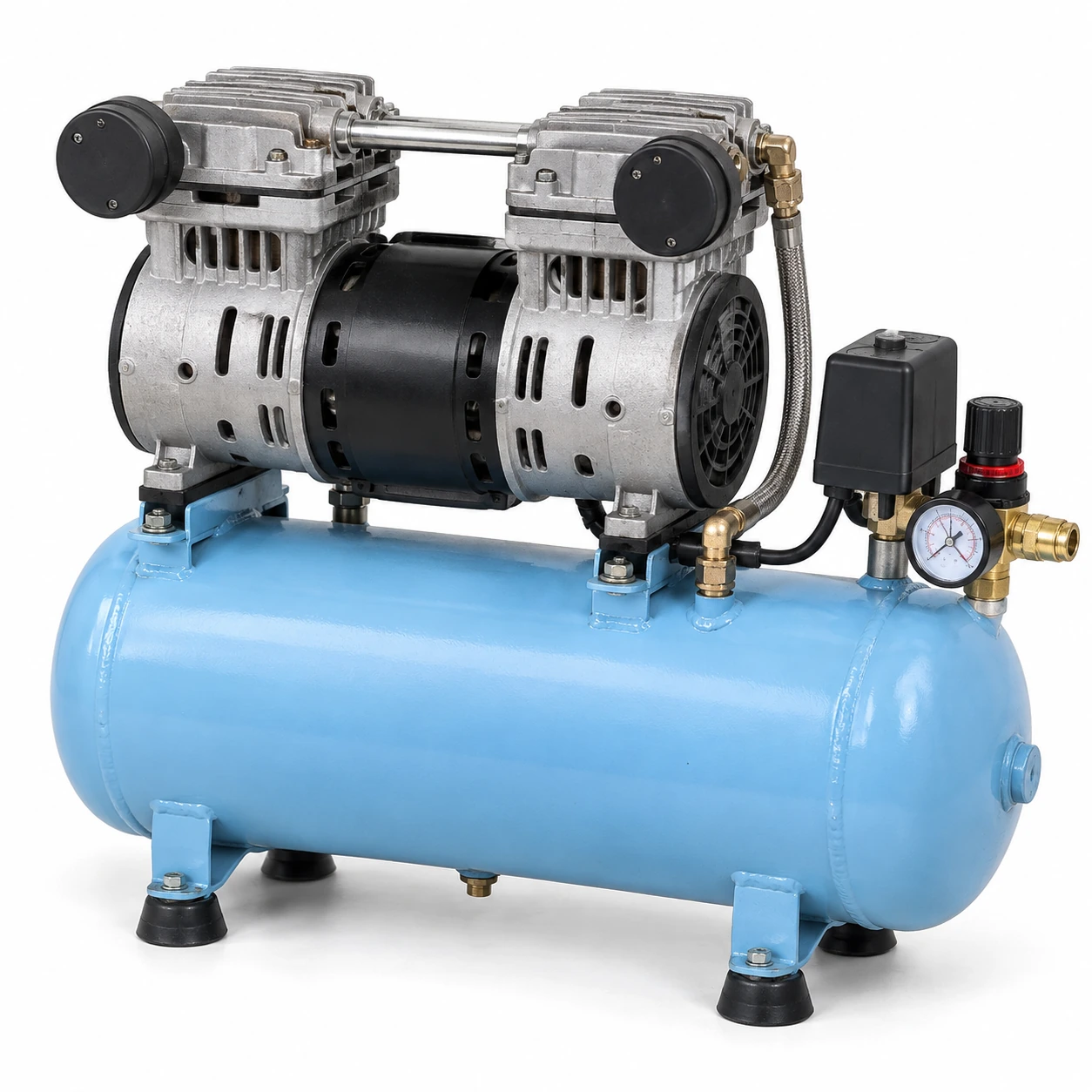
small oil free air compressor
| Compact designs | Dry piston receiver package or enclosed scroll cabinet |
|---|---|
| Power choices | 0.55 kW piston; 1.5 or 2.2 kW compact scroll formats |
| Receiver options | 4 L compact receiver or 20 L cabinet-integrated format; separate buffer storage where required |
| Overall W × D × H (mm) | 405 × 375 × 335 compact piston; 453 × 682 × 895 enclosed scroll |
| Pressure selection | Up to 9 bar(g) piston or 8 bar(g) scroll configurations; regulate to the application |
| Capacity basis | Delivered flow at operating pressure, including any dryer purge or other air consumption |
| Installation | Level support, accessible drain, cooling clearance and suitable electrical supply |
Overall dimensions refer to the compressor package. External treatment, hoses and service access need additional space; the selected unit's duty rating governs run time.
The compact compressor, storage and air-treatment arrangement can be customized to your instrument or industrial workstation.
A small oil free air compressor can supply a single instrument or workstation without a long connection to the central air network. Compact size is valuable when the package still meets the user's flow, quality and operating-hour requirements.
Start with the device using the air
A small actuator may use little air on average but need a brief, rapid fill. An analyser may require a modest but uninterrupted flow. A cleaning nozzle can consume more than either while it is open. Treat these as different duties instead of choosing a compressor from the tool count or available floor space alone.
Obtain the equipment's required pressure and consumption in a clear unit, then identify how many users run together. Free air delivery describes the useful compressor output under stated conditions. Intake displacement and a maximum-pressure label do not establish how much air reaches the equipment during operation.
Storage helps a burst
When a valve opens briefly, a receiver can supply stored air while the compressor catches up. The usable reserve depends on receiver volume and the allowed pressure change, not simply the fact that a tank is fitted. A narrow permitted pressure band leaves less useful storage.
The compressor must refill that reserve during the available recovery period. If operating cycles become more frequent, a previously adequate small unit may begin running too long or lose pressure. Check the new duty rather than raising the cut-out setting beyond the equipment's rating.
Continuous demand needs continuous capability
Some compact piston packages are explicitly rated for intermittent service; other small industrial designs are intended for longer running. Read the rating for the actual assembly, including its ambient conditions. Receiver size cannot turn an intermittent machine into a continuously rated one.
A scroll cabinet may be a better fit for steady demand, but it still needs sufficient cooling and a realistic minimum-to-maximum load match. There is no benefit in replacing a small overheated machine with a larger one inside the same sealed space.
Choose how the package occupies the workstation
Open receiver-mounted unit
Offers direct access to gauges, connections and the pump. It can suit a service area where exposed hot parts, sound and the surrounding work are properly managed. It should not be placed where dust or loose material blocks its cooling.
Enclosed cabinet
Organises the compressor and controls within a defined footprint and can reduce sound. Allow room for its doors and cooling outlets; pushing the cabinet against a wall may remove the access that makes it serviceable.
Separate local supply
Putting the compressor outside a sensitive workstation can improve working space and reduce disturbance. The connecting line then needs adequate bore, drainage considerations and protection against damage.
Under a bench is an installation condition
Check heat removal, drain access, electrical isolation and the clearance needed to remove service parts. The external cabinet dimensions alone cannot establish whether an under-bench position is suitable. Keep the manufacturer's intake and exhaust paths open and avoid transferring vibration into the work surface.
Allow space for the required air quality
A compact compressor is only part of an instrument supply. A dryer, regulator and filters may occupy meaningful additional space and consume some pressure or air. Select them for the instrument's inlet requirement and the actual environment rather than assuming that “oil-free” means dry, particle-free or sterile.
shengtongJH can coordinate a compact package around the equipment specification and installation envelope. If the unit must move between jobs, compare portable packages; if operators sit nearby, consider the installation questions on the quiet compressor page.
The compact compressor, storage and air-treatment arrangement can be customized to your instrument or industrial workstation.