Oil-Free Air Compressors
quiet oil free air compressor
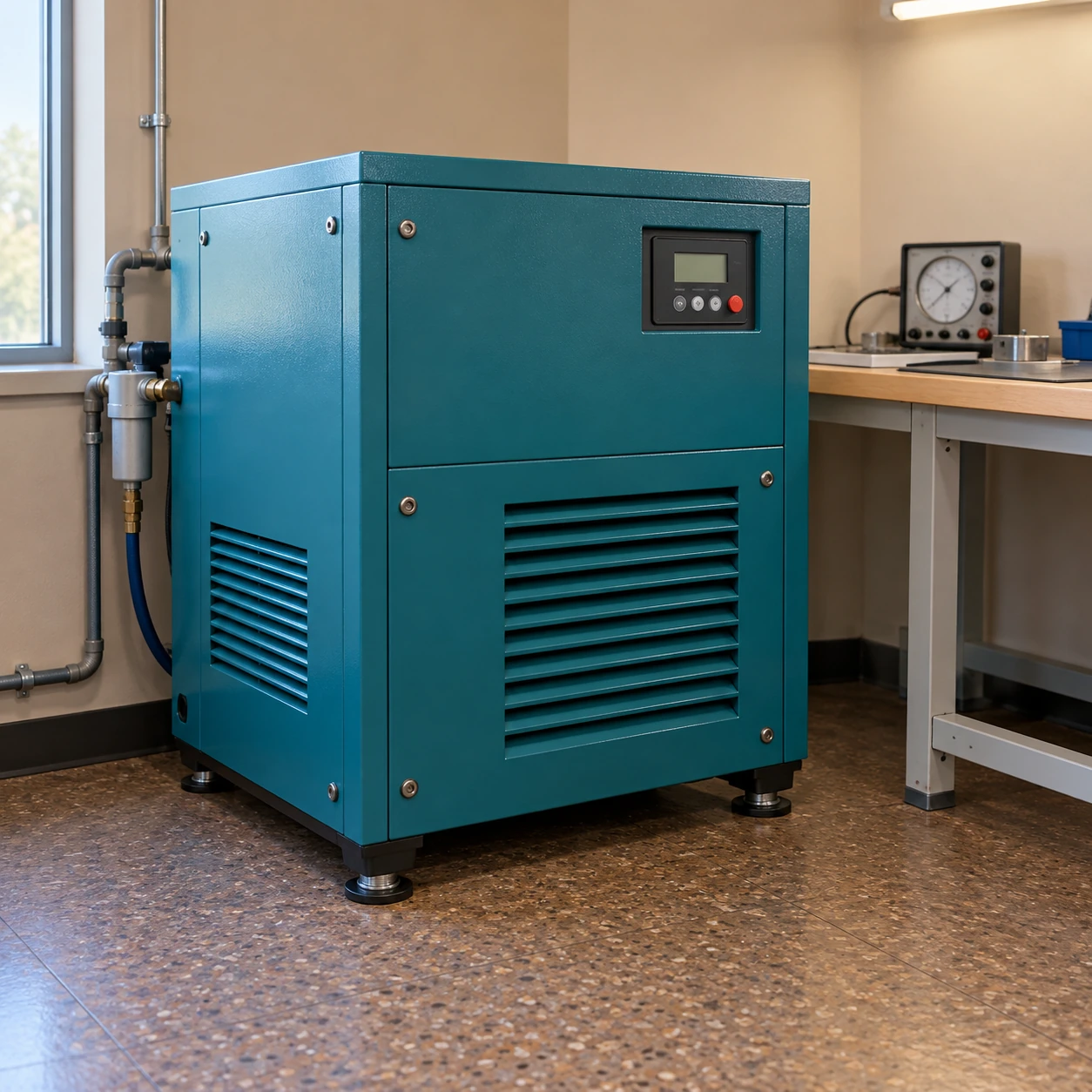
| Package options | Acoustic-enclosed oil-free piston or scroll compressor |
|---|---|
| Compact power options | 1.5, 2.2 or 3.7 kW; multi-scroll packages for higher demand |
| Cabinet W × D × H (mm) | 453 × 682 × 895; 600 × 640 × 895; 750 × 1020 × 1645 |
| Pressure choices | 8 or 10 bar(g) scroll configurations, according to duty |
| Acoustic selection | Declared A-weighted sound pressure with distance, load and test method |
| Vibration and cooling | Isolation mounts, suitable flexible connection and unrestricted cabinet airflow |
| Receiver and control | Internal or separate receiver; start/stop or staged element control |
| Air quality | Dryer and filtration selected independently of acoustic enclosure |
Noise data must relate to the selected package and its test conditions. Cabinet dimensions exclude required ventilation and maintenance clearances.
The compressor enclosure, receiver, controls and installation connections can be customized for your work area's air demand and noise requirements.
A quiet oil free air compressor is selected for the people and equipment around it. The useful result is an acceptable sound environment during real operation, with sufficient air delivery and cooling.
Reduce noise at the machine and along its path
The pump, motor, intake and cooling fan all contribute to the sound of a compressor. An acoustic enclosure can reduce airborne noise, while suitable mounts and connections can limit vibration transmitted into the building. The room then changes what workers hear: hard walls, nearby corners and lightweight partitions can make a modest machine more intrusive.
A scroll package is often considered for point-of-use duties because its compression process avoids the repeated intake and discharge events of a piston. That does not make every scroll package quieter than every piston package. Motor size, cooling fan, cabinet design, load and measurement conditions still decide the comparison.
Compare like-for-like sound data
A number in dB(A) needs a description. Sound pressure measured close to the machine cannot be compared directly with a value taken farther away. Sound power describes a different quantity again. Request the measurement distance, load condition, method and whether the dryer or other accessories were operating. Keep these conditions with the value in the purchase specification.
An enclosure needs breathing space
Closing every opening may reduce a direct sound path while causing overheating. A proper acoustic package manages intake and exhaust airflow through designed routes. Do not add loose foam, block louvres or place the cabinet inside an unventilated cupboard to improve a noise complaint.
Where ducting or an additional acoustic screen is considered, preserve the manufacturer's permitted cooling-air resistance and service access. The heat still needs a route out of the room, even when the machine sounds unobtrusive.
Duty changes the listening experience
A quiet machine that runs almost all the time may be more noticeable than one with a suitable reserve and controlled operating cycle. Conversely, frequent starts and stop events can be disturbing beside precision work. Select delivery, receiver volume and control together so noise reduction does not rely on operating outside the rated duty.
For multiple scroll elements, examine the sound and capacity when more than one element operates. A low figure for a small single element does not describe the whole package at peak demand.
Match the response to the complaint
Airborne hum or intake noise
Review the compressor location, enclosure and intake silencer. A nearby room with a suitable air connection may be more effective than repeatedly adding material around an unsuitable open-frame machine.
Vibration at a bench or floor
Check mounting, rigid pipe bridges and contact with walls. Flexible connections and suitable isolation must be selected for the equipment; a randomly soft pad can allow excessive movement.
Sharp events or a new rattle
Drains, unloading, loose panels and worn parts require different remedies. A change in sound can be a maintenance clue. Inspect the cause instead of covering it with extra insulation.
Describe where quietness matters
For an instrument room, identify the distance to the operator and any vibration-sensitive equipment. In a production area, consider nearby workers, shift duration and other machines. If a workplace noise assessment is required, a catalogue rating alone cannot substitute for that assessment.
shengtongJH can coordinate a package around flow, quality and installation requirements, with acoustic data requested for the selected assembly. If the purchase specification uses the word “silent”, review silent oil free air compressor to translate that term into measurable acceptance conditions.
The compressor enclosure, receiver, controls and installation connections can be customized for your work area's air demand and noise requirements.