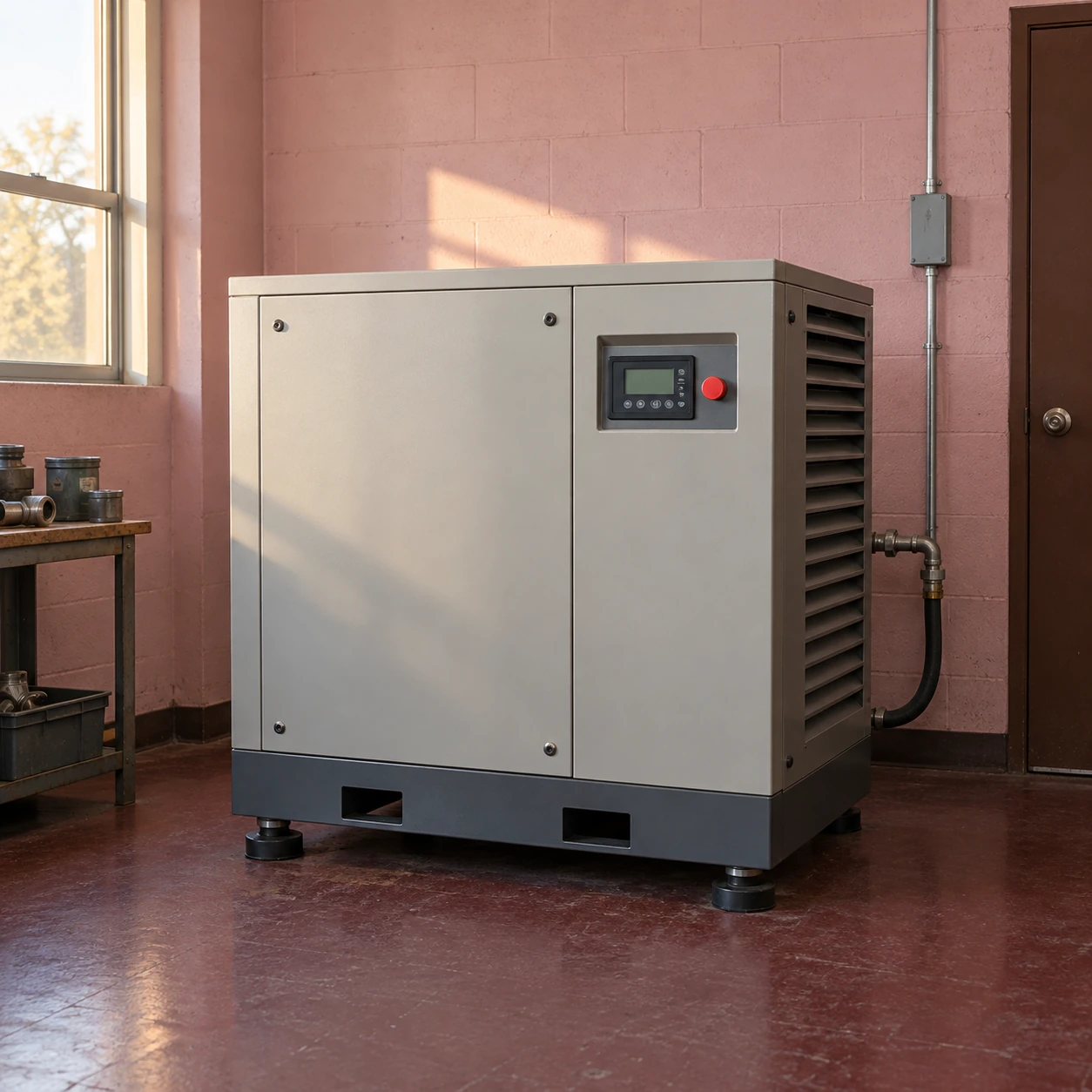
Oil-Free Air Compressors
silent oil free air compressor
| Equipment options | Enclosed oil-free piston or scroll package |
|---|---|
| Compact power selection | 1.5 or 2.2 kW scroll; other duties matched to the required delivery |
| Cabinet W × D × H (mm) | 453 × 682 × 895; 600 × 640 × 895; 750 × 1020 × 1645 |
| Pressure options | 8 or 10 bar(g), subject to selected package |
| Sound requirement | A-weighted sound pressure with stated distance, operating load, accessories and test method |
| Acoustic features | Designed enclosure, intake attenuation and suitable isolation; cooling openings retained |
| Control and treatment | Demand control, receiver, dryer and drains assessed as part of the operating package |
There is no universal zero-noise rating attached to the word silent. Agree the selected package's sound data and any site acceptance conditions with the order.
The low-noise package and its installation interfaces can be customized for your industrial work area and acoustic requirements.
A silent oil free air compressor is a low-noise equipment choice, not a machine that produces no sound. A useful purchase specification describes the operating sound and the installation conditions that matter to the workplace.
Specify the sound that is acceptable
“Silent” is often used to describe an enclosed or low-speed compressor. The motor, compression element and cooling fan still produce sound, while starts, unloading and condensate discharge may add short events. A machine can be unobtrusive in a busy workshop and clearly audible in a quiet instrument room.
For procurement, replace the broad label with a defined criterion. Identify where sound matters, what operating state is assessed and which accessories are running. This lets the supplier select a package and provide relevant data without implying that the same result will occur in every room.
Agree an acoustic acceptance basis
- Identify the quantity. Use sound pressure or sound power deliberately. These are different measurements and should not be ranked as if they were the same number.
- Keep the test conditions. Record the distance, load, method and uncertainty where supplied. A remote measurement during idle operation is not equivalent to a nearby measurement under load.
- Include the complete package. State whether the cooling fan, integrated dryer, drain system and all compressor elements were operating.
- Define any site assessment. Room reflections, background machinery and vibration paths influence the result. If the order includes a site sound requirement, agree its location and assessment method before selection.
This is particularly useful when an instrument supplier has a noise or vibration restriction. The compressor's acoustic rating can inform selection, while the final installation still has to respect the instrument's own conditions.
Enclosure and cooling must work together
An acoustic cabinet reduces direct sound transmission while routing cooling air around the equipment. Treat it as an engineered part of the package. Sealing its openings, covering it with material or placing it in a tight cupboard can produce a thermal problem without delivering the intended workplace result.
Keep the access needed for filter changes and drain service. If the machine must sit farther from the operator, assess the connecting line so the move does not create excessive pressure loss.
Quiet running includes the operating cycle
A receiver and sensible control band can help manage short demand changes, but the selected compressor must still meet average and sustained demand. A small machine that constantly refills may not produce the desired working environment.
For an existing installation, distinguish normal operating events from a new sound. A loose panel, worn component, air leak or failed drain requires investigation. Acoustic treatment should not conceal a developing equipment fault.
Questions buyers often need to resolve
Can the compressor share the room with operators?
Possibly, when its sound, heat and service requirements suit the room. Confirm ventilation and the work being performed rather than relying on the word silent. In some locations, a separate ventilated utility space and a suitable air connection are more practical.
Does a low sound figure prove continuous-duty operation?
No. Noise and duty are separate characteristics. The machine must meet its permitted running conditions as well as the acoustic requirement. Check the actual load and ambient limits for the selected assembly.
Does the enclosure improve compressed-air purity?
Its primary role is acoustic and mechanical packaging. Drying, particle control and total-oil requirements must be addressed through the air circuit and appropriate treatment. A quiet cabinet does not qualify the outlet for medical or breathing use.
Select on measurable requirements
shengtongJH can coordinate a package using the required delivery, pressure, installation space and acoustic conditions. For practical treatment of airborne sound and structure-borne vibration, see quiet oil free air compressor. Include the work-area layout with the enquiry so the selected package can be assessed in its intended setting.
The low-noise package and its installation interfaces can be customized for your industrial work area and acoustic requirements.