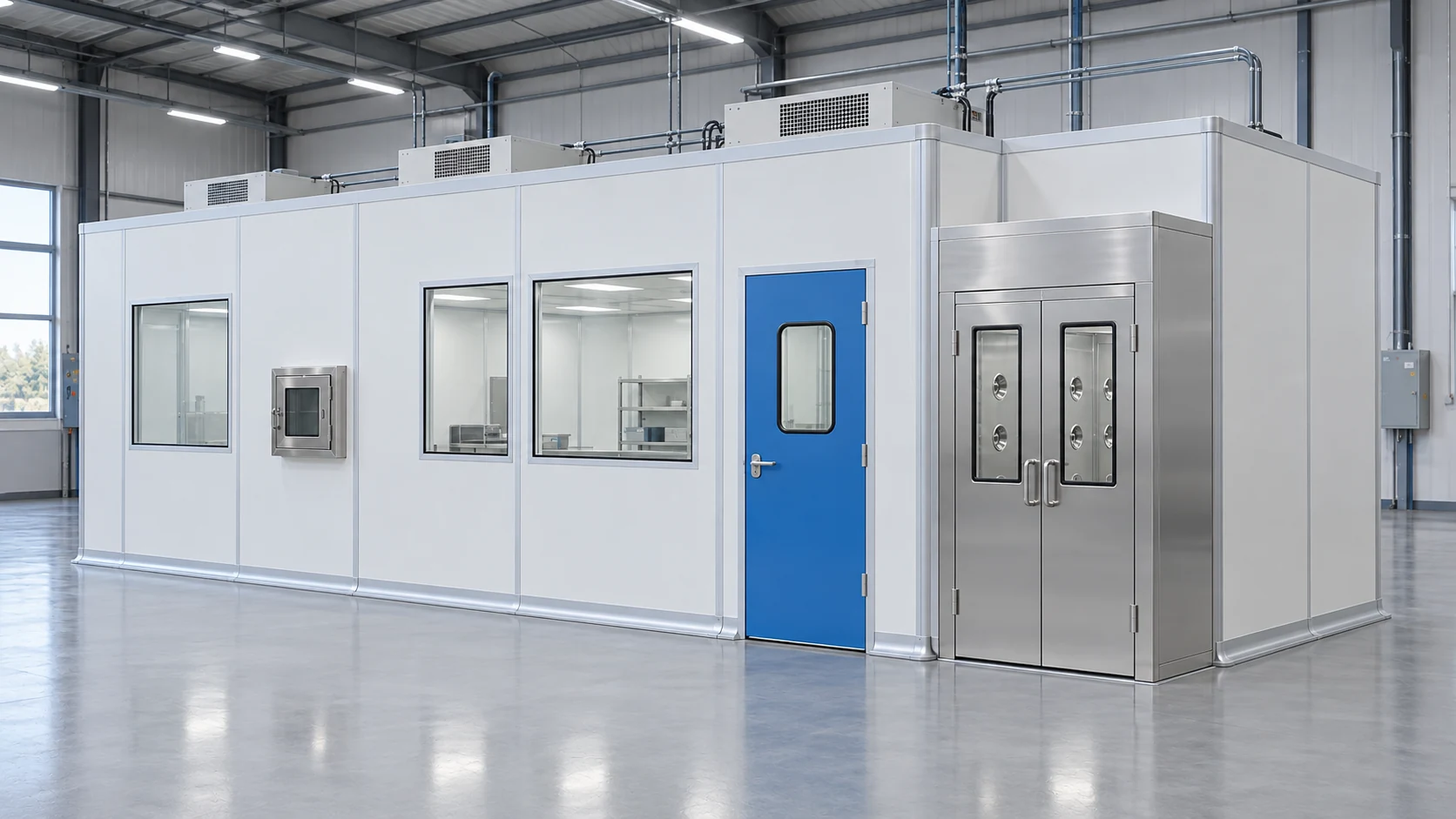
Reduce unnecessary in-room activity
Start with the equipment at its largest operating or service envelope. Add the operator, the handled item and the entry route. This establishes a more realistic minimum space than the equipment footprint alone.
Review storage and preparation tasks separately. Some support activities may be located outside the room under the approved workflow, reducing congestion inside. If a transfer device is used, include the space needed on both sides rather than treating it as a wall-only feature.
Compare several compact footprints at the same scale. Increasing one dimension may improve the working arrangement more than increasing total area uniformly. Keep the environmental and service requirements in the comparison; a small room is not automatically a simple air or cooling project.
Configuration decisions
| Decision | What to define |
|---|---|
| Essential task | Identify the work that must occur inside the boundary. |
| Peak envelope | Include loading, service and operator positions. |
| Support location | Review storage and preparation outside the room where appropriate. |
| Footprint comparison | Compare dimensions using the same equipment and access requirements. |
What is the smallest practical size?
There is no universal minimum for all processes. The task, equipment, movement, services and applicable access requirements define the usable arrangement.