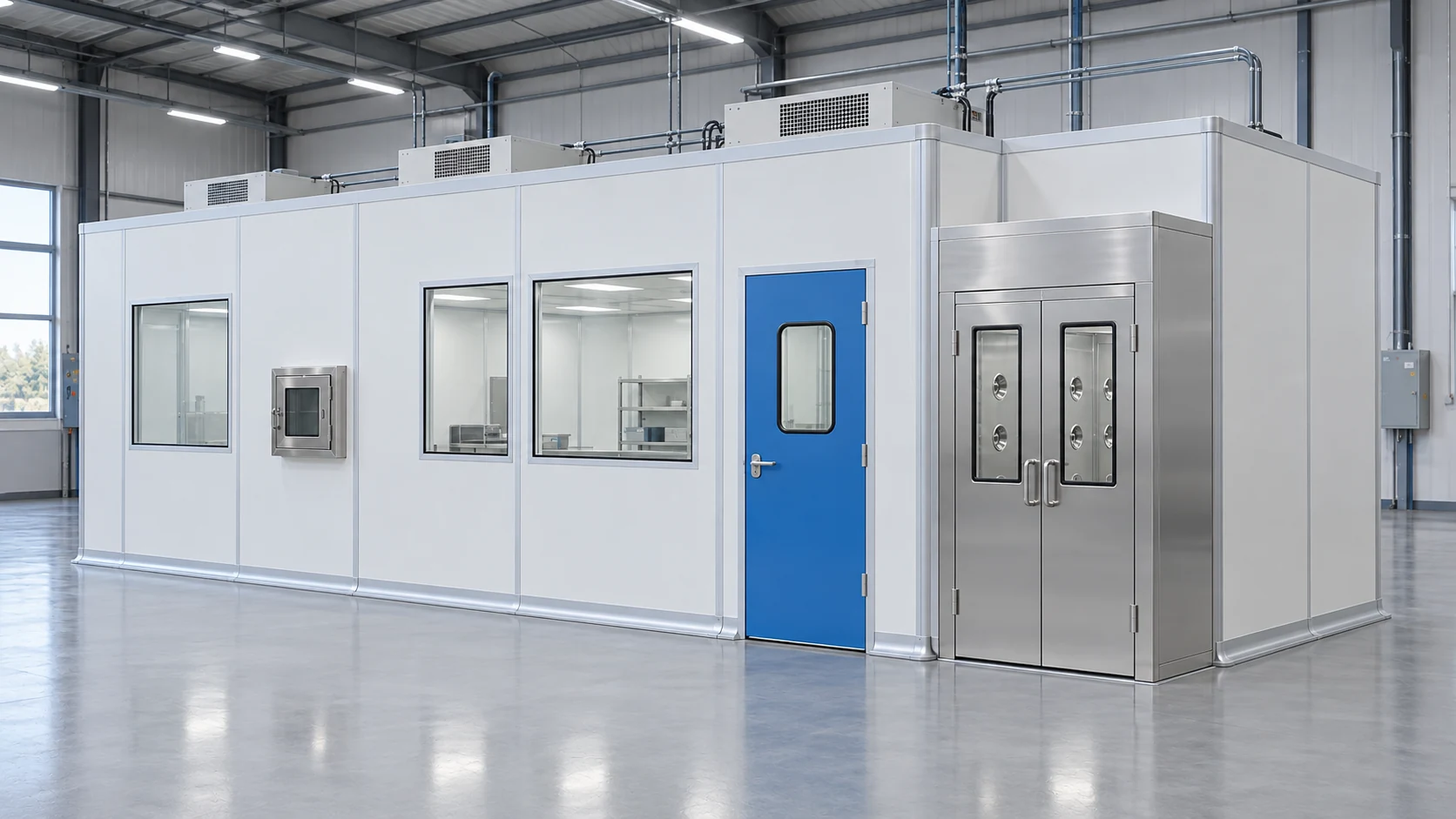
Build the room around the process
A panel enclosure alone does not establish a cleanroom classification. People, equipment, incoming materials, air distribution and operating procedures all affect the finished environment. Define the required operating condition before selecting filters or comparing quotations.
For a hardwall arrangement, review the wall and ceiling assembly together with the door schedule, observation windows, transfer openings and return-air route. A softwall enclosure may suit an accessible local work zone, but its open boundaries create different environmental-control limits. Temperature and humidity requirements deserve a separate discussion from particle control.
Record the usable internal space, overhead service clearance and equipment maintenance envelopes on one layout. Then identify what is supplied with the enclosure and what the host building must provide. This prevents a room that fits on the floor plan from conflicting with ducts, sprinklers or the equipment-loading route.
Configuration decisions
| Decision | What to define |
|---|---|
| Enclosure | Compare rigid panels and softwall boundaries against access and environmental requirements. |
| Air system | Choose the supply and return arrangement using process, background-air and thermal inputs. |
| Entry | Coordinate personnel doors, material transfer and gowning with daily movements. |
| Handover | Agree drawings, operating information and the performance checks required for the intended use. |
Does an ISO target specify the whole system?
No. A particle-class target leaves many design decisions open, including temperature, humidity, process exhaust, personnel flow and the condition in which classification is assessed. Record those requirements alongside the target class.
Technical references
Requirements depend on the intended use and project conditions. Consult the relevant current documents when defining the final specification.