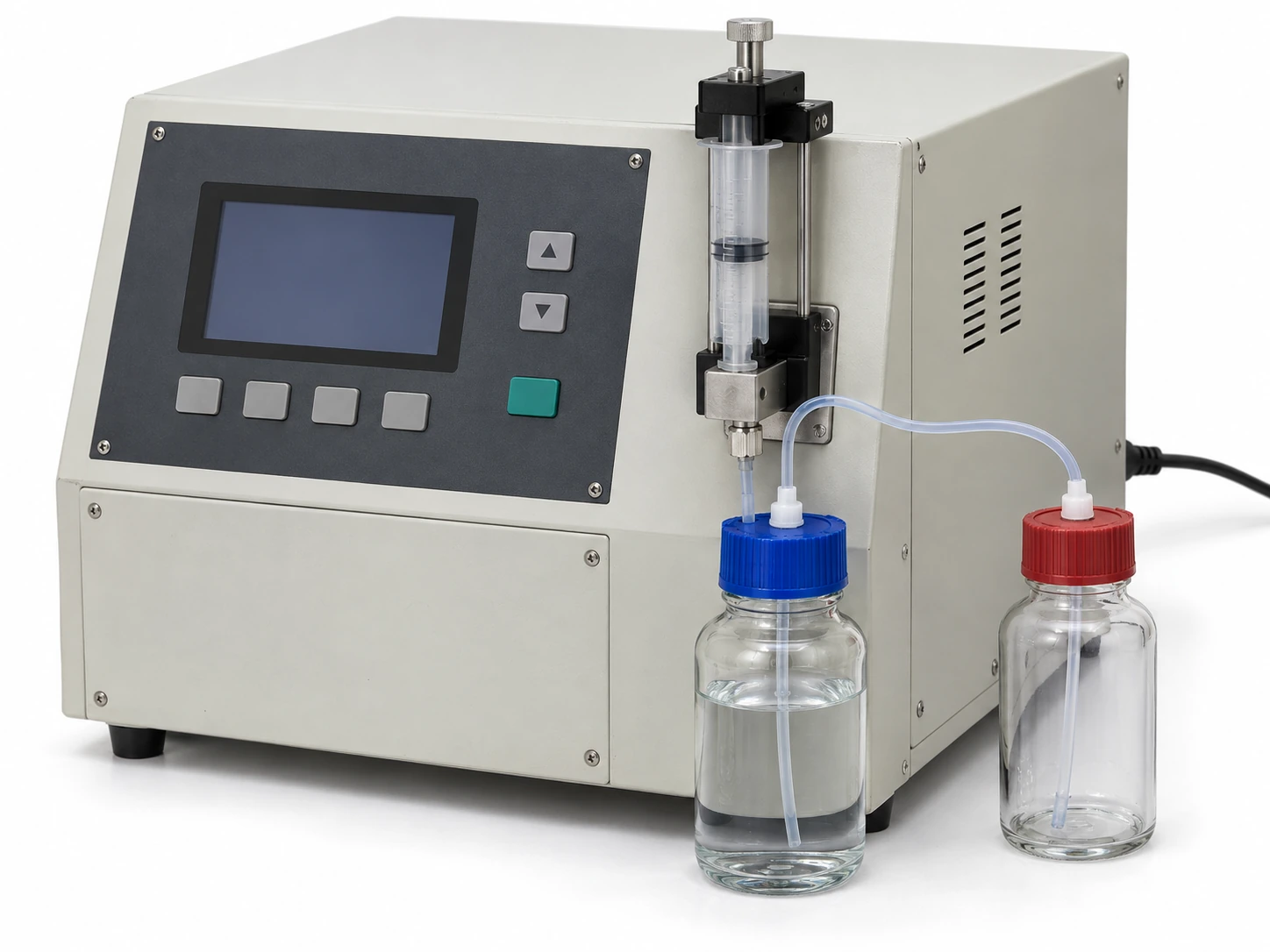
Liquid Particle Counters
liquid particle counters
| Brand | shengtongjh |
|---|---|
| Instrument dimensions, W × D × H (mm) | Syringe bench format: 400 × 280 × 450; pressure-assisted bench format: 400 × 280 × 600 |
| Optical sensor options | Light extinction: 1–200 µm; light scattering: 0.5–20 µm. Separate sensor configurations with different calibration requirements. |
| Sample delivery | Measured syringe sampling for bottles; compatible continuous-flow arrangements for process monitoring |
| Liquid selection | Aqueous or oil-compatible configurations; wetted materials, optical transmission and viscosity reviewed for the actual fluid |
| Result format | Particle counts by size channel, measured sample volume and concentration; report format selected for the application |
Dimensions are outer instrument envelopes. Allow additional space for bottles, external pressure equipment, tubing and service access. Sensor ranges belong to separate options; they do not describe one combined measurement range.
Sampling connections, enclosure arrangement and reporting options can be customized for the liquid and intended operating environment.
Liquid particle counters measure the number and optical size of particles passing through a liquid-filled sensing cell. They support industrial fluid checks, water-system investigations and laboratory quality control when the sensor, sample handling and reporting method suit the liquid being tested.
Read a particle distribution, not just a cleanliness number
A liquid can look clear while containing particles below the scale that an operator can judge by eye. Counting provides a more repeatable view of that contamination: how many events were detected, which size channels they entered and how much liquid was measured. The useful output is a distribution tied to a sampling method, rather than an unexplained single score.
Keep the reporting basis visible. A cumulative channel includes particles at and above its threshold; a differential channel describes a bounded size interval. Those two displays can produce different-looking tables from the same measurement. Comparisons also need consistent units, thresholds and sample locations. A change in any of these can resemble a process change even when the liquid has not changed.
Light extinction
As a particle crosses an illuminated sensing region, it reduces the light reaching a detector. The instrument converts the resulting pulse into an equivalent size using its calibration. This approach is useful for many industrial liquid checks, provided the liquid transmits enough light and the concentration remains within the selected sensor's operating limits.
The reported size is an optical equivalent. It is not a direct description of a particle's shape or composition. An elongated fragment and a calibration sphere can interact differently with the light, so particle counting should not be presented as material identification.
Light scattering
A scattering sensor collects light redirected by a particle. Suitable designs can address smaller particles, but the response depends on the particle and surrounding liquid as well as the optical arrangement. A lower threshold is useful only when the fluid, background level and required method support it.
Select the calibrated range that answers the process question. More channels do not automatically provide better accuracy, and a sensitive water-monitoring sensor is not automatically suitable for a dark oil or an opaque suspension.
Choose how the liquid reaches the sensor
Bottles for separate samples
A bottle sampler suits incoming-fluid checks, retained samples and investigations across several locations. Its value depends on clean containers, representative collection and controlled preparation. Travel from the process to the bench becomes part of the measurement history.
Continuous sampling for changes over time
An online arrangement can reveal transient contamination that occasional bottles miss. The sampling point, flow conditioning, pressure boundary and waste or return connection must be designed around the process. The sensing cell should receive a stable, representative stream.
Portable measurement at the equipment
A portable counter shortens the route between a machine and a result. It still needs a consistent sampling procedure. See portable liquid particle counters for field access, connection and repeatability considerations.
Separate solid contamination from measurement interference
Bubbles and droplets can produce optical events that are difficult to distinguish from solid particles. An unusually high count therefore calls for a review of the fluid and sampling conditions, not an immediate assumption that every event is wear debris. Dark colour, strong turbidity or a second liquid phase can also make a particular optical method unsuitable.
At excessive concentration, multiple particles can occupy the sensing region together. This coincidence can distort both counts and apparent sizes. A saturated result should not be repaired by applying an arbitrary multiplier. Any dilution or preparation method needs to preserve the particles of interest and account for its own background.
Particle counting also leaves other questions unanswered. It does not measure dissolved salts, identify viable microorganisms or establish a fluid's chemical composition. For a water installation, the particle result complements the treatment and monitoring requirements of the ultrapure water system; it does not replace them.
Define the measurement before selecting the package
Identify the liquid, relevant particle sizes, expected contamination range, available sample quantity and decision the result will support. Then match the sensor to a compatible sampling path and a useful report. shengtongjh can coordinate the equipment selection around those interfaces, including bottle handling and data export. Discuss a liquid particle counting configuration.
Sampling connections, enclosure arrangement and reporting options can be customized for the liquid and intended operating environment.