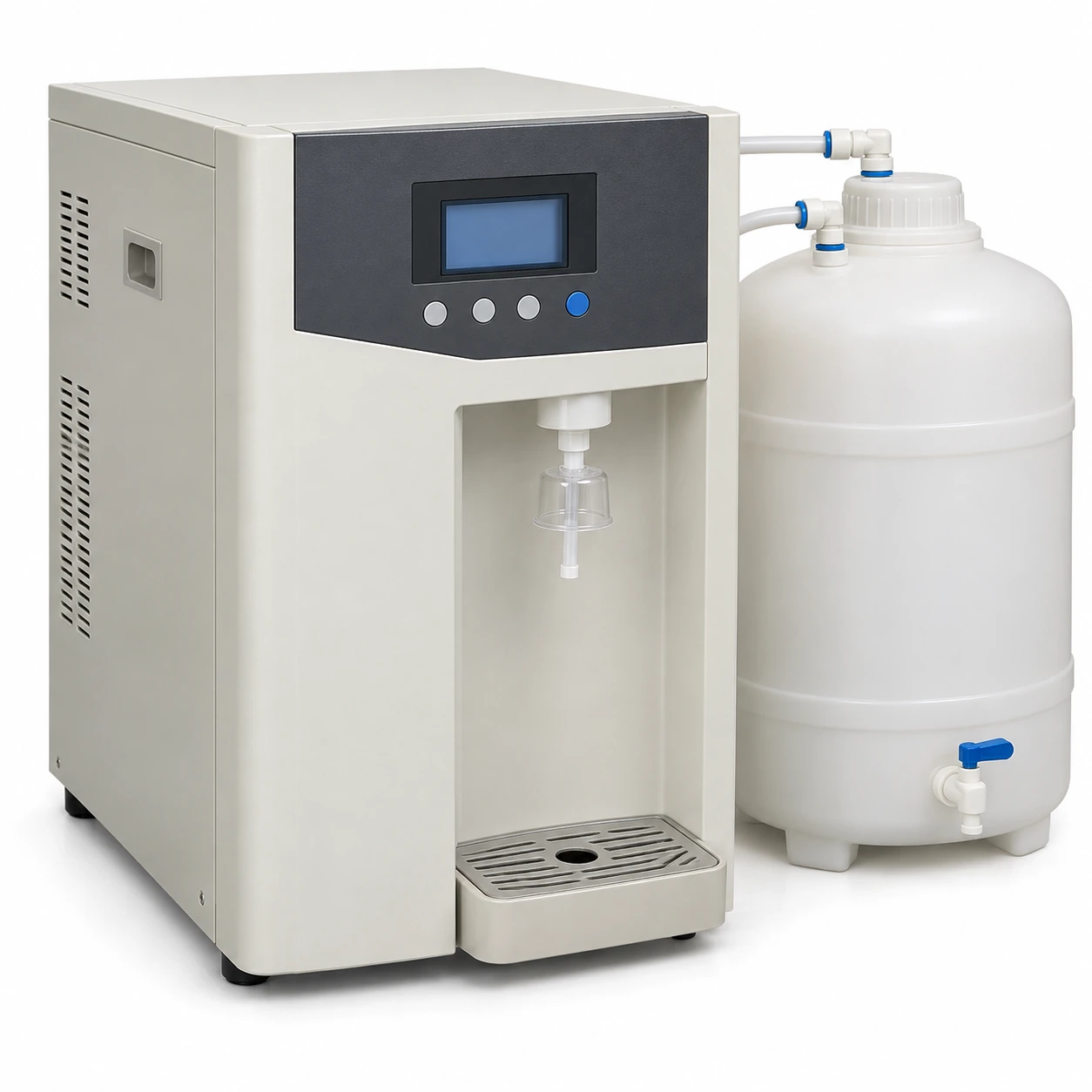
Ultrapure Water Systems
ultrapure water system
| Feed arrangement | Tap-water pretreatment with RO and final polishing; prepurified-feed versions also selectable |
|---|---|
| RO production options | 3 / 6 / 12 L/h at 15°C feed temperature; feed pressure and quality affect output |
| Cabinet W × D × H (mm) | 260 × 470 × 470; 280 × 530 × 510; 305 × 400 × 545 — footprint depends on configuration |
| Storage and dispensing | 5 / 6 / 12 L storage options; up to 1 L/min intermittent ultrapure dispense with a matched unit |
| Ionic-purity acceptance | 18.2 MΩ·cm at 25°C at point of dispense, subject to the selected system and agreed feed conditions |
| Treatment options | Ion-exchange polishing; 185/254 nm UV; selected 0.2 or 0.22 μm final filter; application-specific UF |
| Fluid path | Low-leaching polymer tubing and compatible cartridge housings; seals selected for the treatment and cleaning method |
| Power and controls | 100–240 V AC, 50/60 Hz supply options; resistivity/temperature display, tank-level control and feed alarms |
| Installation | Benchtop or approved wall mount; separate allowance for dispenser, reservoir, tubing and service access |
The quotation identifies one matched configuration, its final dimensions, feed limits and water-quality acceptance conditions. Cabinet sizes exclude separate storage and service space.
An ultrapure water system prepares water for work in which contamination from the water itself can affect a blank, reagent or measurement. Its value depends on the complete route from incoming supply to the vessel at the bench.
Water quality is built in stages
Tap water can be clear and suitable for ordinary use while still carrying dissolved salts, organic compounds and particles that interfere with laboratory measurements. An ultrapure system deals with these groups through different treatment stages. A particle filter cannot remove dissolved ions, and an ion-exchange cartridge does not establish that every organic compound or microorganism has been removed.
Protect the incoming treatment
Pretreatment is selected for the actual supply. Sediment and oxidants can damage or overload downstream components; hardness and silica can limit the membrane operating conditions. Identifying these loads before selection helps avoid repeatedly replacing expensive polishing media.
Reduce the bulk load
Reverse osmosis separates a purified permeate stream from a more concentrated reject stream. It reduces the contaminant burden reaching storage and final polishing. Its product water is not automatically ready for the most sensitive analytical work.
Polish close to use
Ion exchange, appropriate organic treatment and a selected final filter address the remaining requirements. A closed circulation path can help maintain retained water between withdrawals. The dispense point is where the quality needed by the method must be established.
Start with the available feed
A laboratory with a controlled RO or deionized-water supply may need only a compatible final polisher. A laboratory supplied directly from the mains needs an arrangement that includes the upstream treatment and a suitable reject connection. Using a tap-fed unit where a polisher is needed can duplicate equipment; feeding raw water to a polisher can exhaust its media rapidly.
For a complete tap-to-dispense route, see the integrated RO + UV configuration. The feed analysis and peak demand determine which stages belong in the purchase.
Read the quality display correctly
Resistivity describes the water's ionic condition at a stated temperature. A high reading is valuable, but it does not measure every non-ionic organic compound, viable organism or specific trace contaminant. Low-background analytical work may need TOC assessment and method blanks as well as the electrical reading.
A terminal particle filter also has a limited task. Its pore rating does not, by itself, qualify the water for sterile preparation, dialysis or injection. Those applications require separate equipment and application-specific evidence.
The container becomes part of the water path
Once dispensed, water is exposed to the vessel, closure and room air. A clean-looking bottle can release residues or carry material from its previous use. Keep the withdrawal route short, use containers compatible with the analytical method and avoid preparing large volumes long before they are needed. An unexplained blank should prompt an investigation of the whole handling route, not only the purifier.
shengtongJH coordinates equipment and accessories around the required water quality, source water and installation. A useful enquiry includes the main methods, typical and peak consumption, existing pretreatment and the intended location. These facts allow a matched supply scope to be discussed through the product enquiry.
The purification stages, storage, dispensing arrangement and installation interfaces can be customized to your application and working environment.