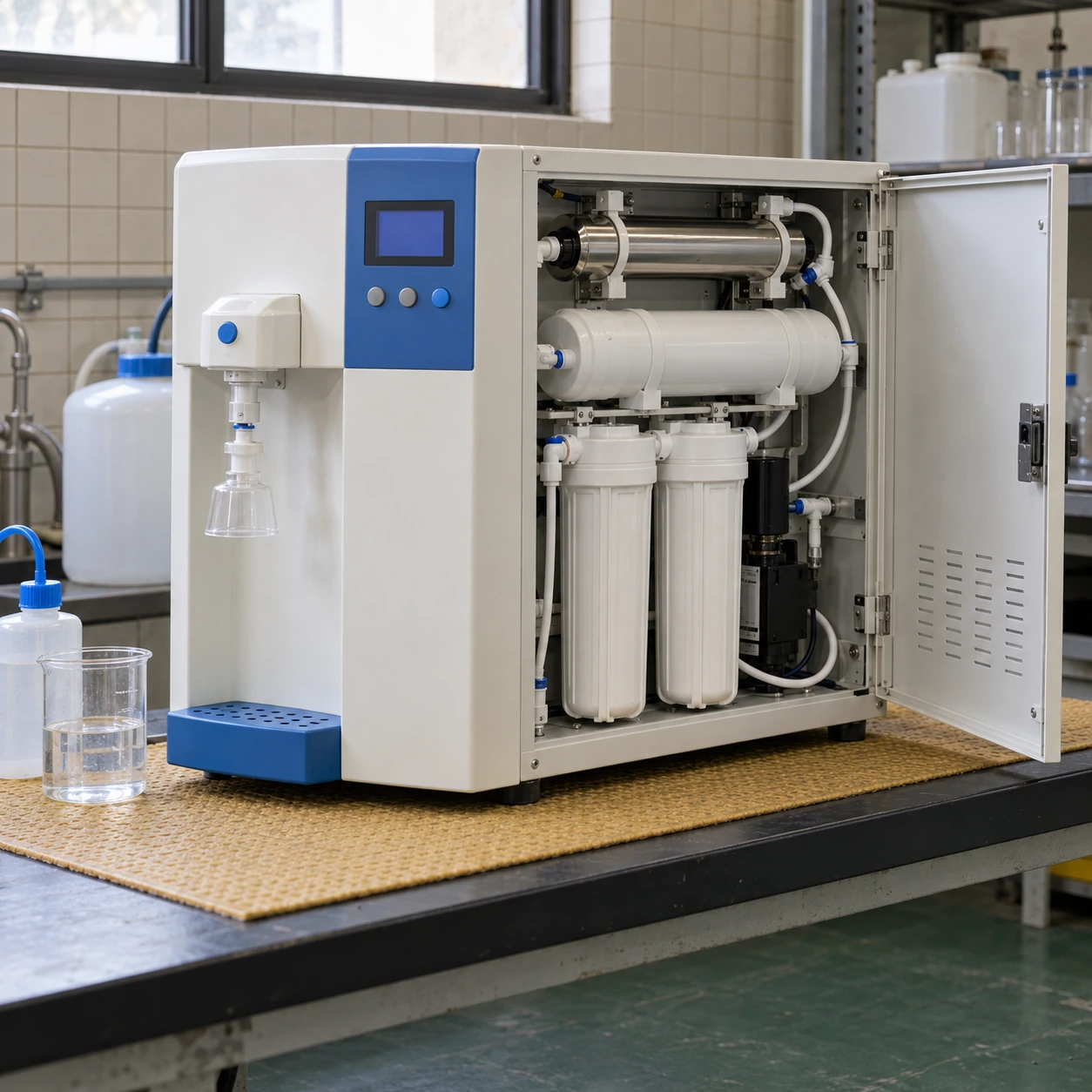
Ultrapure Water Systems
integrated ro + uv ultrapure water system
| Feed arrangement | Tap-water pretreatment with RO and final polishing; prepurified-feed versions also selectable |
|---|---|
| RO production options | 3 / 6 / 12 L/h at 15°C feed temperature; feed pressure and quality affect output |
| Cabinet W × D × H (mm) | 260 × 470 × 470; 280 × 530 × 510; 305 × 400 × 545 — footprint depends on configuration |
| Storage and dispensing | 5 / 6 / 12 L storage options; up to 1 L/min intermittent ultrapure dispense with a matched unit |
| Ionic-purity acceptance | 18.2 MΩ·cm at 25°C at point of dispense, subject to the selected system and agreed feed conditions |
| Treatment options | Ion-exchange polishing; 185/254 nm UV; selected 0.2 or 0.22 μm final filter; application-specific UF |
| Fluid path | Low-leaching polymer tubing and compatible cartridge housings; seals selected for the treatment and cleaning method |
| Power and controls | 100–240 V AC, 50/60 Hz supply options; resistivity/temperature display, tank-level control and feed alarms |
| Installation | Benchtop or approved wall mount; separate allowance for dispenser, reservoir, tubing and service access |
Specify RO, UV, resin and final filtration as one compatible configuration. Water quality is accepted under agreed feed conditions at the designated outlet.
An integrated RO + UV ultrapure water system combines bulk contaminant removal with final water polishing. Integration is useful when the connections, monitoring and storage are designed as one compatible route to the dispense point.
RO and UV perform different jobs
Reverse osmosis reduces the load of dissolved and suspended contaminants entering the downstream system. It separates permeate from concentrate and requires suitable pretreatment and a controlled reject route. UV treats water that passes through its chamber; it does not physically remove dissolved salts or replace the membrane.
In an ultrapure polishing circuit, short-wavelength UV can oxidize residual organic compounds into species that downstream ion-exchange media can remove. UV used for microbial control has a different role. The presence of a lamp is therefore not enough to describe either the treatment sequence or the quality at the outlet.
Follow the connections through the cabinet
- Incoming supply and pretreatment. The selected filters and adsorptive media protect the membrane against the contaminants present in the feed. An inlet test that omits important local conditions can result in premature fouling or damage.
- RO production and storage. The reservoir bridges the difference between a slow production process and short, faster withdrawals. Its materials, vent protection and water turnover influence what reaches the final polisher.
- UV and final polishing. In a low-organic configuration, polishing media downstream of oxidation remove the ionic products generated by treatment. The selected architecture must preserve this function when water circulates as well as when it is dispensed.
- Measurement and collection. The final quality measurement, terminal filter and dispense tubing should be considered together. Water quality before an unsuitable outlet extension does not demonstrate the quality collected in the vessel.
What integration can simplify
A matched unit can coordinate tank level, production, circulation and alarms without requiring separate controls for each purchased component. It can also reduce exposed connections at the bench. These advantages depend on the actual supply scope; external pretreatment or storage may still be necessary.
Replacement access remains important. A compact cabinet that places the lamp or resin behind other components may save footprint while increasing service work.
What integration cannot guarantee
Integration does not make the unit suitable for every feed source or every analytical method. An optional UV stage does not establish zero TOC, and a terminal filter does not qualify the system as a sterile-water plant. Sensitive biological work needs its own water specifications and verification.
UV performance also depends on the chamber, flow and lamp condition. Lamp age or an illuminated status indicator alone does not quantify the delivered treatment or prove that an entire storage circuit has been controlled.
Match the purchase to the source and the method
State whether the feed is mains water or an existing treated supply, which quality tests matter and how the water will be stored and collected. For laboratories with long gaps between withdrawals, compare the UV recirculation arrangement. For a basic purchase, the critical question is whether all required stages and interfaces are included, rather than how many technologies appear in the equipment name.
RO capacity, UV polishing, storage, monitoring and installation connections can be customized to suit your feed water and analytical application.