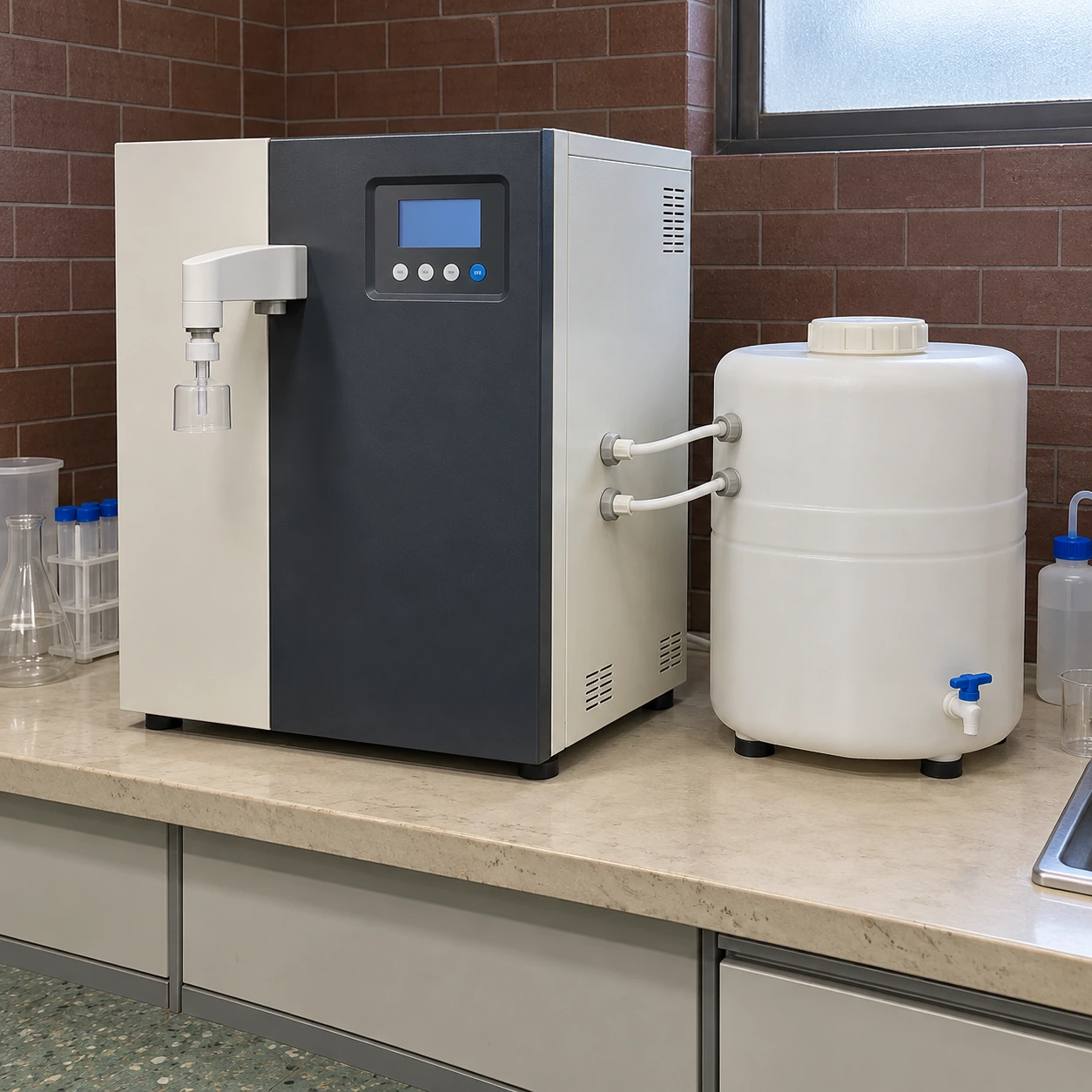
Ultrapure Water Systems
uv recirculating ultrapure water system
| Incoming water | Compatible RO, DI or EDI supply; tap-fed configuration requires its own pretreatment and RO stage |
|---|---|
| Body W × D × H (mm) | 280 × 530 × 510 without an attached dispense unit; 370 × 610 × 640 with an attached dispense assembly |
| Withdrawal options | Up to 1 L/min with a matched feed and polishing circuit; fixed outlet or remote dispensing |
| Purity acceptance | 18.2 MΩ·cm at 25°C ionic-purity target; low-TOC acceptance specified separately for the selected UV configuration |
| Polishing stages | Mixed-bed ion exchange; optional organic adsorption and 185/254 nm UV; selected terminal particle filter |
| Recirculation | Internal polishing-loop circulation; reservoir and remote-dispenser coverage specified with the layout |
| Electrical and monitoring | 100–240 V AC, 50/60 Hz supply options; resistivity, temperature and consumable alarms; TOC monitoring by configuration |
| Service interfaces | Accessible cartridge connections, isolated feed and drain provisions; matched seals and low-leaching water-contact materials |
UV, polishing and recirculation coverage are configuration-specific. Water-quality acceptance, feed limits and the complete installed dimensions are agreed for the selected system.
A UV recirculating ultrapure water system keeps retained water moving through a defined treatment path between withdrawals. The important question is which parts of the circuit are actually treated, including the route to the outlet.
Idle water still needs control
Between withdrawals, water remains in the polishing circuit and, depending on the arrangement, in storage and dispense tubing. Contact materials, retained residues and microbial growth can affect that water. Recirculation repeatedly returns part of the inventory through treatment instead of leaving it indefinitely in one place.
The word “recirculating” does not establish that every branch is covered. A cabinet may circulate its internal polishing path while a remote hose or reservoir remains outside that route. The proposed flow arrangement should identify the water volume treated and the preparation needed at the actual outlet after an idle period.
UV needs the rest of the polishing circuit
Organic oxidation creates products that must be removed by the appropriate downstream treatment. A useful low-organic arrangement therefore combines UV with suitable ion-exchange media and monitoring. UV microbial control also depends on chamber conditions and exposure; it does not clean every surface or eliminate the need for an approved sanitation routine.
Where a tank is included, consider its vent, material and internal water turnover. A lamp in one part of the system does not justify a claim that the complete stored volume is sterile.
Circulation has a temperature consequence
Pumps and lamps can add heat, especially when a small water inventory is repeatedly circulated and little is withdrawn. Temperature can affect measurements and the suitability of water for immediate preparation. The arrangement should balance quality maintenance with heat management and actual demand.
Continuous and intermittent operation are different design choices. Use the selected system's control strategy; copying a timing schedule from unrelated equipment can leave parts of the circuit untreated or add unnecessary heat.
Design for the first withdrawal after a pause
A laboratory that uses water throughout the day has a different idle pattern from one that prepares standards twice a week. The system should make its condition understandable when work resumes. Relevant status information includes circulation operation, water quality, temperature and any overdue maintenance condition.
Keep the outlet and collection vessels controlled as well. Water can meet the internal sensor's objective and still be affected by the last connection, an exposed nozzle or a contaminated closure. Verification at the point of collection is particularly useful when investigating changes that appear only after overnight or weekend inactivity.
Select the arrangement around the application
Describe the longest usual idle period, typical draw size, existing feed quality and any remote collection point. Specify organic or biological requirements separately from ionic purity. A low-TOC configuration and a system qualified for a particular biological method are not interchangeable descriptions.
When the laboratory starts with tap water, the integrated RO + UV route adds the upstream production and storage decisions. When a suitable treated supply already exists, a local recirculating polisher can be assessed on its own inlet conditions and outlet requirements.
The UV treatment, recirculation path, storage connection and idle-period controls can be customized to your laboratory's water-use pattern.