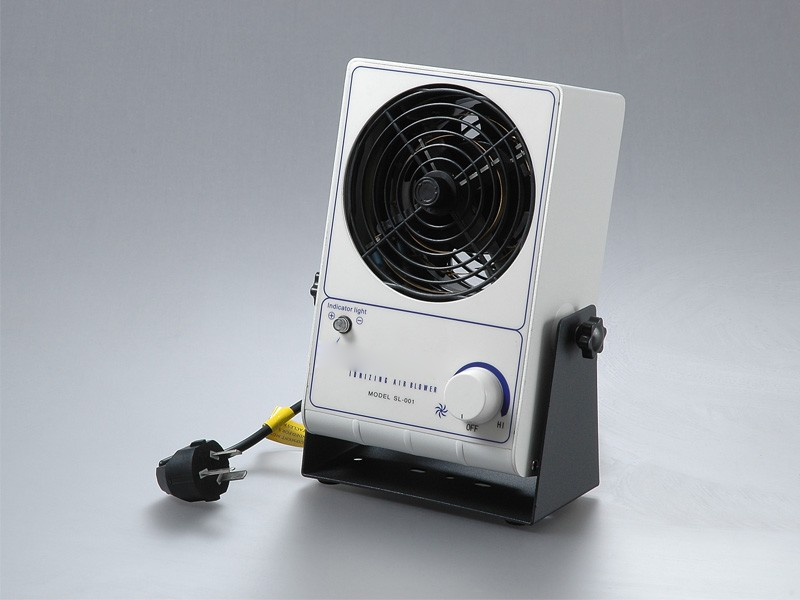
Ionizing Air Blowers
Single-Head Ionizing Air Blower
| Configuration | Single guarded fan head |
|---|---|
| Mounting shown | Adjustable tilt bracket |
| Controls | Front airflow knob and indicator |
| Power connection | Corded electrical supply |
| Primary function | Local static-charge neutralization |
Supply voltage, power, ion balance and discharge-time performance require confirmation for the selected unit and working distance. Plug appearance does not establish the electrical rating.
The power supply and working arrangement can be selected for your workstation.
A single-head ionizing blower directs ionized air toward a localized handling area. Its tilting support helps aim the airflow at a component, tray or insulating surface without requiring the operator to hold a nozzle.
Bring neutralization to the active handling point
The adjustable bracket lets the operator direct the air stream toward the part rather than across the whole room. Place the blower so that the sensitive handling area receives the flow without a fixture, container wall or the operator's hands continuously blocking it. Keep the inlet and fan guard clear.
Start at a setting that reaches the intended working point without moving loose pieces or interfering with inspection. Strong airflow is not, by itself, evidence of effective static neutralization. The result also depends on ion delivery, balance, distance and obstructions.
Use ionization alongside grounding
Ionization is useful for charge on insulating materials that cannot simply be discharged by attaching a ground lead. Grounding remains necessary for suitable conductive objects and personnel. The ESD Association's control guidance describes these as complementary controls.
A practical workstation check
Measure discharge behavior and ion balance where the part is actually handled, with the normal fixture in place. Record the blower position and operating setting. Recheck after changing the bench arrangement instead of assuming that a satisfactory result at an unobstructed point applies everywhere.
Maintain the emitter and the airflow path
Contamination at the emitter and obstruction of the air path can change performance. Follow the selected unit's maintenance procedure and disconnect power before permitted cleaning work. Cleaning frequency should reflect the environment and verification results; do not probe internal high-voltage parts through the guard.
A local ionizing blower is not a HEPA clean-air supply or a fume extractor. Where the process also requires particle control or vapor removal, evaluate those functions separately so one air stream does not disrupt another.
Related products
The power supply and working arrangement can be selected for your workstation.