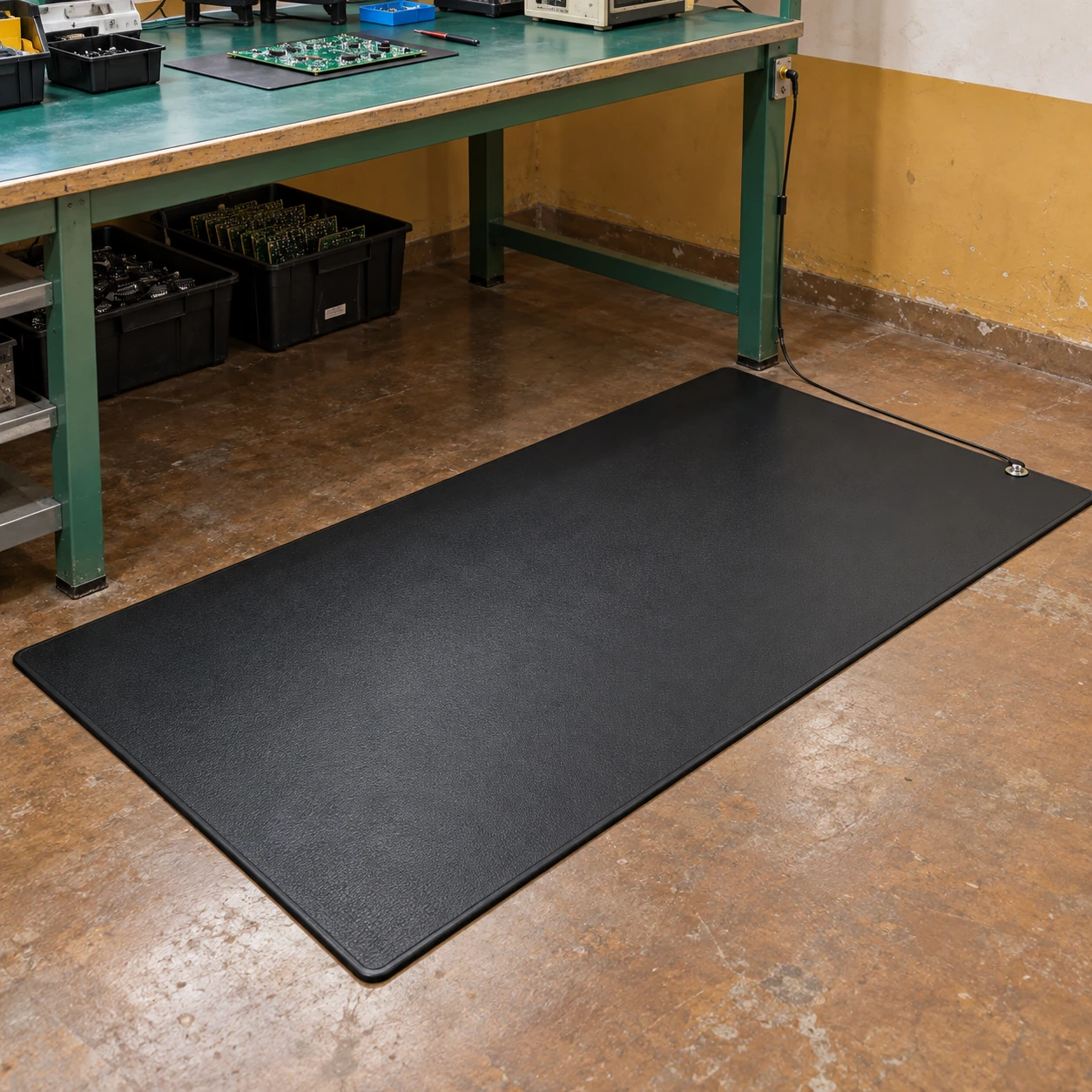
ESD Floor Mats
esd floor mats
| Flat mat sizes, W × L | 914 × 1524 mm; 1219 × 1829 mm (nominal cut sizes) |
|---|---|
| Flat construction | Conductive rubber sheet; nominal 1.5 mm thickness |
| Standing-work alternative | Cushioned ESD mat with suitable edge transitions; select separately from thin sheet |
| Surface and finish | Black textured surface; dry indoor workstation use |
| Ground connection | Mat groundable point and matched lead; connector and lead resistance specified with the ESD plan |
| Supply format | Cut mat or cut-to-length runner; grounding accessories itemized |
Dimensions describe the mat footprint, not the bench or room. Electrical properties and suitability of the supplied construction must be agreed for the intended footwear and operating conditions.
Mat size, edge arrangement and grounding accessories can be customized to suit the working area and application.
ESD floor mats provide a local floor contact area for static-sensitive assembly, inspection and service work. Their useful function depends on the whole contact path: a suitable mat connected to ground, compatible footwear and a working position that keeps the operator on the mat. Choose the construction around movement and traffic as well as electrical requirements.
Keep the contact path intact
A mat can be electrically suitable and still fail to control personnel charge when worn with insulating shoes. The floor material is only one part of the route from the person to ground. Shoe contact, mat condition and the grounding connection all influence the installed result. Assess the actual footwear-and-mat combination before using it as the personnel grounding method.
Place the mat where the operator stands while handling exposed parts. A narrow strip that leaves one foot on the surrounding floor, or a mat positioned behind the normal working stance, creates an avoidable break in coverage. For repeated movement between benches, compare a continuous ESD vinyl flooring system with isolated workstation mats.
Choose around traffic and standing time
Flat, low-profile sheet
A thin mat keeps the transition small where chairs or light trolleys approach a station. Check that the sheet stays flat, does not slide on the substrate and can tolerate the actual wheel contact. A chair or cart also needs suitable conductive or dissipative wheels and electrical continuity through its structure; an ESD floor mat cannot correct insulating casters.
Cushioned standing mat
A cushioned construction may be preferable for a mainly stationary operator. The thicker edge needs more space and a transition suited to the approach direction. Consider how a trolley will cross it and whether the operator must turn or step off the mat frequently. Comfort and static-control performance need separate evidence.
Make the ground connection serviceable
Position the connector away from the main foot and wheel path. Route its lead along a protected edge so that cleaning or moving a bench does not pull the connection loose. A snapped-on lead is not proof of a verified ground path: the mat, connector and designated grounding point need to function together. Have the grounding arrangement established by the responsible site personnel rather than attaching a lead to an arbitrary metal bench leg.
Removable mats allow local replacement without renewing an entire floor. They also create an underside that needs inspection. Grit, moisture or a damaged edge can make the mat rock, move or curl. Lift and clean it using the material supplier's method, then allow both the mat and substrate to dry before refitting.
When readings or handling conditions change
- Performance changes after cleaning
- Review the cleaner, dilution and rinsing method. Residues and floor polishes can change shoe contact and charging behaviour. Use an approved maintenance product and recheck after the surface is dry.
- The same station behaves differently with another operator
- Investigate footwear condition and fit as well as the mat. Keep the test method and operating conditions consistent so that the results are comparable.
- A connector loosens or an edge curls
- Restore the physical connection or replace the damaged item before relying on it. Do not hide a torn edge under general-purpose tape across the working surface.
Define acceptance tests and recurring checks in the site's ESD control programme. Record the mat identity, installation, footwear used and relevant environmental conditions. ESD mats manage electrostatic charge; they are not electrical insulating mats for work on live equipment.
Information for a workable quotation
Provide the usable standing area, bench layout, footwear type, chair or trolley traffic, cleaning chemicals and required electrical acceptance criteria. Identify whether the request is for a bare mat or a complete mat-and-lead arrangement. For a seated workstation, review the separate personnel wrist grounding arrangement instead of assuming that the floor contact remains continuous.
Mat size, edge arrangement and grounding accessories can be customized to suit the working area and application.