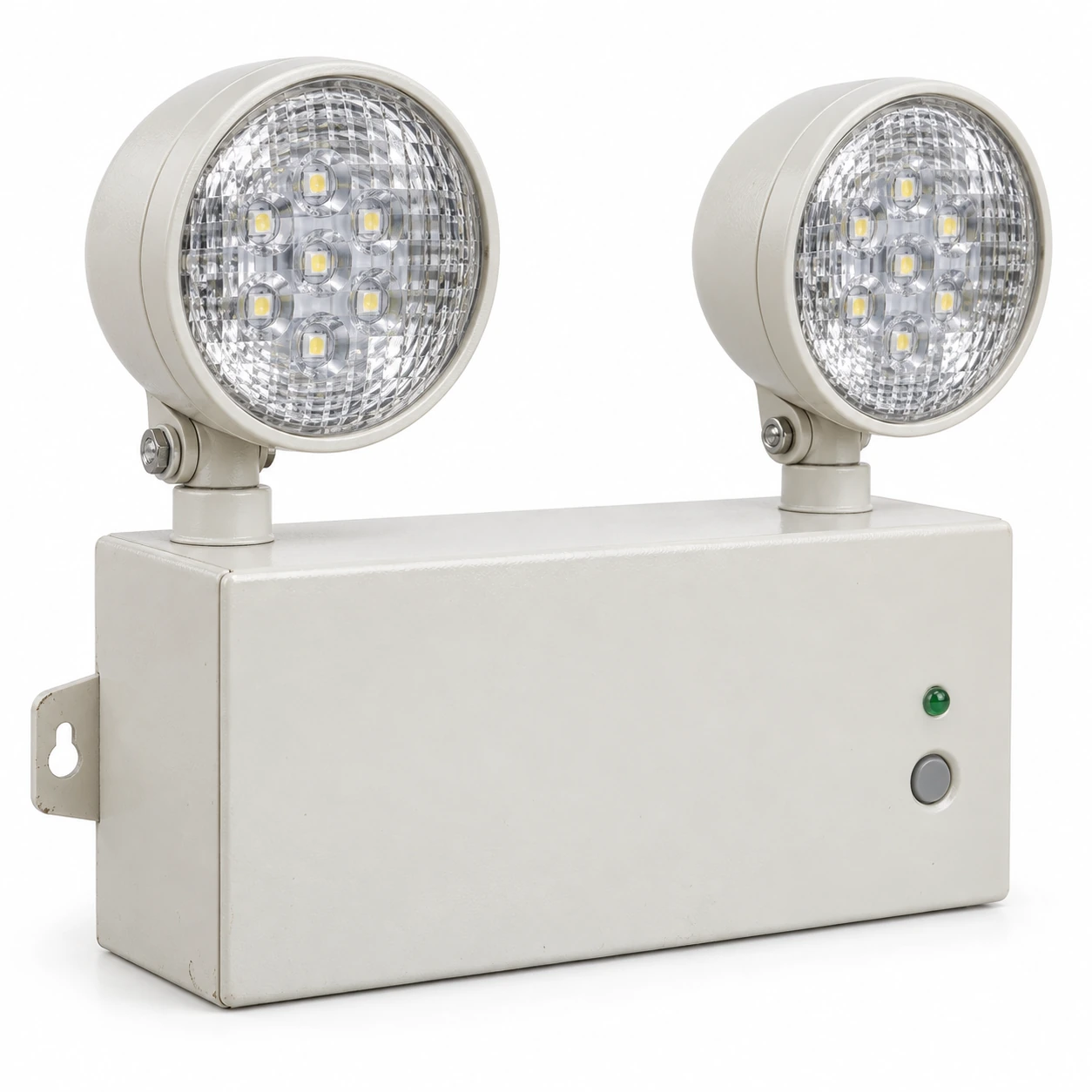
Emergency Lighting
emergency lighting
| Supply formats | Self-contained light units; emergency LED driver packs; centrally supplied luminaires |
|---|---|
| Compact unit sizes, approximately W × H × D (mm) | 181 × 121 × 67; 260 × 121 × 67 |
| Unit supply option | 120–277 V AC, 50/60 Hz; other supplies require a matching configuration |
| Light heads | Adjustable LED optics; housing and head arrangement vary by unit |
| Backup duty | 90-minute configuration available for project selection; confirm output and runtime together |
| Indication and testing | Charge/status indicator; manual test or automatic diagnostics |
The listed dimensions relate to compact self-contained units. Central power equipment is sized separately; the approved project establishes placement, illumination and operating duration.
The luminaire format, power arrangement and monitoring options can be customized to the facility and its emergency-lighting design.
Emergency lighting provides usable illumination when the normal lighting supply fails. A complete arrangement connects the backup source, changeover or emergency driver, luminaires and local failure detection so that people can see the escape route when it is needed.
Follow the path from a power failure to useful light
When normal lighting fails, the backup arrangement has to recognise the condition, provide energy and deliver light through a suitable optical system. A battery that is charged but disconnected from its load cannot help. A light supplied from a central inverter may remain dark if an ordinary local switch or control device still holds it off. Each interface has a practical role.
The design starts with the escape route and other locations requiring emergency illumination under the applicable rules. It then identifies which normal supply failures must trigger the lights. Losing a local lighting circuit can leave an area dark while the building's main supply remains healthy, so monitoring only the incoming mains can miss a relevant failure.
Choose where the batteries belong
At each light
A self-contained unit places its battery and charger close to the lamps. It suits local additions and can limit the effect of an individual equipment failure. The tradeoff is a larger number of batteries and test points distributed around the building.
Inside a general luminaire
An approved emergency driver arrangement can use the normal fitting for backup illumination. It reduces the number of visible fixtures, but the emergency output, LED compatibility and control connections need their own evaluation.
At a central service location
A central battery or inverter makes battery access and supervision more concentrated. The outgoing circuits, cable protection, local sensing and fault distribution then become essential parts of the installation.
These arrangements can coexist in a facility where the design coordinates them. The right choice depends on the layout, access, existing wiring and maintenance resources, not only the purchase price of the light unit.
Design for the emergency output
Emergency operation may use a different driver, a lower light level or only part of a luminaire. The normal lighting calculation therefore does not automatically describe the escape route during a failure. Use the selected emergency-mode photometric data with the intended mounting height, head aiming and obstructions.
Both the initial condition and performance through the specified operating period matter. Battery condition and temperature influence the available energy, while dirty optics or changed aiming affect the light reaching the floor. A bright spot immediately below a unit does not establish an adequately illuminated route between units.
Test function and duration separately
A short functional test can show that a unit changes over and lights its lamps. It cannot demonstrate that the battery sustains the required output for the full period. Arrange duration testing and recharge around occupancy and the facility's procedures. Keep faults visible until the defective item has been corrected and confirmed.
Plan for the return of normal power
Restoration involves more than switching the lamps back. The charger must recover the battery, controls must return to their intended state and any fault indication needs review. A second outage during recharge may not have the same available duration as an outage after a full charge.
Hand over a maintainable installation
A useful equipment schedule identifies each light, its supply, battery or central circuit, test method and replacement parts. Keep the approved layout and photometric information with it. For discrete battery-powered assemblies, compare emergency lighting units; for signs and route visibility, see exit emergency lighting. Final selection and installation should follow the project requirements and be coordinated by the responsible electrical professional.
The luminaire format, power arrangement and monitoring options can be customized to the facility and its emergency-lighting design.