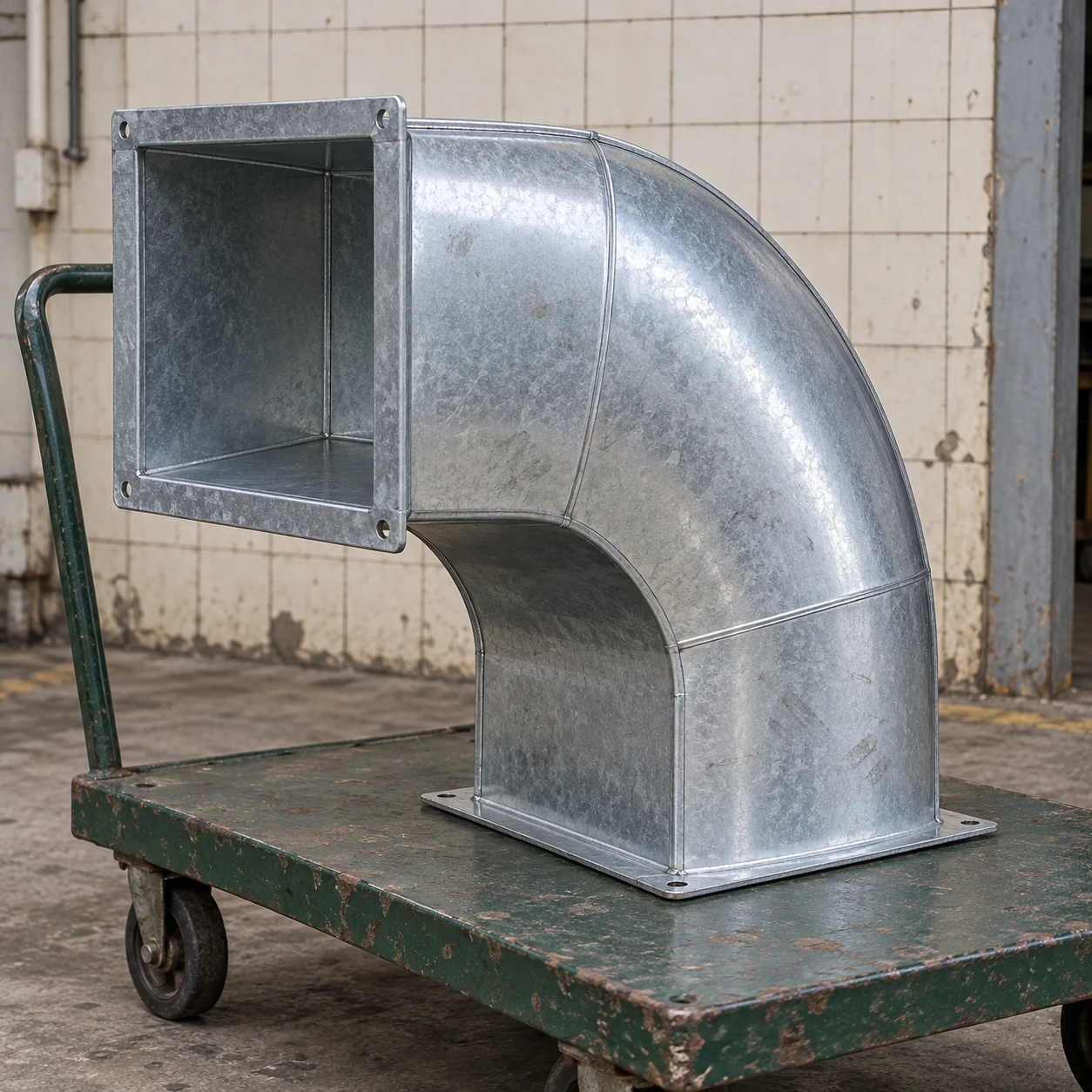
Equal-sided openings and corner geometry
square duct elbows
| Clear square opening W × H (mm) | 200 × 200 / 300 × 300 / 400 × 400 / 500 × 500 |
|---|---|
| Turn angle | 45° or 90° |
| Passage shape | Radius bend or compact mitered bend |
| Air guides | Specified turning vanes for selected corner geometry |
| Body | Galvanized or stainless sheet construction |
| End frame | Matched square flange or slip connection |
Square here describes equal width and height. A square-throat elbow describes the corner geometry and can also have a rectangular opening.
Square duct elbows can be configured for the opening, corner space and adjoining equipment.
A square duct elbow has an equal-sided air opening. That is different from the term square elbow when it is used to describe a sharp or mitered corner. Identifying both the cross-section and the internal turn prevents two different fittings from being treated as the same product.
Specify the opening and the corner separately
A square opening can continue through a smooth radius turn or a compact corner fitted with a designed vane arrangement. The opening establishes the connection size; the turn establishes the air path and space occupied. State both on the order drawing, particularly when replacing a part supplied under an informal workshop description.
Equal sides do not remove orientation
Rotating a square flange can leave the nominal opening unchanged, yet move a seam, access door or vane arrangement to the wrong side. Identify the airflow direction and the intended bend plane. If an inspection cover must face an access hatch, mark that relationship before fabrication.
Area alone does not establish equivalence
A square and a rectangular duct can have the same opening area but different wall perimeter and corner behavior. The transition, pressure loss and available installation space still need assessment. Do not substitute a square elbow into a rectangular route based only on equal area.
Connect squarely without stressing the frame
Measure both diagonals and the mating frame when assessing an existing connection. A distorted opening may accept bolts while leaving uneven gasket contact. Support the elbow and straighten the alignment before tightening the joint; avoid using the fasteners to pull an unsupported duct into position.
For cold supply air, carry the insulation detail around all four sides and the inner curve. For dirty extract air, position any access opening so the throat and heel can be reached. These service requirements can determine which side of the fitting should remain accessible.
Compare broader aspect ratios in rectangular duct elbows and fabricated joint details in sheet metal duct elbows.
Square duct elbows can be configured for the opening, corner space and adjoining equipment.