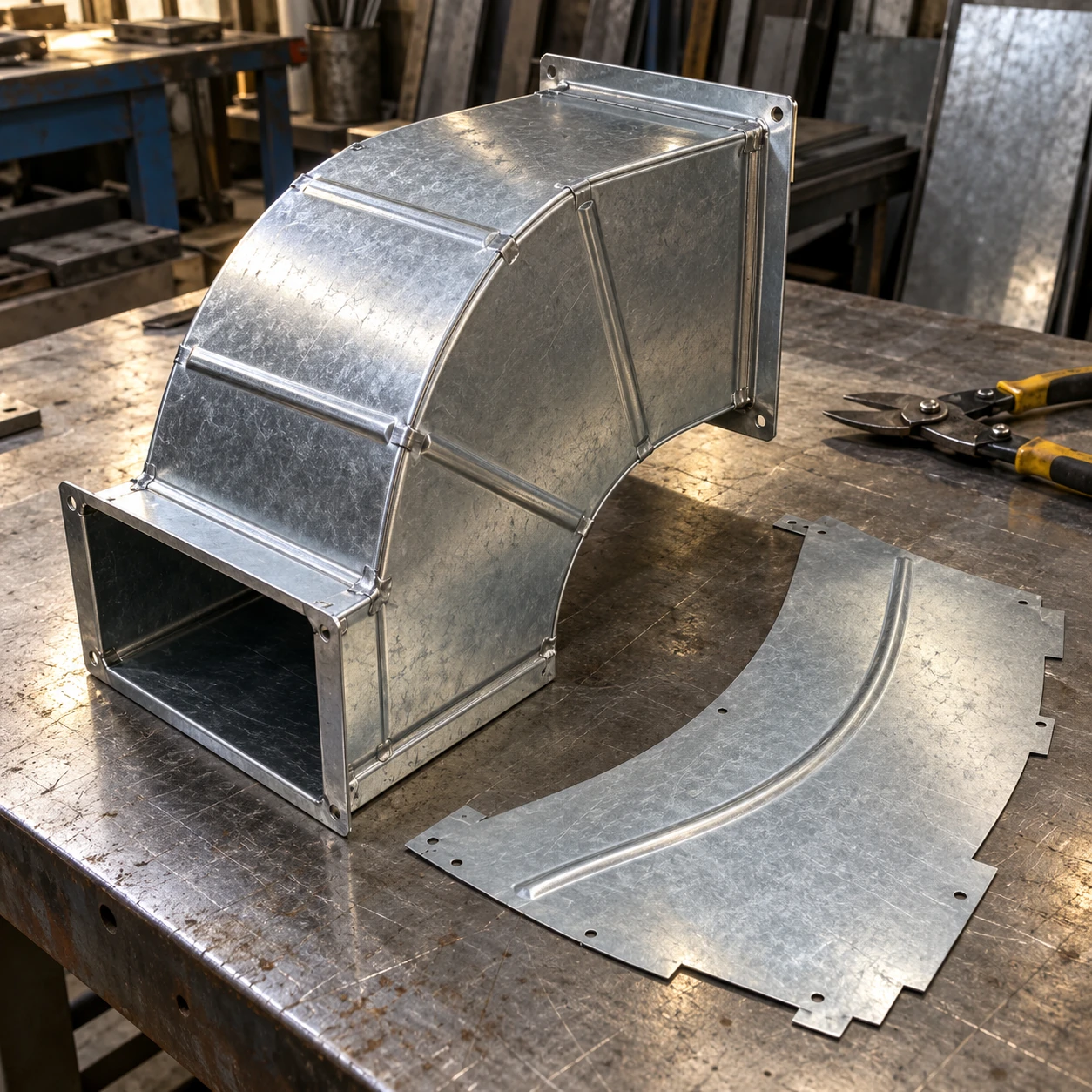
Fabrication details that remain in service
sheet metal duct elbows
| Rectangular opening W × H (mm) | 300 × 200 / 500 × 300 / 800 × 400 |
|---|---|
| Round nominal bore (mm) | 160 / 250 / 400 / 630 |
| Sheet material | Galvanized steel, stainless steel or aluminum |
| Forming | Folded rectangular or segmented circular construction |
| Seams | Specified lockseam or welded arrangement |
| Stiffening / ends | Coordinated beads, reinforcement and connection frame |
Sheet thickness and reinforcement depend on dimensions, material and pressure duty. Gauge numbers are not interchangeable across all materials.
Sheet metal duct elbows can be configured around the fabrication detail, duct route and operating conditions.
Sheet-metal elbow quality is visible in more than its outer shape. Seam placement, flange squareness, local stiffening and the finish at internal joints all affect whether the fitting connects cleanly and remains serviceable after installation.
From developed panels to an air passage
A rectangular bend is assembled from side cheeks and the surfaces forming the throat and heel. A round fabricated elbow uses curved segments. In both cases, allowance for forming and joining must preserve the intended opening and end orientation. A geometrically correct outside profile can still conceal an internal step or a distorted connection.
Inspect the features that will be difficult to reach later
- Internal edges: check for projecting fasteners, unfinished edges or seam lips that could interfere with cleaning or the intended air stream.
- Joint preparation: keep surfaces appropriate for the selected sealant or gasket, with no damage preventing consistent contact.
- End frames: confirm squareness, straightness and mating dimensions before the elbow is packed or lifted into a congested location.
- Vane attachment: where fitted, the internal guides should follow the specified geometry and remain securely located.
Strength and tightness require separate decisions
Increasing sheet thickness can address one aspect of stiffness, but does not seal a seam. Adding sealant can reduce a leakage path, but does not correct a weak panel or an unsupported joint. The fabrication specification should distinguish material, reinforcement, seam construction and leakage requirements.
Protect the manufactured shape
Stacking fittings on their collars or dragging a flange across a floor can damage an otherwise acceptable part. Pack and support the elbow on suitable surfaces, keep the ends protected, and inspect it on arrival before incorporating it into a long run.
Keep the drawing useful for replacement
Retain opening dimensions, bend plane, connection detail and any nonstandard straight ends. When a future part is needed, those details are more useful than a photograph alone. Material choices are discussed in metal duct elbows; interface checks are covered in rectangular elbow installation details.
Sheet metal duct elbows can be configured around the fabrication detail, duct route and operating conditions.