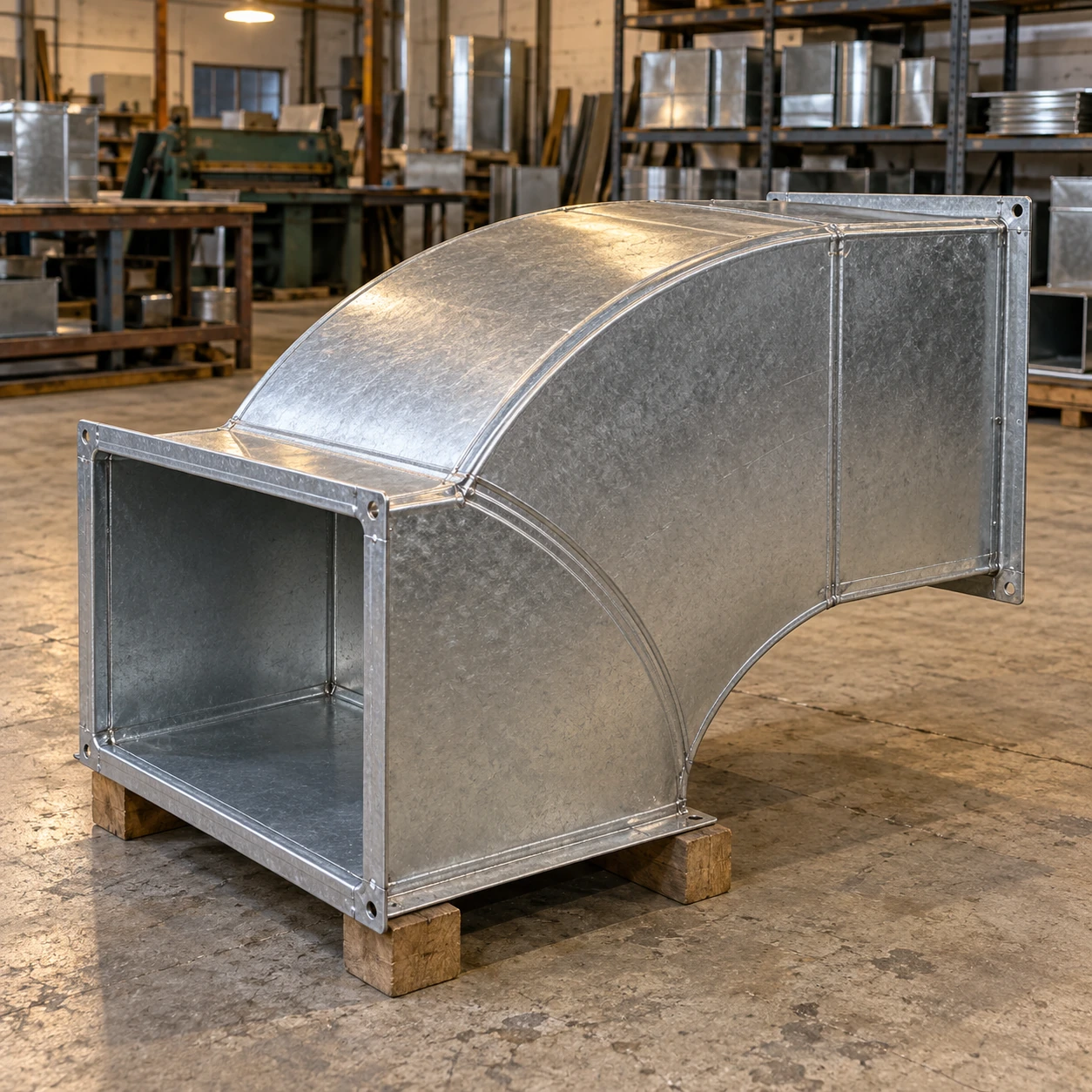
Rectangular airflow passages
rectangular duct elbows
| Clear opening W × H (mm) | 300 × 200 / 500 × 300 / 800 × 400 |
|---|---|
| Bend angle | 45° or 90° |
| Geometry | Radius throat and heel; compact mitered alternatives |
| Air guides | Vanes or splitters where specified for the geometry |
| Body / connection | Galvanized or stainless sheet; slip or flanged ends |
| Construction | Single skin, externally insulated or double skin |
Width and height describe the air opening. Flanges, stiffeners and insulation add to the installed envelope.
Rectangular duct elbows can be configured for the required opening, route and air duty.
Rectangular elbows keep the duct passage compatible with wide, shallow distribution runs. Their performance depends on the side that turns: rotating the same opening into a different bend plane changes both the footprint and the passage through the corner.
The throat and heel work together
The throat is the inside of the turn and the heel is the outside. A generous curved throat can provide a smoother route than an abrupt internal corner, but requires more space. A sharp outer heel does not necessarily mean the entire passage has a sharp inner turn. Read the section drawing rather than identifying the elbow only from its external box shape.
Two ways to manage a tight corner
Radius passage with splitters
Curved splitter plates divide the passage into narrower turning channels. Their shape and position belong to the bend design. Adding an arbitrary plate after fabrication can create narrow channels, loose edges or a different resistance from the intended arrangement.
Mitered passage with turning vanes
A vane bank guides air around a compact corner. Vane curvature, spacing and secure attachment matter together. The assembly must remain accessible if the air carries deposits; a dense bank in a dirty extract system can introduce a cleaning problem.
Wide panels need a construction decision
A broad side panel can flex under positive or negative pressure. Sheet thickness, joint stiffness and reinforcement must therefore be selected for the opening and operating pressure, rather than copied from a smaller elbow. External stiffeners also occupy space that the duct opening does not describe.
Keep the internal opening consistent with the adjoining run. If the elbow also reduces or enlarges the duct, show both ends and the transition explicitly. An accidental internal step is not a substitute for a designed transition.
Rectangular duct elbows can be configured for the required opening, route and air duty.