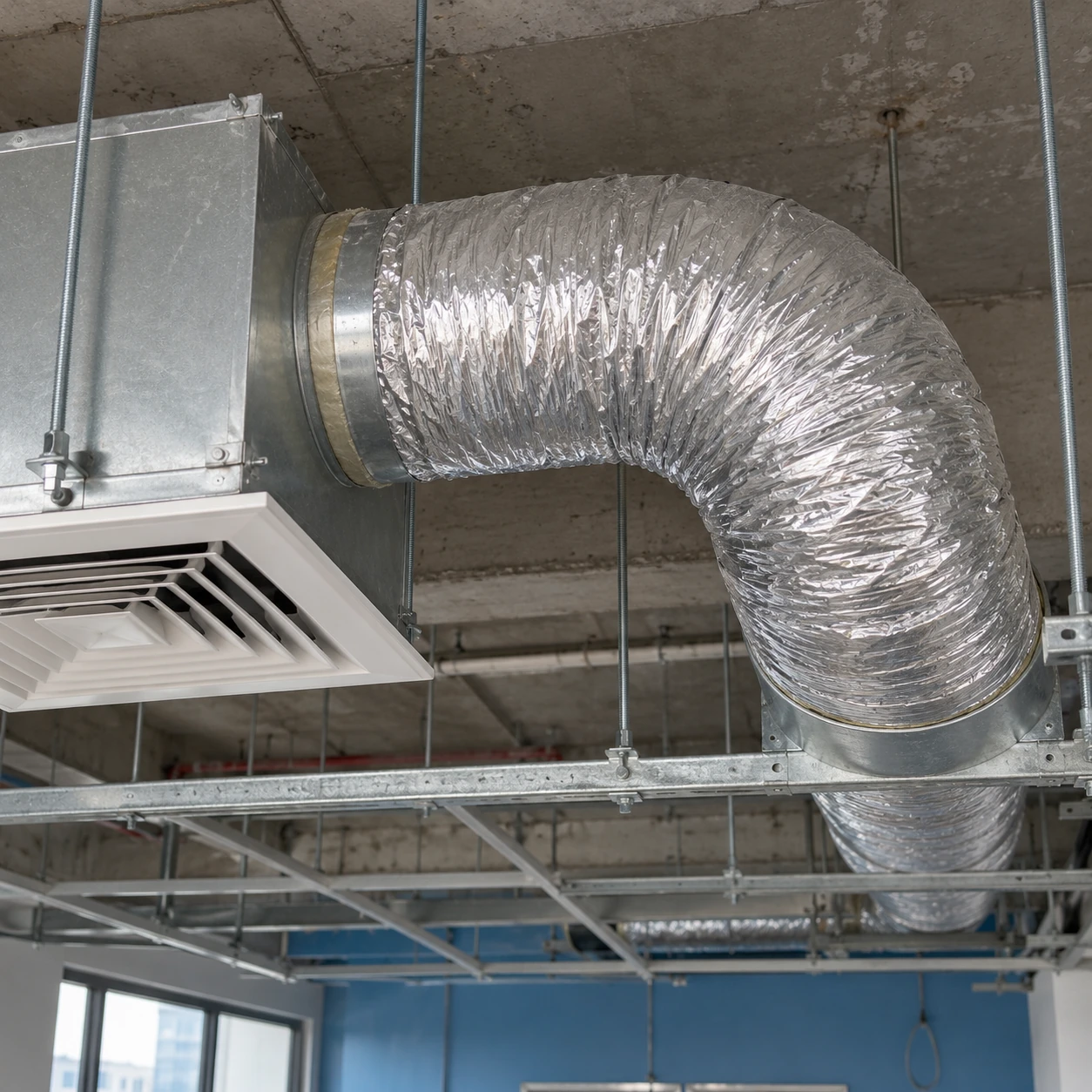
Supported turns in flexible air duct
flex duct elbows
| Nominal flexible-duct sizes | 4 / 6 / 8 / 10 / 12 inch |
|---|---|
| Nominal bore equivalents (mm) | 101.6 / 152.4 / 203.2 / 254 / 304.8 |
| Turn arrangement | Supported flexible curve or rigid elbow with flexible connections |
| Support | Broad saddle or approved bend support without constriction |
| Connection | Matched collar with liner seal, mechanical restraint and jacket closure |
| Insulation | Retained continuously through bend and connection |
Follow the selected duct manufacturer's minimum bend radius and support instructions. These dimensions describe nominal bore, not insulated outside diameter.
Flexible-duct bend arrangements can be configured for the connection, support space and ventilation application.
A flex duct elbow is an installed bend arrangement, which may use a shaped support or a rigid fitting between flexible sections. Simply folding a flexible duct into a corner can pinch the inner passage even when the outer jacket appears to reach the connection.
Preserve the bore through the turn
The inner liner and wire helix must follow a gradual curve without flattening. Pull unnecessary compression out of the approach run, then provide enough space for the bend required by the duct manufacturer. The outer jacket can hide a kink, so check the liner position while the connection remains accessible.
A strap that is too narrow or too tight can create the restriction it was intended to prevent. Use a broad supporting surface and retain clearance from beams, pipes and other services that could press against the bend.
Which arrangement fits the location?
- There is room for a broad curve
- A supported flexible turn can accommodate the route while preserving a short, direct connection. Avoid extra loops introduced merely to use up surplus duct.
- The turn is close to a rigid collar
- Provide a straight supported approach so the duct does not hinge sharply over the collar edge. A suitable rigid elbow can move the direction change into a controlled metal passage.
- The ceiling void is too shallow
- Review the route or fitting geometry. Compressing the duct to fit the void changes its air passage and insulation thickness; it is not equivalent to selecting a shallow rigid duct.
Seal the liner, then close the insulation
The air seal belongs at the liner-to-collar interface. Mechanical restraint holds that connection, while the outer jacket closure protects the insulation and vapor-control layer. Finishing only the outer foil can leave an unseen air leak beneath it.
Keep the supporting arrangement visible in the installation record, especially where later electrical or plumbing work could displace it. For cold supply air, read the condensation considerations in AC duct elbows. The adjoining flexible air duct must be selected for the same duty.
Flexible-duct bend arrangements can be configured for the connection, support space and ventilation application.