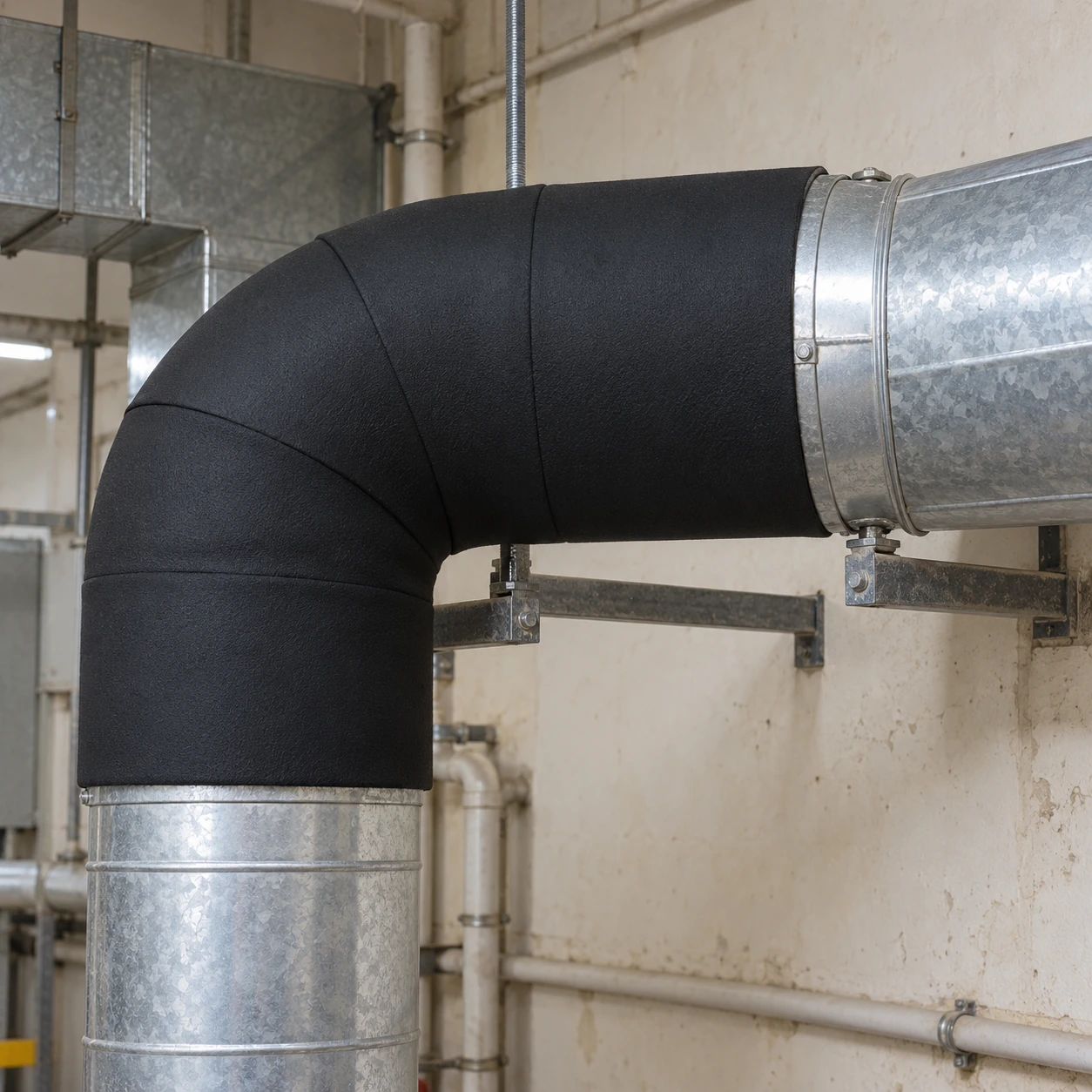
Air-conditioning supply and return routes
ac duct elbows
| Round nominal bore (mm) | 100 / 125 / 160 / 200 / 250 |
|---|---|
| Rectangular opening W × H (mm) | 300 × 200 / 500 × 300 |
| Angle | 45° or 90° |
| Air passage | Rigid metal radius elbow or specified guided corner |
| Thermal finish | External insulation with sealed vapor-control joints |
| Connections | Matched collars or flanges; insulated interfaces |
Sizes refer to the metal air passage. Insulation thickness is selected for air temperature and ambient humidity.
AC duct elbows can be configured for the air-conditioning layout and local operating conditions.
An air-conditioning elbow must carry the required air through a confined route while maintaining the insulation around cold surfaces. The metal joint, insulation seam and support detail solve different problems and should be specified as one installation.
A cold corner can become a wet corner
Where the duct surface is below the surrounding air's dew point, exposed metal can collect condensation. Bends are vulnerable because insulation is cut, stretched or joined around the curve. A gap at the inner throat or a compressed section beneath a support can leave a locally cold surface even when the straight run looks well insulated.
Use a continuous insulation build-up around the fitting, including the connection and hanger detail. Seal the vapor-control layer at seams and penetrations. Air sealing comes first: insulation should not conceal an unsealed duct connection that will be difficult to repair later.
Protect the terminal's air supply
A tight turn immediately before a diffuser or small plenum can deliver a strongly uneven inlet stream. The resulting hiss or poor room distribution may be caused by the route rather than the terminal. Preserve a suitable approach to the inlet and compare the bend against the available fan pressure before choosing a smaller, tighter fitting.
Keep flexible connections open
Flexible duct pushed against a beam can flatten at the turn. A rigid elbow may be useful where it fits, with the flexible section connected on a straight collar. Where a flexible bend is retained, support its curve without squeezing the jacket or internal helix.
Repair the cause of recurring moisture
Inspect the metal joint and insulation beneath the wet area, including the upper surface that is hard to see from below. Replacing stained ceiling material alone does not restore the thermal or vapor barrier. Provide access to the elbow and serviceable joints wherever the route makes later inspection difficult.
For connection support options, see flex duct elbows; for the adjoining duct, see insulated flexible air duct.
AC duct elbows can be configured for the air-conditioning layout and local operating conditions.