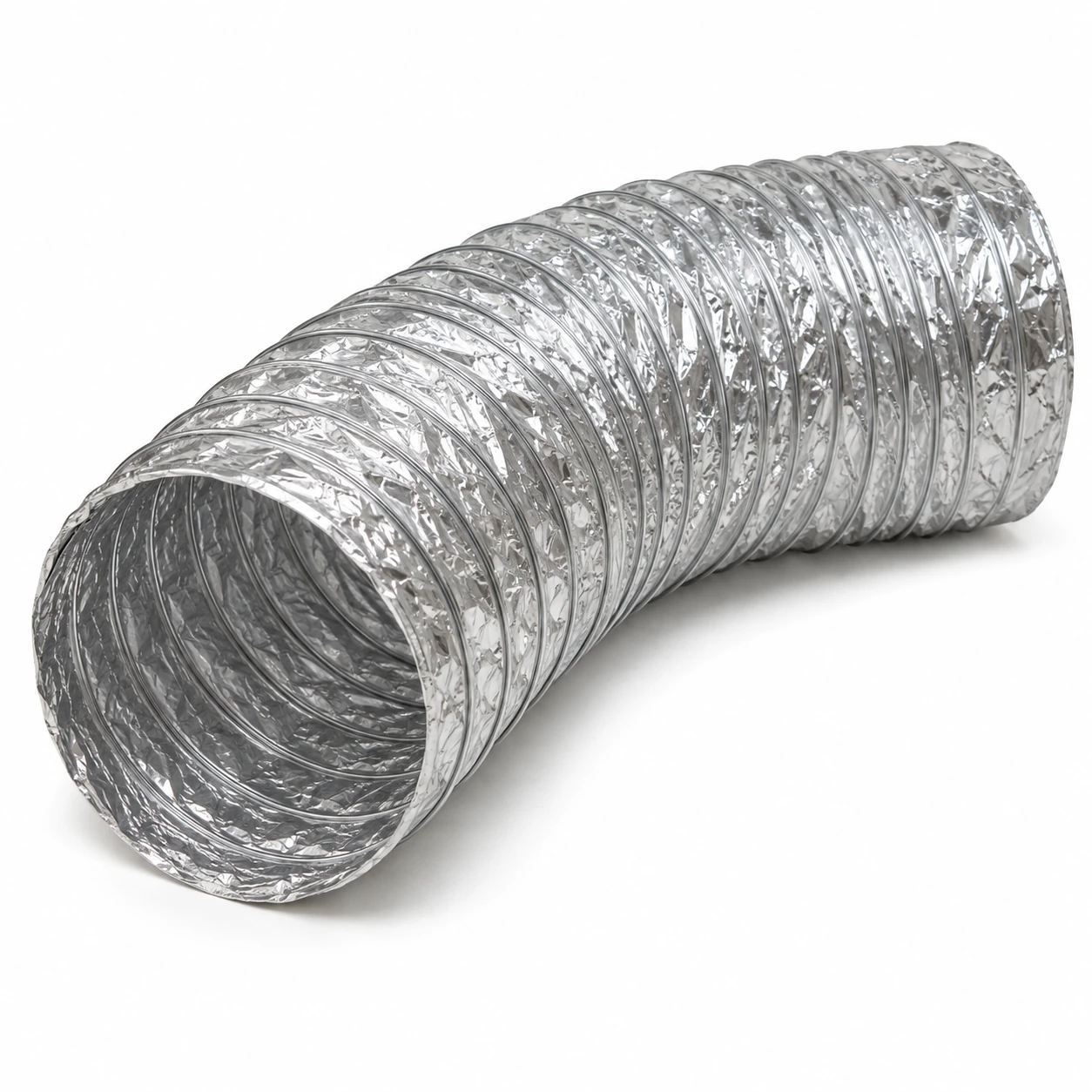
Flexible Air Ducts
flexible air duct
| Brand | shengtongJH |
|---|---|
| Nominal bore options | 127 / 152 / 203 / 254 / 305 / 406 / 508 mm; other sizes by connection drawing |
| Inner construction | Aluminium/polyester laminate supported by a steel-wire helix |
| Insulation choices | Uninsulated or glass-wool insulated construction |
| Outer jacket | Foil laminate vapour jacket on insulated versions |
| Supply length options | 10 m fully extended pack or agreed cut lengths |
| Connections | Round slip collars with compatible seals and mechanical clamps |
| Air service | General ventilation and conditioned-air distribution |
| Installation location | Protected indoor locations; weather exposure needs a different specified assembly |
| Pressure selection | Positive and negative pressure ratings selected separately |
| Temperature selection | Liner, adhesive, jacket and seal limits must all suit the air temperature |
| Accessories | Collars, clamps, supports and compatible closure materials |
These are selectable construction and size options. The ordered assembly determines pressure, temperature, insulation and fire-performance ratings.
Bore, cut length, insulation and connection accessories can be customized to the industrial installation and operating conditions.
Flexible air duct connects rigid ductwork to terminals or equipment where a short, adaptable route is useful. A good selection starts with the air being carried and the available space, then matches the duct construction to the pressure and temperature of that particular connection.
Use flexibility where it earns its place
A rigid main duct gives a defined route through a workshop, warehouse or commercial plant room. A flexible final connection helps accommodate small offsets between that route and a diffuser, grille or equipment spigot. It can also make later removal of a terminal less disruptive. Flexibility does not remove the need for a planned route: a long coil hidden above a ceiling can turn a straightforward connection into an unnecessary restriction.
For a new installation, mark both connection positions before ordering. Leave room for the duct to approach each collar without folding sharply at the mouth. If the route needs several tight changes of direction, formed rigid bends with a shorter flexible section are often a more practical arrangement.
Air inside
Ordinary ventilation air and cooled supply air call for different insulation decisions. Chemical vapours, abrasive dust and hot process exhaust need purpose-selected materials; a general foil duct should not be substituted solely because the diameter fits.
Space outside
The outside diameter of an insulated duct exceeds its nominal bore. Include the jacket, support and bend envelope when checking ceiling voids. Compressing the insulation to fit a gap undermines the reason for specifying it.
Pressure through the route
A round opening does not establish an airflow rating. The fan, duct length, bends and terminal resistance all affect delivery. State the target airflow and available pressure when comparing constructions.
Order the connection as a small assembly
Include collars, sealing materials and suitable supports in the purchasing scope rather than leaving these decisions to whoever unpacks the hose. Keep the supplied duct identification with the installation record. For cooled air in a warm ceiling void, review insulated flexible air duct before choosing the lowest-cost bare liner.
Bore, cut length, insulation and connection accessories can be customized to the industrial installation and operating conditions.