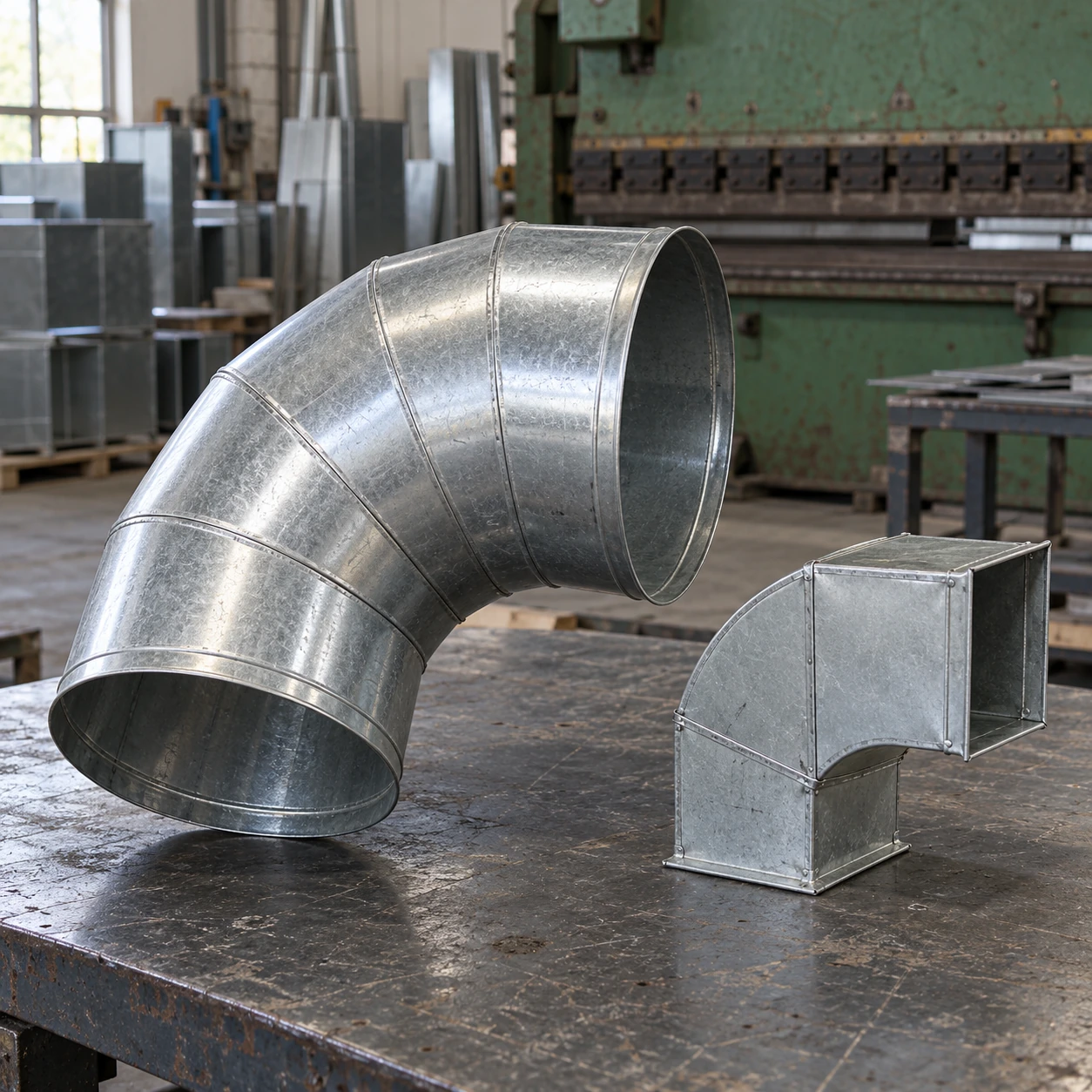
Direction changes in ventilation ductwork
duct elbows
| Cross-section | Round or rectangular |
|---|---|
| Round nominal bore (mm) | 100 / 160 / 250 / 400 |
| Rectangular opening W × H (mm) | 300 × 200 / 500 × 300 / 800 × 400 |
| Direction change | 30° / 45° / 60° / 90°, according to construction |
| Body | Galvanized steel, stainless steel or aluminum |
| Ends | Spigot, slip connection, clamped collar or flange |
Opening dimensions exclude flanges, reinforcement and insulation. Bend radius, wall thickness and end details are selected together.
Duct elbows can be configured to suit the application, duct interfaces and installation space.
A duct elbow turns an air path around a wall, beam or equipment connection. The opening must match the adjoining duct, but the space occupied by the turn and the way air passes through it are equally important. A fitting that connects successfully can still leave a noisy or difficult-to-maintain installation.
Choose the passage before the connection
A curved elbow guides the air through a gradual change of direction. A compact mitered corner saves space, but creates a different flow pattern; a properly designed vane assembly can help guide air through that corner. Neither shape has one universal pressure loss. The result depends on the bend geometry, air velocity and the duct immediately before and after it.
Start with the route and required airflow. Then compare the available bend envelope with the resistance allowed in the system. Enlarging a fan to overcome a poorly arranged corner may leave the underlying noise and flow imbalance unresolved.
What passes through the elbow?
For ordinary supply air, joint sealing and thermal insulation may dominate the choice. For extraction carrying particles, the outer curve, internal steps and access for removing deposits need attention. For damp or chemically contaminated air, the body, fasteners, sealant and gasket must all suit the exposure; a material name alone is insufficient.
Can the fitting be installed and removed?
Leave room around a flange for bolts and tools. A clamped connection also needs clearance to open the clamp. Supports should carry the fitting and adjacent duct without forcing the elbow into alignment. An accessible joint is useful only if the elbow can actually be withdrawn past nearby services.
Define the complete turn
A useful purchase drawing shows the inlet and outlet, the plane of the bend, the radius convention, straight ends and connection detail. Add the air duty and whether the installation is indoors or exposed. That information separates a fitting that merely shares the right bore from one that suits the run.
Explore round duct elbows for circular connections or rectangular duct elbows for low-height routes and wide openings.
Duct elbows can be configured to suit the application, duct interfaces and installation space.