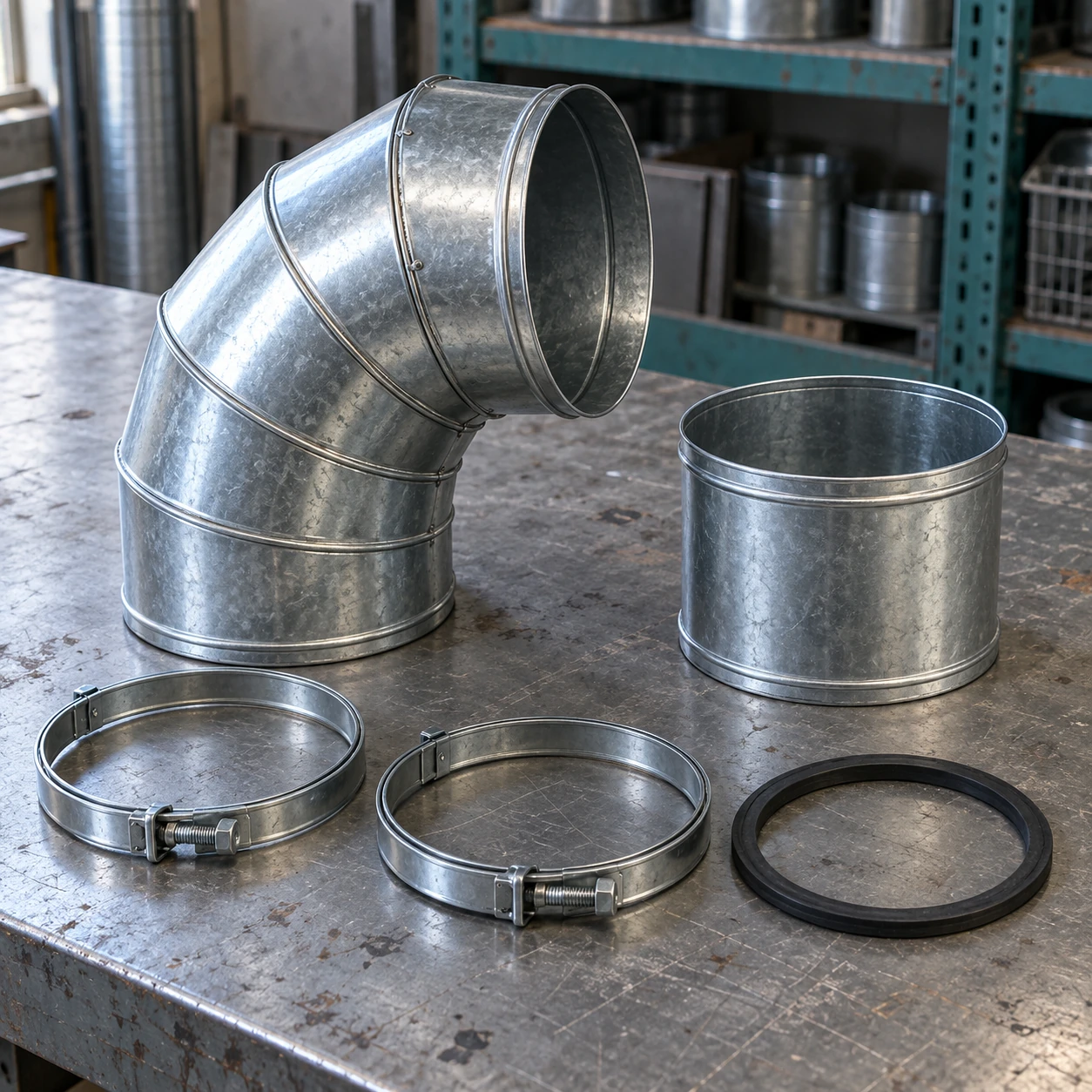
The elbow and its connection parts
duct elbows fittings
| Round nominal bore (mm) | 100 / 160 / 250 / 400 |
|---|---|
| Rectangular opening W × H (mm) | 300 × 200 / 500 × 300 / 800 × 400 |
| Bend angles | 45° or 90°; other angles by construction |
| Joining system | Spigot and sleeve, clamped collar or bolted flange |
| Companion parts | Matching coupling, seal, clamp or fastener set as specified |
| Supply scope | Elbow only or coordinated connection package |
Connection accessories are specified separately in the quotation. Matching nominal dimensions do not prove interchangeability between systems.
Duct elbow fittings and connection accessories can be configured for the installation and maintenance method.
An elbow is only one part of a completed duct joint. The required sleeve, clamp, gasket or bolt set depends on how its ends were formed and what is already installed. Defining that interface early avoids a fitting arriving with no compatible way to connect it.
Choose a connection package that closes the joint
- Spigot and sleeve
- Establish which parts are male and female, the required insertion and the sealing method. Two spigots of the same size can still require an intervening coupling. Retention must suit the system as well as the available overlap.
- Clamped collar
- The collar profile, clamp and seal form one joint system. Similar diameter is not enough to establish compatibility. Leave room to release the clamp if the elbow is intended to be removable.
- Bolted flange
- Match the flange dimensions, hole arrangement, gasket and fasteners. Include room for tools around the perimeter. A rotating flange can help alignment only where that construction has actually been specified.
Separate a joint from a transition
A coupling joins compatible ends. A transition changes opening size or shape. Combining those functions requires a defined component; forcing one duct over a different size does not create a controlled transition. Where round and rectangular runs meet, record both openings and the available length for the change.
Make the delivery list match the assembly sequence
List the elbow, each end connection and the associated seals or fixings. Identify which items are supplied loose and which are fitted to the body. If the surrounding duct is already installed, confirm whether there is enough movement to engage a sleeve or whether a removable section is needed.
Keep spare seals identifiable for joints that will be opened during maintenance. Reusing a damaged gasket after removing an elbow can introduce leakage even when all metal components remain undamaged.
For circular fitting geometry, see round duct elbows. For existing rectangular frames, see rectangular elbow interface planning.
Duct elbow fittings and connection accessories can be configured for the installation and maintenance method.