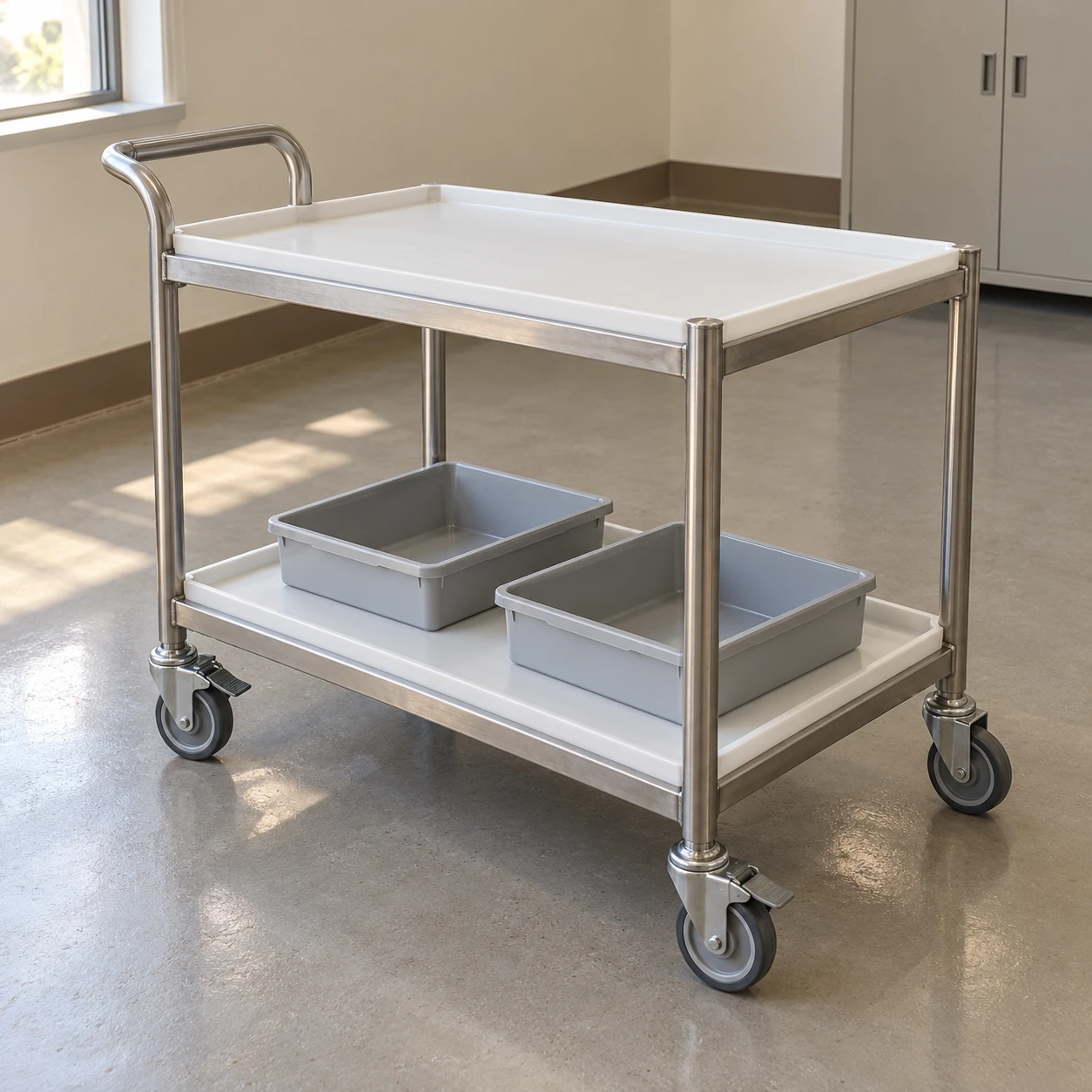
Cleanroom Trolleys & Storage Racks
cleanroom carts
| Overall W × D × H | 648 × 465 × 965 mm; 927 × 627 × 965 mm |
|---|---|
| Shelf arrangement | Two levels; removable decks or fixed shelves selected around the containers |
| Frame and deck | 304 stainless steel frame with polypropylene decks; stainless shelf configurations also available for selection |
| Surface and edges | Solid or open construction; raised edges or removable trays where small items need support |
| Mobility | Manual push handle; caster tread, swivel arrangement and brakes selected for the route |
| Load specification | Whole-cart moving load and each shelf load specified separately |
| Process requirements | Cleaning compatibility, product covering and any ESD requirements defined for the application |
Overall dimensions include the cart structure and are rounded to the nearest millimetre; they are not clear shelf dimensions. Final dimensions, components and permissible loads depend on the selected assembly.
Cart dimensions, shelf materials, handles and mobility options can be customized to the material flow and working environment.
Cleanroom carts move containers, tools and work in progress between receiving points, storage and workstations. Their usefulness depends on how the load is supported and protected, how the cart enters the work area, and how easily the complete assembly can be cleaned after the trip.
Design the transfer, then choose the cart
A cart can make material movement easier while still creating an awkward handover. A container may fit on the shelf but be difficult to lift past the handle. A trolley may pass through a doorway yet leave too little room to turn beside the receiving bench. Start with the actual container, its closed height and the place where the operator removes it. The useful carrying area is the space between posts and retaining edges, not simply the outside footprint.
Load at a defined point
Provide a stable staging surface and keep clean items separate from returned containers. Load the cart so the operator can see the route and reach the handle without leaning across the material.
Move without repacking
Choose shelf gaps around the containers with their lids fitted. Suitable trays or dividers reduce loose movement, while an accessible handle keeps hands away from the load during steering.
Unload in a useful order
Place frequently needed items where they can be removed without moving another container. Leave room to operate brakes and open lids when the cart is parked at its destination.
When an open cart works well
Open shelves provide quick access to closed bins, wrapped supplies and tools in compatible containers. Operators can see what remains on the cart and identify the next item without opening a cabinet. A removable solid deck supports small containers and can be taken off for cleaning, provided its underside and support rails are also accessible.
A wire or perforated shelf allows visibility through the structure, but small feet and flexible bags may need a suitable tray. Adding a liner changes the cleaning task: it creates an additional surface and an interface beneath it. Select that accessory deliberately rather than leaving a temporary sheet in place indefinitely.
When the product needs more protection
An ordinary cart does not filter the air around an exposed component. Closed containers or suitable covers can reduce exposure during transport, but a cover is not a controlled airflow enclosure. For a process that requires filtered air during movement, consider a purpose-built Laminar Flow Cart and define its operating conditions separately.
Cover access also matters. A cover that is difficult to remove at the receiving station may be left open in practice. Check how the operator opens it, where it is stored and whether the material can be transferred without dragging the cover over a clean surface.
Decide what crosses the room boundary
A cart that travels through a general corridor brings its wheels and lower frame along with the load. Wiping only the top shelf does not address those surfaces. Define whether one cart stays within a controlled zone, whether containers are transferred to a separate cart at the boundary, or whether the complete cart follows an approved cleaning and entry procedure. The right arrangement depends on the process and available space.
The cleaning station needs access to the push handle, shelf undersides, joints and caster forks. Removable decks make some surfaces easier to reach, but the operator still needs somewhere clean to place and dry them. A cart should return to service in a defined condition, with the correct decks fitted and its brakes functioning, rather than becoming an unassigned storage rack between trips.
Make the receiving point part of the purchase
At a bench, the cart needs parking space that does not block the operator or the next load. Compare shelf access with the receiving surface and the way items are lifted or slid across. A small mismatch may be manageable for light closed trays but unsuitable for a heavy instrument with projecting feet. Do not use a loose bridging plate to compensate for an unplanned transfer gap.
For an established workstation, review the cart alongside the Cleanroom Workbenches configuration. Together, their access sides, handles and parking positions determine whether the handover can be completed comfortably.
Specify a complete working combination
A useful quotation identifies the largest container, load distribution, route, cleaning products and receiving arrangement. Add any restrictions on exposed metal, polymer components or static control. These details allow the shelf, frame and caster combination to be assessed together; a material name alone does not establish a cleanroom classification or an ESD performance level.
For repeat purchases, retain the agreed assembly drawing and replacement-part details. A later caster substitution can change overall height, rolling behaviour and cleaning compatibility even when the cart appears similar. Keeping the configuration identifiable makes maintenance and future additions more consistent.
Cart dimensions, shelf materials, handles and mobility options can be customized to the material flow and working environment.