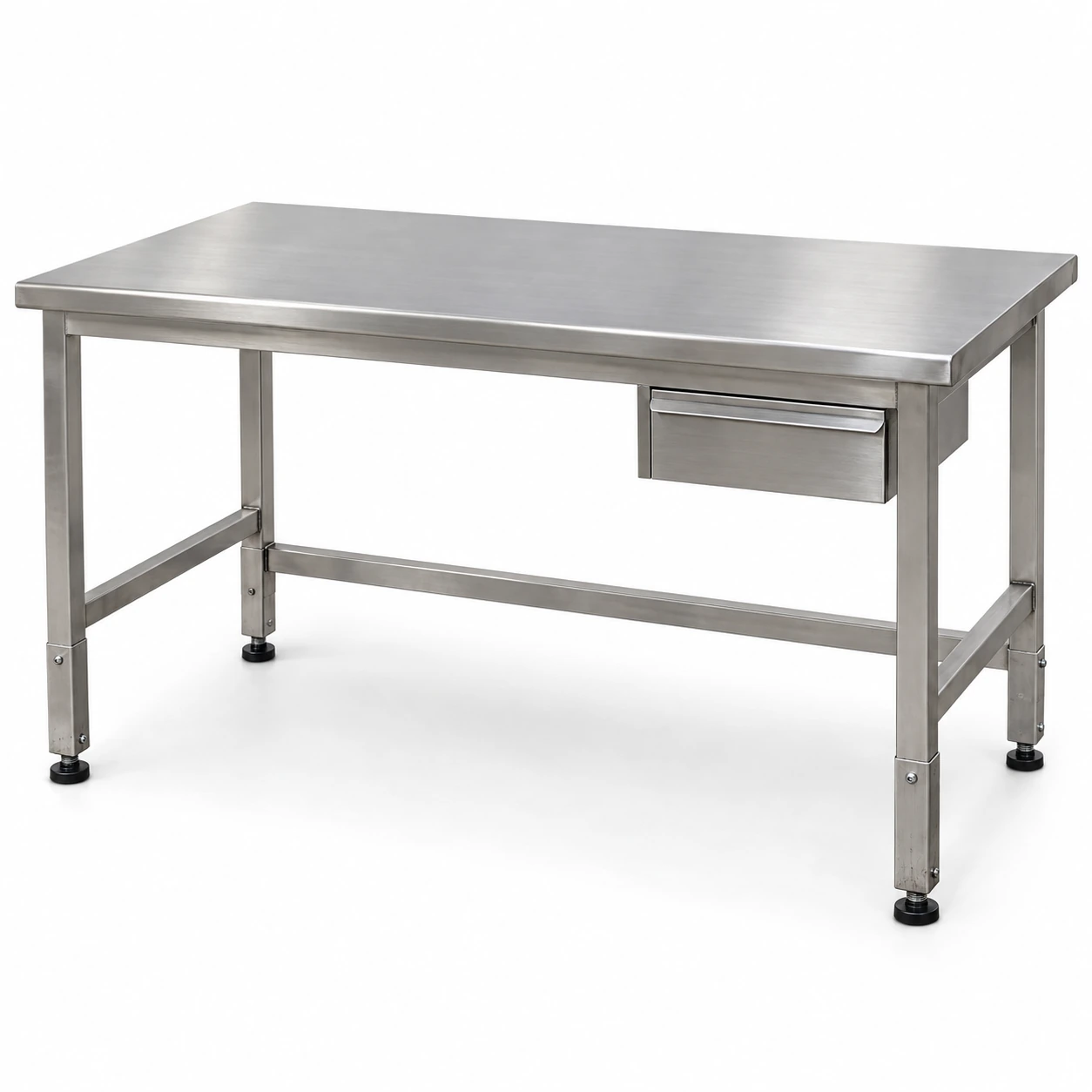
Cleanroom Tables, Benches & Stools
Cleanroom Workbenches
| Worktop W × D (mm) | 1219 × 610; 1524 × 762; 1829 × 914 |
|---|---|
| Worktop height (mm) | Fixed-height base or manual adjustment option of 635–864 |
| Contact surface | 304 or 316L stainless steel; sealed laminate or dissipative laminate |
| Top construction | Solid top; perforated stainless steel option |
| Support and feet | Stainless steel or coated steel frame; leveling feet or locking casters |
| Storage accessories | Drawers, lower shelf or rear shelf selected around working clearance |
| ESD option | Dissipative surface with coordinated grounding connections |
| Load capacity | Specified for the selected top, base and load distribution |
Metric dimensions are rounded from nominal inch sizes. W × D is the worktop plan size; height is measured from the floor to its upper surface. Options are combined as a matched package, with overall dimensions and rated loading stated on the approved drawing.
Cleanroom workbenches can be customized in size, surface, height, storage and ESD configuration for your production process and cleaning requirements.
Cleanroom workbenches provide a cleanable, stable working surface for assembly, component packing and laboratory handling. The useful configuration depends on what rests on the top, how people reach the work and how the whole bench will be cleaned. Surface material, support frame and accessories need to work together.
Start with the workpiece and the fixture
A bench that holds one instrument may need a different depth from a bench used to unpack trays and assemble parts. Place the actual workpiece, fixture and incoming material on the layout first. Leave a usable front working area instead of allowing equipment and storage bins to fill the whole surface.
For seated work, the apron, drawer and cross-bracing must leave room for knees and feet. For standing tasks, consider the height of the operation above the tabletop: a tall fixture can make a comfortable empty bench awkward to use. Occasional mechanical height adjustment suits a stable task; frequent changes between operators may justify a purpose-selected lifting base. The adjustment method and its load restrictions belong in the complete bench specification.
Choose the contact surface around the process
Solid stainless steel
A continuous top supports small parts, trays and instruments without openings beneath them. Smooth joints and accessible edges help routine wiping. Select the steel grade and finish against the cleaning agents, exposure and contact requirements; a stainless surface is not resistant to every chemical.
Sealed laminate
Laminate can provide a practical assembly surface where its cleaning and wear characteristics suit the task. Edge sealing and protected cutouts matter because exposed substrate and damaged seams are difficult to keep in service. Evaluate cleaners against the complete surface construction, including the edge treatment.
Dissipative work surface
Electronics handling may call for a documented dissipative contact surface. Select it with the personnel, fixtures and grounding arrangements in the ESD control programme. A metal frame or an ESD label alone does not establish the performance of the assembled workstation.
A load rating needs a load arrangement
A heavy instrument standing on four small feet applies a different demand from evenly distributed cartons. Supply its weight, footprint and support-point positions, together with any off-centre fixture, clamping force or moving mechanism. The top, reinforcing members, joints, legs and feet all contribute to the usable capacity.
Ask for the rating of the selected assembly and the conditions attached to it. Adding casters or a lifting base can change the applicable limit. A bench that carries the weight may still be unsuitable for precision measurements if it flexes or transmits vibration; dedicated isolation requires a separate design decision.
Keep the space below the bench useful
An open base favours access
Open knee space helps seated assembly, while clear floor access makes cleaning and equipment removal easier. Position braces where they support the structure without crossing the operator's feet or blocking the planned cart. Leveling feet suit a fixed working position; casters suit planned movement and need a suitable locking arrangement.
Storage saves reach but occupies space
A shallow drawer can keep frequently used tools off the top. A lower shelf can hold replenishment material, but it also adds a surface to clean and can obstruct access below. Use only the storage needed at the station, with enough clearance to open drawers and remove their contents without disturbing exposed work.
Fit the bench to the room's air path
A perforated top can let room air pass through where the ventilation arrangement benefits from that opening. Its usefulness depends on what covers the top and what sits below it. Solid trays, shelf contents and large equipment can block the intended path. Hole size, open area and support for small components therefore need to be considered together.
A furniture workbench does not supply filtered air or establish a cleanroom classification. Where the operation needs a local filtered working zone, consider a vertical flow clean bench as a separate equipment selection. Tasks dominated by viewing and defect recognition can use the lighting and sample-handling arrangements discussed under Cleanroom Inspection Workstations.
Cleaning reaches beyond the top
The underside, frame joints and fittings remain part of the working environment. During selection, examine the places that become difficult to reach once the bench is installed:
- Folded edges, open tube ends and fastener recesses where residues can collect.
- Drawer runners, shelf brackets and cable supports that interrupt a wiping path.
- The gap to the wall and floor needed for the actual cleaning tools.
- Replaceable surface inserts and accessories that must be removed for cleaning.
Agree the cleaner, concentration, contact time and drying method with the selected material supplier. Include any dissipative surface in the cleaning procedure and its electrical verification programme rather than assuming that a visually clean surface still has the required properties.
Define one complete bench package
Send shengtongjh the task layout, workpiece and equipment loads, preferred working position, available floor space and cleaning method. Include any ESD requirements and the accessories used during normal production. These details allow the worktop, base and storage to be coordinated in one configuration, with clear supply boundaries for fixtures, powered fittings and installation.
Cleanroom workbenches can be customized in size, surface, height, storage and ESD configuration for your production process and cleaning requirements.