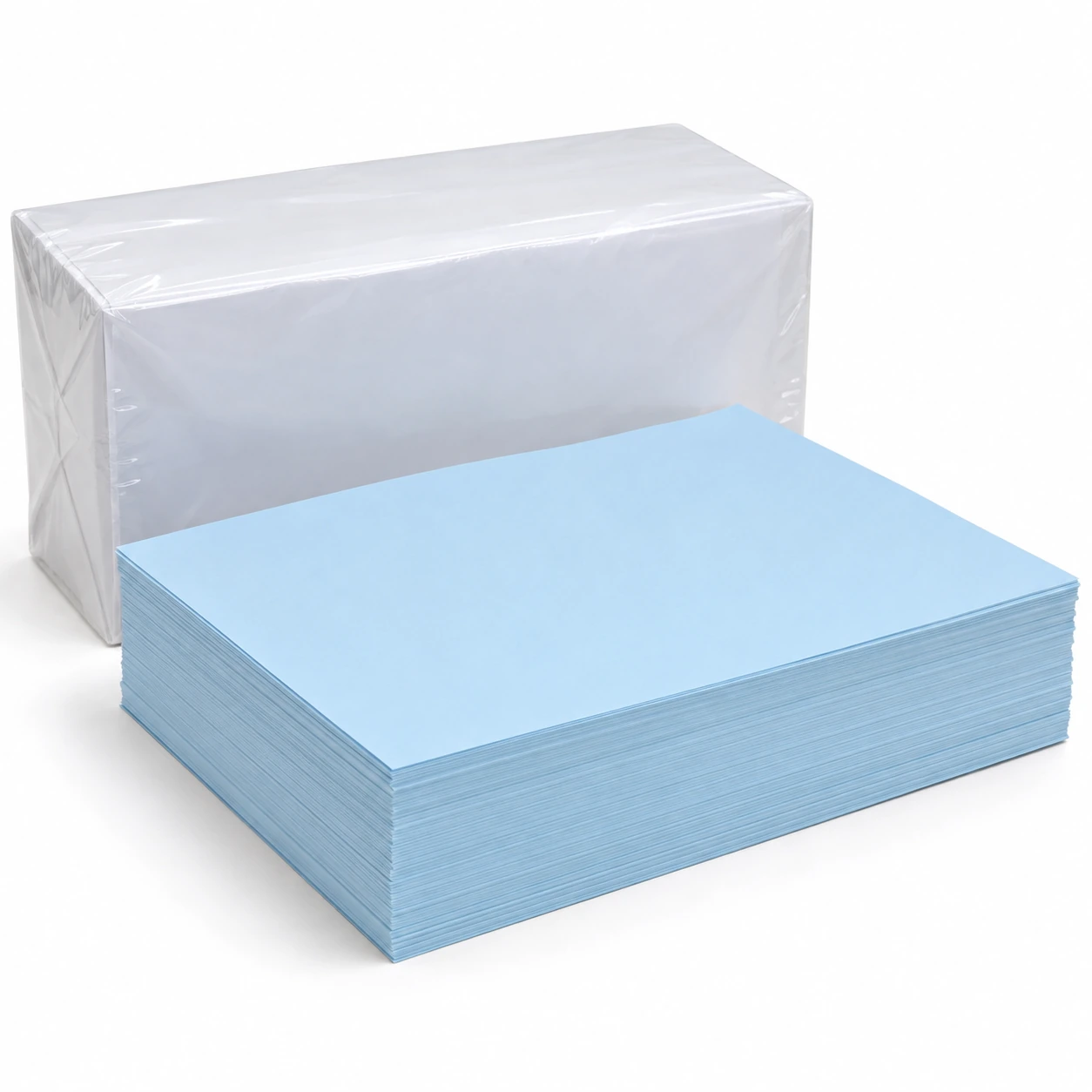
Cleanroom Paper
cleanroom paper
| Material | Cellulose bond paper with a selected polymer treatment to reduce fibre release |
|---|---|
| Sheet formats, width × length (mm) | A4: 210 × 297; US Letter: 215.9 × 279.4; A3: 297 × 420; A5: 148 × 210 |
| Nominal basis weight | 68, 85 or 104 g/m², according to the selected grade |
| Colours | White or blue; yellow, pink and green available in selected grades |
| Sheet finish | Plain unlined sheets; cut edges; selected pre-punched formats |
| Printing and writing | Laser/copier and pen compatibility to be checked with the selected paper |
| Pack choices | 250 or 500 sheets per pack, according to format and grade |
| Transfer packaging | Selected double-bagged packs with product and lot identification |
Sizes are finished-sheet dimensions, not package dimensions. Paper grade, colour, pack count and supporting quality information are specified together; room suitability follows the site's material qualification.
Sheet format, colour, packaging and document requirements can be coordinated for your controlled-area workflow.
Cleanroom paper allows written instructions, production records and inspection forms to enter a controlled workspace with less fibre release than ordinary office paper. The useful choice combines a suitable paper construction with reliable printing, clear records and a controlled route from the sealed pack to the workbench.
Reduce shedding where documents are handled
Turning pages, folding corners and rubbing a sheet against a folder place stress on its fibres. Selected cleanroom bond papers use a coating or polymer reinforcement to hold the fibre structure together and reduce the material released during use. Clean-cut edges and appropriate packaging help preserve that condition before the sheet reaches the process.
The term low-lint describes a contamination-control purpose; it does not mean that no particles can ever be released. Cutting, punching or repeatedly abrading a sheet can create a different condition from the paper originally evaluated. Keep those operations outside the critical area where the site's procedure requires it.
A paper's colour does not establish its cleanliness. Coloured grades can support area or document identification, but the material specification and the way it is used determine whether it is suitable.
Choose the sheet for the record it must carry
Routine forms
A lighter grade can suit short-lived records when it feeds reliably and the printed information remains clear. Evaluate the actual form, especially where both sides are used.
Repeated handling
A heavier sheet may be useful for instructions or records that pass between several people. Check folding, binder capacity and printer limits instead of treating weight alone as a quality ranking.
Detailed layouts
Match the finished format to the document master. Automatic resizing can change margins, signature fields and the readability of small codes or diagrams.
Qualify the paper, ink and printer together
Paper that retains toner well in one printing process may behave differently with liquid ink. Check feed, curl, toner adhesion, writing legibility and any relevant contact with the site's cleaning agents. Allow markings to dry before handling. A generic claim of printer compatibility should not replace a trial using the actual equipment and document.
The printer itself also belongs within the site's contamination-control arrangements. Choosing cleanroom paper does not automatically make an ordinary office printer suitable for a critical zone.
Keep the transfer route consistent
Separate shipping cartons from the clean inner packaging according to the site's entry procedure. Open only the quantity needed, protect unused sheets and retain the pack identification where traceability is required. Repacking leftover sheets from several lots into an unlabelled bag can undo an otherwise clear material-control system.
Low particle release does not establish sterility, electrostatic performance or universal chemical resistance. If the process needs one of those properties, specify it separately and obtain evidence for the selected grade. An acceptable cleanroom classification for the room cannot be inferred from a paper label alone.
Standardise the format
Use the A4 page for metric document workflows or the US Letter page for Letter-based records. They are different sheet shapes and should remain distinct in ordering and storage.
Define repeat supply
The supply specification can combine grade, pack quantity, colour and quality-document requirements so that a later delivery is assessed against the same accepted material.
Sheet format, colour, packaging and document requirements can be coordinated for your controlled-area workflow.