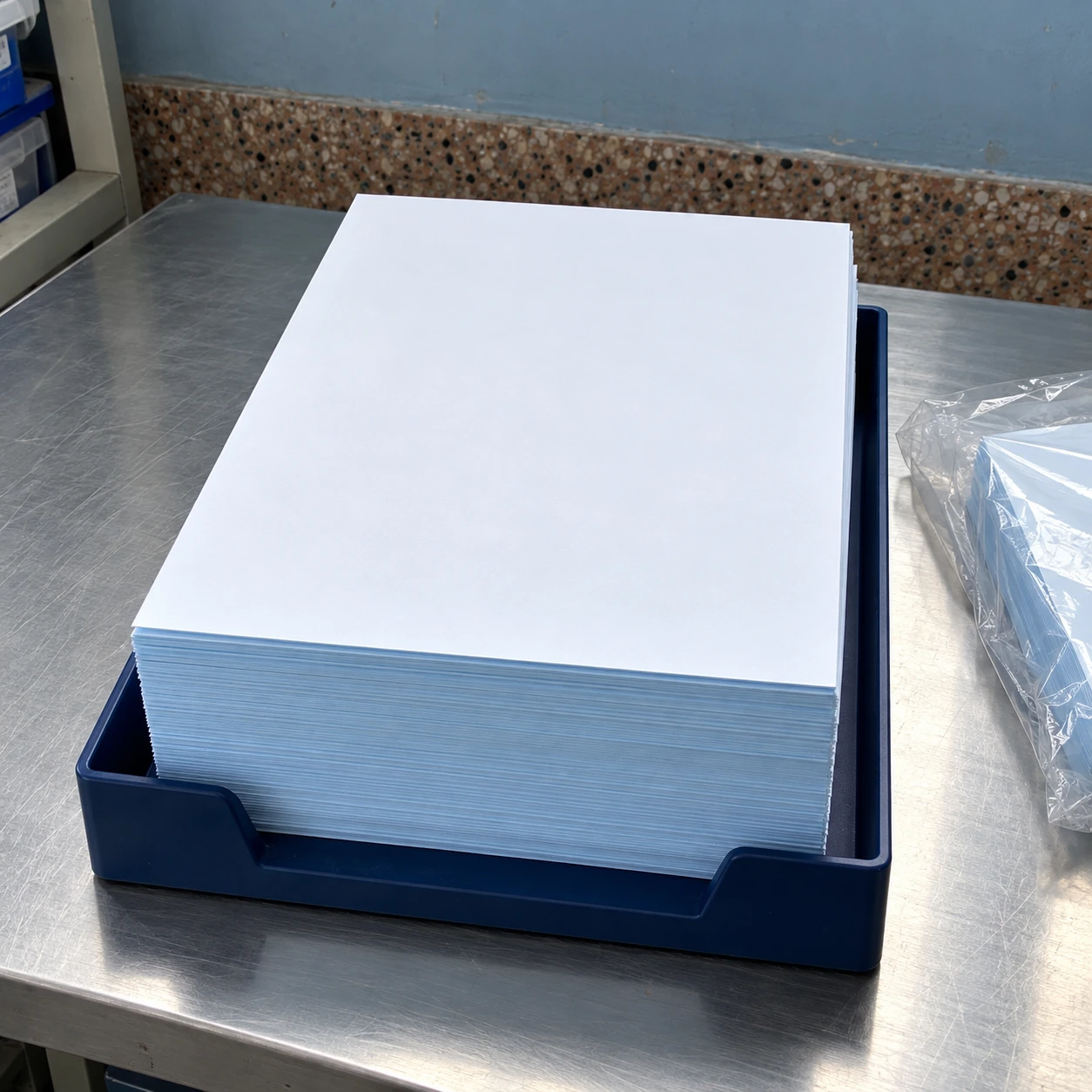
Cleanroom Paper
cleanroom paper 8.5 x 11
| Finished sheet, width × length | 8.5 × 11 in; exact conversion 215.9 × 279.4 mm |
|---|---|
| Larger related format | 11 × 17 in; 279.4 × 431.8 mm, separately selected |
| Nominal basis weight | 68, 85 or 104 g/m² |
| Material | Selected polymer-treated cellulose cleanroom bond |
| Colours | White and blue; yellow, pink and green in selected medium-weight grades |
| Sheet formats | Plain loose sheets; selected three-hole-punched configurations |
| Letter pack choices | 250 sheets for selected medium/heavy grades; 500 for a selected light grade |
| Transfer packaging | Double-packed configuration with product and lot identification |
The metric dimensions convert the stated inch sizes; supplier shorthand may round them. Pack count, colour, grade and hole pattern must match the selected item.
US Letter paper grade, colour, hole pattern and packaging can be selected for your documentation and handling requirements.
Cleanroom paper in the 8.5 x 11 format supports US Letter document masters, equipment records and forms that must retain their original page layout. The sheet is wider and shorter than A4, so a visually similar stack should not be accepted as the same format.
Keep the Letter master at its intended scale
Use Letter settings in the source document, printer driver and selected tray. Automatic fit-to-page can make a file printable on another format while shrinking text or moving the relationship between boxes, margins and binding areas.
For controlled records, check the footer, revision identification, page count and fields completed by hand. A readable central paragraph does not establish that the full form has printed correctly.
Specify the sheet, not only a regional name
Include the inch size and finished-sheet dimensions in cross-border enquiries. Some catalogues use rounded metric descriptions, while shipping dimensions may describe the entire wrapped pack. Make clear which measurement is being compared.
Keep A4 stock separately identified if both formats are used in the facility. A single printer tray should not quietly become the place where leftover sheets of either size are mixed.
Choose the grade around use and storage
A lighter paper can reduce the bulk of a large working record. Medium or heavier grades may be convenient for two-sided printing and frequent handling, but the accepted choice must still feed correctly and retain legible markings with the intended printer or pen.
Evaluate show-through with the actual form rather than an empty sheet. Dense printing on the reverse side, dark backgrounds or a crowded table can create a different reading experience from a short text page. Also check the resulting stack against binder and file-storage capacity.
Prepare binding before entry
If records need three-hole filing, specify the hole pattern and orientation with the paper order. Pre-punched material can reduce a cutting operation at the workstation, but it must still be qualified for edge condition and the chosen feed path. Hole positions and binding margins should suit the document master; a generic punched-paper description leaves that relationship unresolved.
Control the supply between printing and use
Protect unopened stock
Keep packs dry, intact and identified. Use the outer and inner packaging according to the site's transfer procedure.
Release complete records
Print and inspect in the designated location. Paper selection alone does not qualify the printer or its emissions for a critical area.
Retain a clear identity
Keep the accepted format, grade and lot information with the material-control record where required. Avoid combining unidentified leftover stock.
Make the next order match the first
State Letter size, grade, colour, sheet count per pack and any punching. Ask for the required supporting information for the offered material instead of assuming that low-lint also means sterile or suitable for every printing process.
The supplier comparison page explains how to align pack quantities, test data and repeat-order controls before requesting a quotation.
US Letter paper grade, colour, hole pattern and packaging can be selected for your documentation and handling requirements.