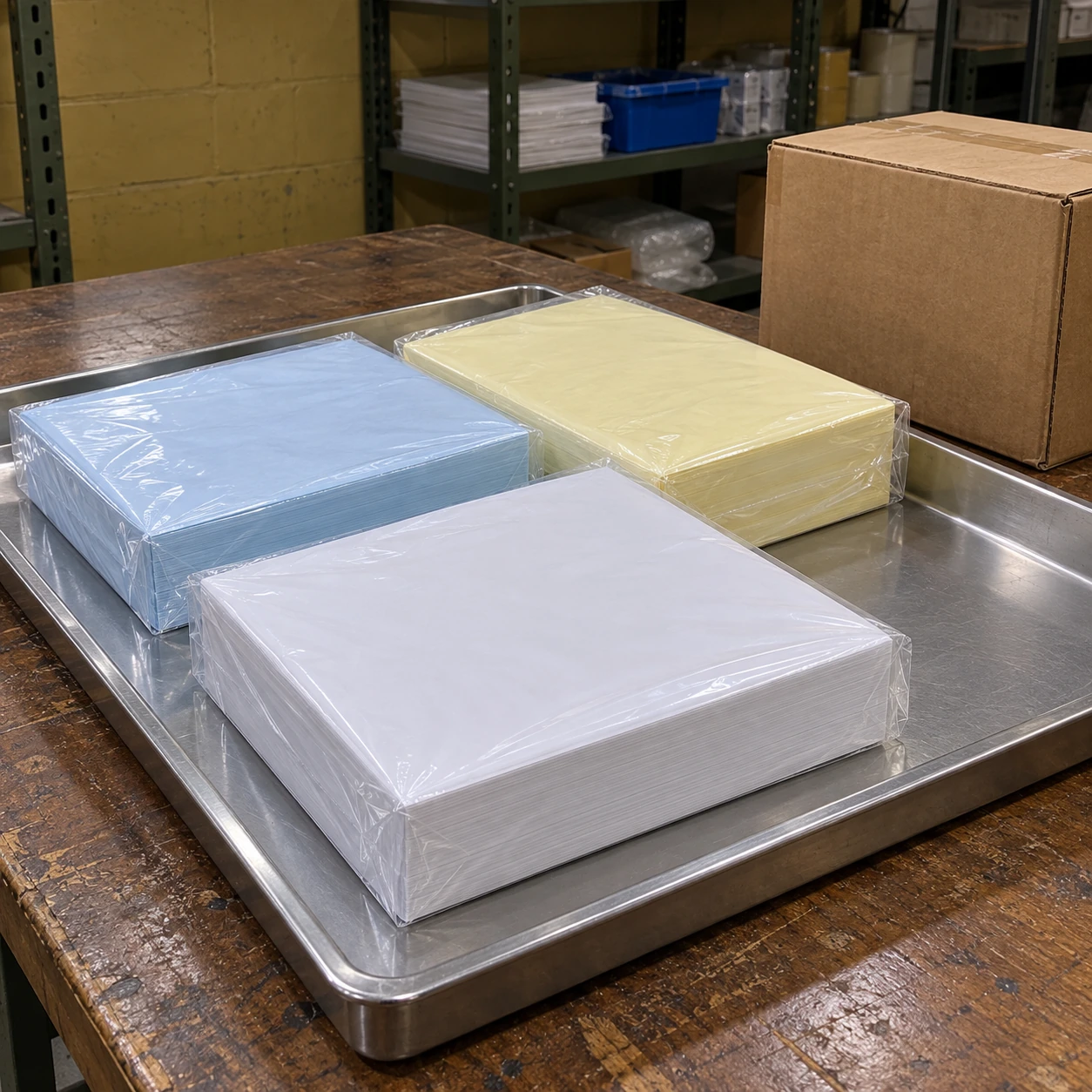
Cleanroom Paper
cleanroom paper suppliers
| Supply formats, width × length (mm) | A4: 210 × 297; US Letter: 215.9 × 279.4; A3: 297 × 420; A5: 148 × 210 |
|---|---|
| Nominal paper grades | 68, 85 or 104 g/m², selected for the record and printing process |
| Material declaration | Cellulose and polymer-treatment information for the offered grade |
| Colour selection | White or blue; other colours subject to the selected paper family |
| Pack quantity | 250 or 500 sheets, with case quantities explicitly identified |
| Packaging scope | Selected double-bagged packs; separately identified outer shipping packaging |
| Quality information | Product specification, test-method basis and agreed lot-linked documents |
| Order controls | Format, grade, colour, pack identification and approved substitution conditions |
The offered combination is confirmed in the quotation. Manufacturer data and any lot documents must identify the supplied material; no universal cleanliness, sterility or printer-performance guarantee is implied.
Paper specifications, pack arrangements and documentation can be coordinated for your facility's purchasing and material-control needs.
Cleanroom paper suppliers should be compared on the material and evidence delivered with each order, not only on the price of a ream. shengtongJH supports industrial procurement by helping define the paper grade, document format, packaging and supply information required for a consistent purchasing specification.
Make the accepted paper an identifiable item
A description such as blue cleanroom paper leaves important choices unresolved. Record the sheet format, nominal basis weight, material family, colour, pack count and any pre-punching. The accepted combination should be traceable to an item in the quotation and on the delivered packaging.
Nominal weight alone is not an equivalence test. Papers can differ in binder, surface, edge preparation, thickness and printing behaviour even when their weight and colour match. If a supplier proposes a substitute, compare it against the approved characteristics before treating it as an interchangeable replenishment.
Ask what the cleanliness figures actually measure
- Test method and reporting units
- A particle result from a dry flexing test is not directly comparable with particles extracted into liquid. Check the size threshold, procedure and reporting basis before using numbers from different sheets to rank products.
- Typical data and delivered-lot evidence
- A published typical value describes the manufacturer's data set; it is not automatically an acceptance limit or a test result for the delivered lot. Define the document type needed for purchasing and release.
- Special requirements
- Sterility, electrostatic properties, extractables and compatibility with cleaning agents are separate requirements. Specify those that matter to the process and request evidence for the particular offered grade, rather than transferring claims from another paper family.
Evaluate the paper in the intended workflow
A useful sample assessment includes the actual printer or copier, toner or pen, document layout and handling pattern. Review feed consistency, curl, readability, two-sided show-through and marking retention. Where a relevant chemical contact occurs, evaluate that contact under the site's approved procedure.
Material suitability also depends on where printing and cutting occur and how paper enters the controlled area. A supplier's cleanroom-use recommendation does not replace that local qualification.
Compare delivered quantities correctly
Reams and cases do not always contain the same sheet count. Put quotations on a common usable-sheet basis and include format, grade, packaging, freight and any documentation or preparation scope. This exposes differences that a price-per-case comparison can hide.
Choose a pack size that suits consumption and the handling procedure. Opening a large pack for very occasional use can leave more stock exposed between jobs.
Keep repeat deliveries consistent
Agree product and lot identification, damage reporting and how material or packaging changes will be communicated. Retain the accepted specification with the purchasing record and make substitution approval explicit.
Delivery dates, stock and commercial terms should be established for the actual enquiry. A generic product description does not establish immediate availability or a fixed supply lead time.
Prepare the enquiry around the document system
Send the required A4 or Letter format, expected consumption, printing process, delivery destination and quality-document needs. Include the existing accepted specification when replacing a supply so that differences can be resolved before an order is placed.
Paper specifications, pack arrangements and documentation can be coordinated for your facility's purchasing and material-control needs.